
Chhinnamasta Puja at Rajrappa 2026 – Navratri at the Sangam Shrine
छिन्नमस्ता पूजा (रजरप्पा)
When is Chhinnamasta Puja at Rajrappa in 2026?
Worship of Goddess Chhinnamasta at Rajrappa peaks during Sharad Navratri, from 11 to 20 October 2026. The Rajrappa temple in Ramgarh district, Jharkhand, stays busy through the year, with the largest crowds on Navratri days, Kali Puja (8 November 2026) and every amavasya (new moon).
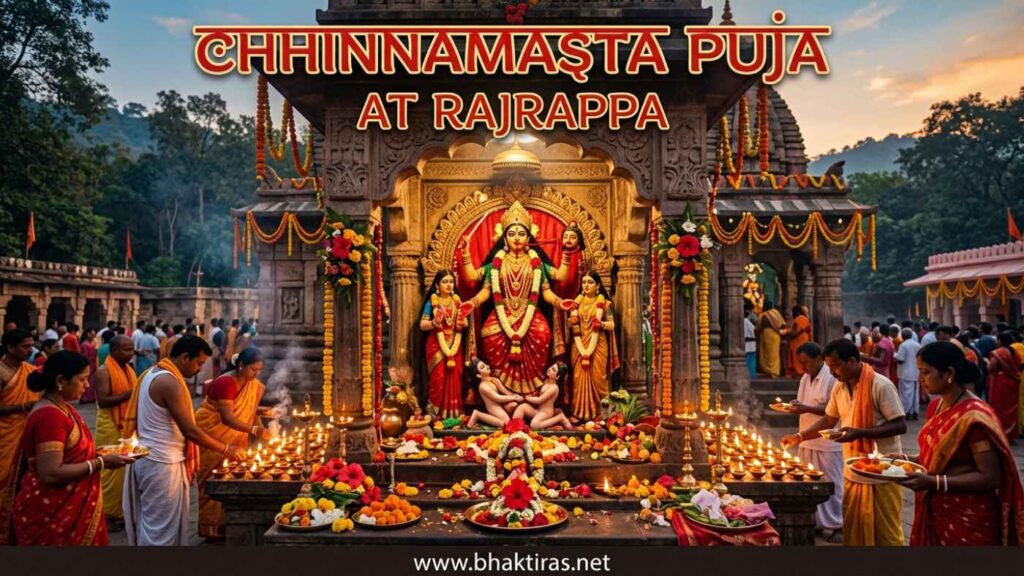
Chhinnamasta Puja at Rajrappa is the worship of Chhinnamastika, the self-decapitated goddess and one of the ten Mahavidyas, at a hill shrine in Ramgarh district, Jharkhand. The temple sits where the Bhairavi (Bhera) river meets the Damodar, and it is counted among the most important Shakti and Tantric centres of eastern India. Devotees arrive all year, but the crowds swell during Sharad Navratri, on Kali Puja and on every new-moon night, when the goddess is honoured with offerings that in local practice include animal sacrifice.
Chhinnamasta Puja at Rajrappa 2026-2028: Peak Dates
The Rajrappa shrine has no single festival date; worship intensifies during Sharad (Ashwin) Navratri and on Kali Puja, both of which move each year with the Hindu lunar calendar. The next major stretch begins on 11 October 2026.
| Year | Sharad Navratri | Kali Puja | Notes |
|---|---|---|---|
| 2026 | 11-20 October | 8 November | Next peak season |
| 2027 | 30 Sept – 9 October | 28 October | Navratri arrives earlier |
| 2028 | 19-28 September | 17 October | Earliest of the three years |
Beyond these festivals the temple is busiest on every amavasya (new moon), regarded as an especially charged night for the goddess. Ash-immersion pilgrims from Santal and other communities gather in large numbers around December and on Makar Sankranti.
Why Chhinnamasta Is Worshipped at Rajrappa
Chhinnamasta Puja honours a goddess who cuts off her own head to feed her devotees, a startling image of self-sacrifice and the endless flow of life-force. At Rajrappa the meaning is doubled by the sacred meeting of two rivers.
Chhinnamasta, whose name means “she whose head is severed”, holds her own severed head in one hand while three streams of blood spring from her neck. One stream feeds her own mouth and two feed her attendant yoginis. The image reads as a single truth from several angles: creation and destruction are one movement, giving and receiving are the same act, and life renews itself only through surrender. Tantric practitioners read the severed head as the death of ego and the freeing of pure awareness.
The sangam of two rivers
The shrine stands where the Bhairavi meets the larger Damodar. In local understanding the Bhairavi is the active feminine current and the Damodar the calmer masculine one, so their union at Rajrappa mirrors the goddess’s own symbolism of energy meeting stillness. Bathing at this sangam is the first act of most pilgrims.
A living Tantric centre
Rajrappa is one of the leading Shakti and Tantric shrines of eastern India, drawing sadhaks who seek the fierce grace of a Mahavidya. The goddess is worshipped here as a natural rock wrapped in an ashtadhatu (eight-metal) kavacha rather than a carved idol, a form the site is known to have held since at least the eighteenth century.
Self-sacrifice as the lesson
The heart of Chhinnamasta worship is the idea that the highest power comes from giving oneself away. Her blood nourishes others even as it flows from her own body, a picture of the way the universe sustains itself. Devotees come to ask for courage, for the cutting away of fear and pride, and for release from what binds them.
The Goddess Chhinnamasta
The presiding deity is Chhinnamasta, also called Chhinnamastika, a fierce form of the Devi and the sixth of the ten Mahavidyas. She embodies both terrifying power and boundless generosity.
Chhinnamasta
Chhinnamasta is shown nude and garlanded, holding a scimitar in one hand and her own freshly severed head in the other, drinking the blood that arcs from her neck. She stands on the divine couple Kama and Rati, the god and goddess of desire, a posture read as complete mastery over craving and the turning of that raw energy toward realisation.
Dakini and Varnini
Flanking the goddess are two attendant yoginis, usually named Dakini and Varnini, who receive the two side-streams of her blood. Their presence completes the image of a shared, circulating life-force, in which the goddess feeds her companions from her own body.
Chhinnamasta Puja at Rajrappa, Step by Step
A visit to Rajrappa usually moves from the river to the sanctum, with rituals shaped by each devotee’s tradition. The sequence below is the common pattern during Navratri and on amavasya.
- Bathe at the sangam. Most pilgrims begin with a dip at the confluence of the Damodar and Bhairavi rivers, treating the water as purifying before darshan.
- Queue for darshan. Devotees join the line to the sanctum, where the goddess is present as the ashtadhatu-covered rock rather than a figural idol.
- Offer to the goddess. Common offerings include red hibiscus and other red flowers, sindoor, incense, sweets and kheer, presented to Chhinnamastika by the temple priests.
- The bali tradition. A section of devotees fulfil vows through animal sacrifice, most often goats, offered near the temple in keeping with long-standing Shakta practice at the site; many others come only with vegetarian offerings and prayer.
- Navratri and Kali Puja worship. During Sharad Navratri and on Kali Puja the shrine holds special pujas and stays open long into the night, with far larger crowds and extended aarti.
- Amavasya sadhana. On new-moon nights, held sacred to the goddess, some Tantric practitioners perform private sadhana while ordinary devotees offer lamps and prayers.
- Aarti and prasad. Worshippers attend the aarti and receive prasad before leaving, many circling the temple and pausing again at the riverside.
Bhog and Prasad at Rajrappa
Offerings and shared food at Rajrappa follow simple, regional tastes, with khichdi and rice-based dishes at the centre.
Khichdi bhog
A comforting khichdi of rice and lentils is a common bhog offered to the goddess and shared as prasad, especially on busy festival days.
Kheer
Kheer, a slow-cooked rice and milk pudding, is a favoured sweet offering to Chhinnamasta and is distributed to devotees after puja.
Pitha
Pitha, the family of rice-flour cakes and dumplings loved across eastern India, appears among festival foods carried by pilgrims and prepared at home for the occasion.
Plain rice and prasad
Simple cooked rice, fruit, batasha and other light prasad items are shared at the shrine, keeping the offering accessible to the very large crowds the temple draws.
Who Comes to Rajrappa
Rajrappa sits about 28 km from Ramgarh and roughly 80 km from Ranchi, and its pull crosses community lines.
Ramgarh and Ranchi
The shrine lies in Ramgarh district and is reached most easily along the Ranchi-Ramgarh route via NH-20, making it a frequent day-trip and pilgrimage stop for people across central Jharkhand.
Tribal and Santal devotees
The site has been a place of worship for Santal and other tribal communities since well before it became a formal Chhinnamasta centre. Many still come to immerse the ashes of loved ones in the Damodar, gathering in large numbers around December.
Wider eastern India and Nepal
As a major Shakti and Tantric shrine, Rajrappa draws Shakta devotees and sadhaks from across eastern India and from Nepal, particularly on Navratri, Kali Puja and new-moon nights.
Chhinnamasta Puja at Rajrappa: Do's and Don'ts
A little planning makes a Rajrappa visit smoother, especially in the crowded festival weeks.
Do
- Arrive early on Navratri, Kali Puja and amavasya days, when queues are long.
- Take care near the rivers and the falls, as currents at the sangam can be strong.
- Dress modestly and keep footwear at the designated area before entering.
- Follow the priests’ guidance on how and where to place offerings.
- Keep valuables secure and stay with your group in the heavy crowds.
Avoid
- Do not treat the bali (animal-sacrifice) rituals as a spectacle; observe respectfully or step away.
- Do not swim or wade into deep water at the confluence or below the falls.
- Do not litter the riverbank or leave plastic offerings at the sangam.
- Do not photograph rituals or people without asking first.
- Do not push in the darshan line; move with the crowd and heed the volunteers.
Frequently Asked Questions
When is Chhinnamasta Puja at Rajrappa in 2026?
Worship of Chhinnamasta at Rajrappa peaks during Sharad Navratri, from 11 to 20 October 2026, and again on Kali Puja on 8 November 2026. The temple has no single fixed festival day; it stays active all year and is busiest on Navratri, Kali Puja and every amavasya.
When are the peak dates in 2027 and 2028?
Sharad Navratri falls on 30 September to 9 October in 2027 and on 19 to 28 September in 2028, with Kali Puja on 28 October 2027 and 17 October 2028. These are the main high-footfall periods at Rajrappa, alongside the year-round new-moon worship.
Who is Goddess Chhinnamasta?
Chhinnamasta, also called Chhinnamastika, is a fierce form of the Devi and the sixth of the ten Mahavidyas. She is shown holding her own severed head while three streams of blood feed her mouth and her two attendant yoginis, an image of self-sacrifice and the endless flow of life-force.
Where is the Rajrappa Chhinnamasta temple?
The Rajrappa Chhinnamasta temple stands on a hillock in Ramgarh district, Jharkhand, about 28 km from Ramgarh and roughly 80 km from Ranchi. It sits at the confluence of the Damodar and Bhairavi (Bhera) rivers, near the Rajrappa falls.
Why is the sangam of the Damodar and Bhairavi so important here?
The temple stands where the Bhairavi river meets the larger Damodar, and this confluence carries deep Tantric meaning. In local understanding the active feminine Bhairavi joins the calmer masculine Damodar, mirroring Chhinnamasta’s own symbolism, which is why most pilgrims bathe at the sangam before darshan.
Is animal sacrifice offered at Rajrappa?
Yes, animal sacrifice (bali), most often of goats, is part of the long-standing Shakta tradition at Rajrappa, offered by devotees fulfilling vows. Many other worshippers come only with flowers, sweets and prayer, so both practices are seen at the shrine.
What offerings are made to Chhinnamasta?
Common offerings to Chhinnamasta include red hibiscus and other red flowers, sindoor, incense, sweets, kheer and khichdi bhog. Some devotees also fulfil vows through the traditional bali ritual near the temple.
How do I reach Rajrappa temple?
Rajrappa is reached most easily from Ranchi or Ramgarh along NH-20, a drive of about 80 km from Ranchi and 28 km from Ramgarh. The nearest railway hubs are around Ramgarh and Ranchi, from where taxis and buses run to the temple.
Whether you come for Navratri, for Kali Puja or on a quiet new-moon night, may Maa Chhinnamastika grant you courage and peace at the Rajrappa sangam. Jai Maa Chhinnamasta.