
Bhavnath Mahadev Mela 2027 – Girnar's Maha Shivaratri Fair
भवनाथ महादेव मेळो
When is the Bhavnath Mahadev Mela in 2027?
The Bhavnath Mahadev Mela runs for about five days ending on Maha Shivaratri, which falls on 6 March 2027. The fair is held at the Bhavnath Mahadev temple at the foot of Mount Girnar in Junagadh, Gujarat. Its climax is the midnight Maha Shivaratri procession of Naga sadhus and their ritual dip in the Mrigi Kund.
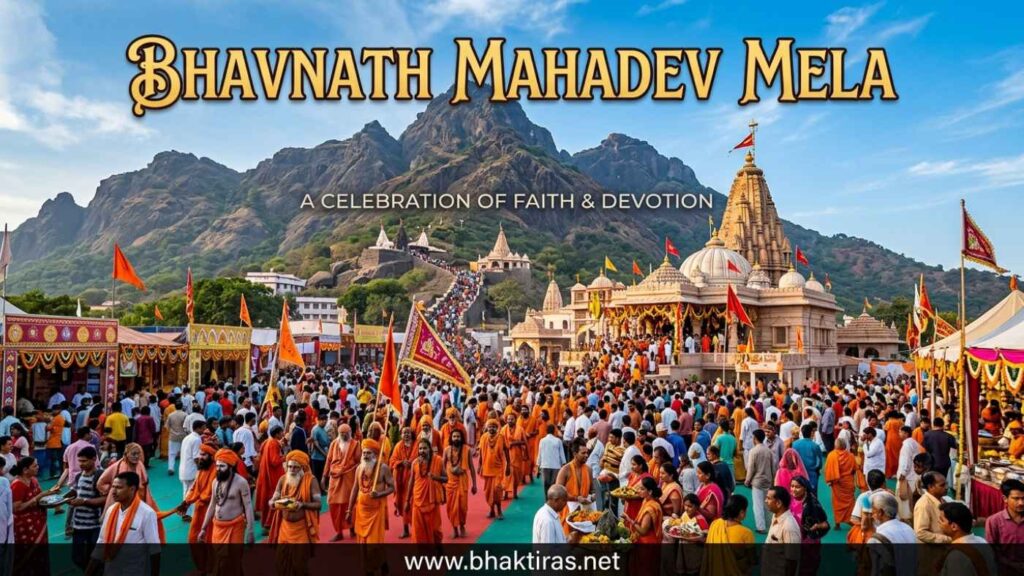
The Bhavnath Mahadev Mela is a five-day fair held at the Bhavnath Mahadev temple at the base of Mount Girnar in Junagadh, Gujarat, closing on the night of Maha Shivaratri (February or March). It draws Naga sadhus from the Himalayan akhadas, mahamandaleshwars, folk musicians and lakhs of pilgrims. The ascetics live quietly in the Girnar forests and emerge only for these days, walking in a torch-lit midnight procession to bathe in the Mrigi Kund. For many it feels like a smaller cousin of the Kumbh Mela, set against one of Shaivism’s oldest sacred hills.
Bhavnath Mahadev Mela 2026-2028: Dates & Calendar
The fair spans roughly five days and always closes on Maha Shivaratri night, so its dates shift each year with the Hindu lunar calendar. In 2027 that final night falls on 6 March.
| Year | Fair closes (Maha Shivaratri) | Day | Fair window (approx.) |
|---|---|---|---|
| 2026 | 15 February | Sunday | About 11-15 February |
| 2027 | 6 March | Saturday | About 2-6 March |
| 2028 | 23 February | Wednesday | About 19-23 February |
The five-day window is approximate; the temple administration and akhadas fix the exact opening a little before the festival. The Ravadi, the great procession of Naga sadhus, moves off on Maha Shivaratri night, usually after 9 pm.
Why the Bhavnath Mahadev Mela Is Held
The mela marks Maha Shivaratri at a spot Shaivites hold especially dear: the Girnar range, long linked with Shiva, Dattatreya and generations of wandering ascetics.
Girnar's sacred geography
Mount Girnar is one of Gujarat’s oldest pilgrimage hills, its peaks tied to Shiva, Amba Mata and Guru Dattatreya. The Bhavnath temple sits at its foot on the Suvarnarekha stream, so the fair joins the plains-level shrine to the climb that pilgrims make up the mountain’s thousands of steps.
A swayambhu Shiva of Bhavnath
The temple enshrines a Shiva linga that devotees regard as swayambhu, self-manifested rather than installed by human hands. Local belief holds that Shiva himself is present on Maha Shivaratri night, which is why worship peaks in the small hours.
The mini-Kumbh of the akhadas
The fair is best known for the Naga sadhus of the akhadas, ash-smeared ascetics who normally keep to the forests and hermitages of Girnar. Their public procession, martial displays and the dip in the Mrigi Kund give the mela the feel of a compact Kumbh, drawing crowds that come as much for the sadhus as for the shrine.
The garment and the kund
A well-loved local tale says that as Shiva and Parvati crossed the Girnar hills a piece of Shiva’s garment fell near the Mrigi Kund, sanctifying the water. The ritual bath there on Shivaratri night carries this story forward each year.
Deities & Figures Worshipped
Worship centres on Shiva as Bhavnath Mahadev, with the Naga ascetics and their guru Dattatreya at the heart of the fair’s atmosphere.
Bhavnath Mahadev (Shiva)
Shiva is honoured here as Bhavnath, lord of the linga enshrined at the temple. The mahapuja and the all-night vigil of Maha Shivaratri are offered to him, with milk, water, bilva leaves and the chant of Om Namah Shivaya.
The Naga sadhus
Naga sadhus are renunciate warriors of the Shaiva akhadas who go without clothes, smear their bodies with ash and live apart from ordinary society. At Bhavnath they emerge from the Girnar forests for the fair, and their midnight walk to the Mrigi Kund is its most watched moment.
Guru Dattatreya
An image of Dattatreya, revered as a combined form of Brahma, Vishnu and Shiva, is carried at the front of the sadhus’ procession in a palanquin. Girnar’s highest peak is a Dattatreya shrine, so his presence links the fair to the mountain above.
Mahamandaleshwars
The senior abbots of the akhadas, the mahamandaleshwars, preside over the ascetics’ rites and lend the fair its formal religious weight. Their akhadas, including the ancient Juna akhada, camp near the temple through the five days.
Key Rituals, Step by Step
The fair builds over five days from arrival and worship to the great midnight procession, then closes with the sacred bath and shared prasad.
- Arrival of the akhadas. Over the opening days, Naga sadhus and mahamandaleshwars descend from the Girnar forests and set up camp near the Bhavnath temple, some arriving in procession with conches, drums and elephants.
- Mahapuja at Bhavnath Mahadev. The swayambhu linga is bathed and dressed and a grand mahapuja is offered, with devotees keeping the Maha Shivaratri fast and joining the night-long vigil.
- Folk gatherings and the ravanhattha. Around the temple, folk singers and musicians perform, the bowed ravanhattha among their instruments, while traders, bhajan groups and pilgrims fill the fairground.
- Akhada displays. On the eve of the main puja the sadhus gather at the akhada grounds for a striking blend of dance and martial movement, a public show of the ascetic orders’ discipline.
- The midnight Ravadi procession. On Maha Shivaratri night, usually after 9 pm, the Naga sadhus set off in the Ravadi, an idol of Dattatreya carried at the head, moving through the crowd toward the Mrigi Kund.
- Mrigi Kund snan. At the climax the naked ascetics take a ritual dip in the Mrigi Kund, a bath devotees believe purifies both the sadhus and the place before the final worship.
- Mahaprasad and annakshetra. Free community meals are served through the fair at annakshetra kitchens, and mahaprasad is shared as the crowds disperse at dawn.
Special Foods of the Bhavnath Mela
Fasting fare and Junagadh’s Kathiawadi snacks sit side by side with the free meals served to pilgrims and sadhus.
Khichdi
Simple khichdi of rice and lentils is cooked in large quantities at the community kitchens and served warm to sadhus and pilgrims through the fair days.
Ganthiya and fafda
Junagadh is gram-flour country, so crisp ganthiya and fafda, often eaten with fried chillies and a sweet chutney, are sold across the fairground stalls.
Mahaprasad
Food blessed at the Bhavnath shrine is distributed as mahaprasad, taken by devotees as a share of the deity’s grace after the night’s worship.
Vrat food
Those keeping the Maha Shivaratri fast take fruit, milk, and dishes made from singhara or sabudana, avoiding grains and salt until the vigil ends.
Around the Fair: Junagadh & Girnar
The mela is one thread in a wider pilgrimage landscape around Junagadh and the Girnar hill.
Junagadh town
The old town below Girnar, with its Uparkot fort, Ashokan rock edicts and Mahabat Maqbara, fills with visitors during the fair, and it is the usual base for reaching the temple and the hill.
The Girnar parikrama
Girnar also hosts the Lili Parikrama, a separate circumambulation of the hill held around Kartik Purnima in autumn. Many who come for Bhavnath return then to walk the forested route around the mountain.
Girnar's shrines above
The stepped climb up Girnar leads to Jain temples, the Amba Mata shrine and, at the summit, the Dattatreya peak, so pilgrims often pair the fair with the ascent.
Bhavnath Mela Do's and Don'ts
A few sensible habits make the crowded five days safer and more respectful.
Do
- Reach the Ravadi route early, as the midnight procession draws very dense crowds.
- Keep to marked paths and follow police and volunteer instructions in the throng.
- Watch the Naga sadhus and the Mrigi Kund rites with quiet respect.
- Carry water, a torch and sturdy footwear for the night and the temple approach.
- Try the free annakshetra meals and buy from local Kathiawadi food stalls.
Avoid
- Do not crowd, touch or block the ascetics during their procession.
- Avoid intrusive photography or flash aimed at the sadhus without consent.
- Do not attempt to bathe in or enter the Mrigi Kund during the sacred rite.
- Do not bring small children into the thickest part of the midnight crush.
- Do not litter the temple grounds or the Suvarnarekha stream.
Frequently Asked Questions
When is the Bhavnath Mahadev Mela in 2027?
The Bhavnath Mahadev Mela runs for about five days ending on Maha Shivaratri, 6 March 2027 (Saturday). The fair is held at the Bhavnath Mahadev temple at the foot of Mount Girnar in Junagadh, Gujarat, with the midnight Naga sadhu procession on the final night.
When is the fair in 2026 and 2028?
The Bhavnath Mahadev Mela closes on Maha Shivaratri each year, so it ends on 15 February in 2026 (Sunday) and on 23 February in 2028 (Wednesday). In each case the five-day fair begins roughly four days before that closing night.
Why is the Bhavnath Mahadev Mela celebrated?
The Bhavnath Mahadev Mela is celebrated to mark Maha Shivaratri at the Bhavnath Shiva temple below Girnar, a hill long sacred to Shiva and the ascetic orders. Devotees believe Shiva is present at the swayambhu linga on Shivaratri night, and the Naga sadhus of the akhadas gather here for their ritual procession and bath.
Which god is worshipped at Bhavnath?
Shiva is worshipped at Bhavnath, honoured as Bhavnath Mahadev at a Shiva linga devotees regard as self-manifested (swayambhu). The fair also venerates Guru Dattatreya, whose image leads the Naga sadhus’ procession, and the ascetics themselves are central to the event.
What is special about the Naga sadhus at the fair?
The Naga sadhus are ash-smeared, unclothed renunciates of the Shaiva akhadas who live in the Girnar forests and emerge only for the five fair days. Their midnight Ravadi procession to the Mrigi Kund, led by an idol of Dattatreya, is the most watched moment of the mela.
What is the Mrigi Kund and its ritual?
The Mrigi Kund is a sacred water tank near the Bhavnath temple where the Naga sadhus take a ritual dip on Maha Shivaratri night. Local legend links the water to a garment of Shiva that fell there, and the bath is believed to purify both the ascetics and the site before final worship.
Where is the Bhavnath Mahadev Mela held?
The Bhavnath Mahadev Mela is held at the Bhavnath Mahadev temple at the base of Mount Girnar near Junagadh in Saurashtra, Gujarat, on the banks of the small Suvarnarekha stream. Junagadh town is the usual base for visitors reaching the fair and the hill.
How is the fair connected to the Girnar parikrama?
The Bhavnath fair and the Girnar Lili Parikrama are two separate events at the same hill: the mela falls on Maha Shivaratri, while the parikrama, a walk around Girnar, is held around Kartik Purnima in autumn. Many pilgrims take part in both across the year.
Whether you come for the linga, the folk music or the torch-lit walk of the sadhus, the Girnar nights leave a mark. Har Har Mahadev.