
Aoling Monyu 2027 – The Konyak Naga Spring Festival
When is Aoling Monyu in 2027?
Aoling Monyu (also spelt Aoleang) falls on 1-6 April 2027, spread across roughly six days in the first week of April. It is the biggest festival of the Konyak Naga of Mon district, Nagaland, welcoming spring and the new year and asking for a good harvest after the sowing is done.
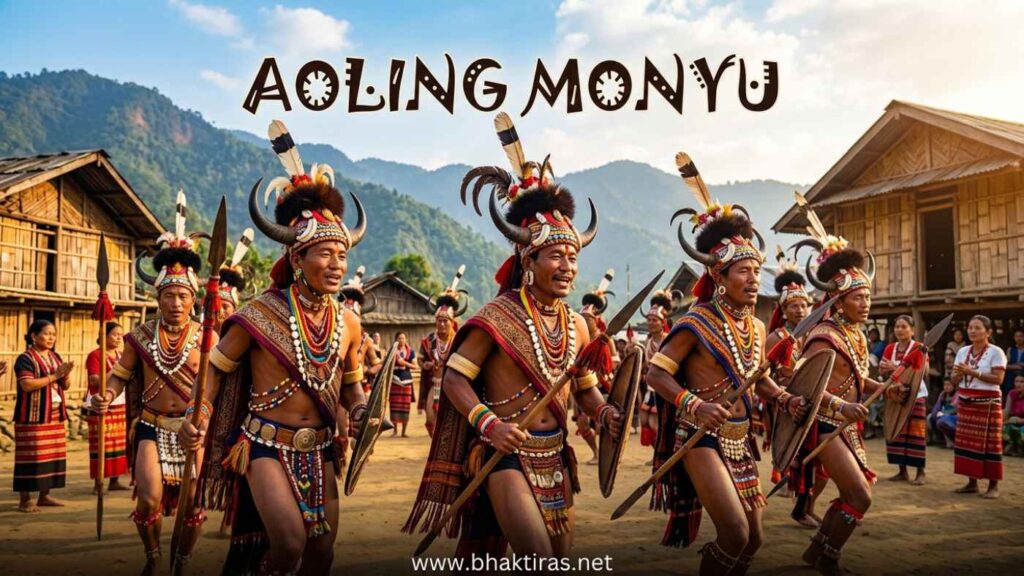
Aoling Monyu is the grandest festival of the Konyak Naga, the tattooed-face people of Mon district in the far north-east corner of Nagaland. Held in the first week of April, it greets the arrival of spring and the Konyak new year once the fields have been sown, and carries a prayer for a full harvest to come. Over about six days each Konyak village keeps its own rhythm of firewood-gathering, cooking, rice-beer brewing, and finally a great day of feasting and dance when the men appear in the feathered, tusked finery of their warrior past.
Aoling Monyu 2026-2028: Dates & Calendar
Aoling Monyu is fixed to the first week of April, so it barely moves from year to year. The next celebration runs 1-6 April 2027; the 2026 festival has already passed.
| Year | Dates | Main feast day | Notes |
|---|---|---|---|
| 2026 | 1-6 April | Approx. 3rd day | Already celebrated |
| 2027 | 1-6 April | Approx. 3rd day | Next occurrence |
| 2028 | 1-6 April | Approx. 3rd day | Expected |
The Konyak name and observe each day separately, so the peak day of feasting and dance usually lands mid-festival rather than on the first or last day. Some villages and the district administration in Mon also fold in a public cultural programme during the week.
Why Aoling Monyu Is Celebrated
Aoling Monyu marks the turn from sowing to waiting – a spring new-year celebration where the Konyak thank their land, bond as a community and pray for the harvest ahead.
The festival sits at a natural pause in the farming year. The jhum fields have been cleared and sown, the hardest labour is behind, and before the crop grows the whole community stops to celebrate, share food and reset for the season. It is as much a social and spiritual reset as an agricultural one.
A prayer for the harvest
The central hope of Aoling is a bountiful crop. After the sowing, the Konyak offer thanks and ask for rain, growth and a full granary in the months ahead. The feasting itself is a way of sharing plenty and inviting more of it.
The Konyak new year
Aoling doubles as a new-year threshold. It closes one working cycle and opens the next, a moment to settle debts and disputes, welcome guests and begin the year on good terms with neighbours and kin.
Keeping the warrior memory alive
The Konyak were once feared headhunters, and Aoling is when that martial heritage is worn with pride. The feathered headgear, boar-tusk ornaments and old war-dances are not costume for tourists but a living link to the identity of the Angh (chief) and clan.
The Six Days of Aoling, Step by Step
Each day of Aoling has its own name and job, moving from preparation to the great feast and then to song, dance and farewell.
- Day 1 – Hoi Lah Nyih. The village readies itself: paths are cleared, firewood and bamboo are gathered, and the materials for cooking and brewing are collected and brought home.
- Day 2 – Yin Mok Pho Nyih. Food preparation begins in earnest – rice is pounded, meat is set aside, and the rice beer that will carry the whole festival is brewed and left to ferment.
- Day 3 – Yin Mok Nyih. The main feasting and dancing day. Konyak men appear in full finery of hornbill feathers, boar tusks and beadwork, and the village fills with communal meals, war-dances and songs.
- Day 4 – Lingnyu Nyih. The celebration continues with more feasting, visiting between households, and the sharing of meat and rice beer among relatives and guests.
- Day 5 – Lingha Nyih. A day given to song and dance, courtship and games, when younger Konyak take the lead and the mood is lighter and social.
- Day 6 – Lingshan Nyih. The winding-down day. Blessings are exchanged, guests are seen off, and the village turns back towards the farming season with the year formally begun.
Special Foods of Aoling
Aoling food is Naga home-cooking at its most generous – smoked meat, foraged greens, sticky rice and rice beer shared across the whole village.
Smoked and boiled pork
Pork is the centrepiece meat of Aoling, often smoked over the hearth through the year and then boiled with local herbs, bamboo shoot and the fiery Naga king chilli (raja mircha). Whole pigs are shared out among households.
Sticky rice & bamboo dishes
Sticky rice, sometimes cooked inside a bamboo tube over open fire, is the staple of the feast. Bamboo shoot, fermented and fresh, flavours many of the meat and vegetable pots.
Anishi & foraged greens
Anishi – fermented, dried yam or colocasia leaves pressed into cakes – is cooked with pork in the Konyak style, alongside foraged wild greens, herbs and roots gathered from the forest and jhum fields.
Rice beer
Locally brewed rice beer is central to Aoling hospitality. Prepared in the early days of the festival, it is offered to every guest and passed around the feasting and dancing, a marker of welcome and community.
Aoling Across Konyak Country
Aoling is a Konyak festival above all, centred on Mon district, with echoes wherever Konyak people live across the India-Myanmar border.
Mon district, Nagaland
Mon is the heartland of Aoling. Villages such as Longwa, Shangnyu, Chui and Mon town hold the fullest celebrations, often around the morung (bachelors’ dormitory) and the house of the Angh, the hereditary Konyak chief.
Longwa & the border villages
In border villages like Longwa, which sits astride the India-Myanmar line, Aoling is shared by Konyak communities on both sides. The Angh’s authority and the festival cross the frontier as easily as the people do.
The Konyak diaspora
Konyak who have moved to Dimapur, Kohima and beyond keep Aoling alive through community gatherings and cultural programmes, and the festival is increasingly showcased at wider Naga events to share Konyak identity.
Aoling Do's and Don'ts
A few pointers for joining or visiting Aoling respectfully.
Do
- Greet elders and the Angh with respect – the chief’s household is central to the festival
- Accept food and rice beer graciously when offered; sharing is the heart of Aoling
- Ask before photographing people in traditional finery, especially elders
- Learn a little about Konyak history so the feathers and tusks read as heritage, not costume
- Plan travel to Mon in advance – it is remote, and roads and stays are limited
Avoid
- Don’t treat the headhunter past as spectacle or make light of it
- Don’t touch ceremonial headgear, ornaments or the morung without permission
- Don’t interrupt dances or rituals to pose for photos
- Don’t assume village timings match the calendar exactly – confirm dates locally
- Don’t drink beyond your welcome; rice beer is hospitality, not a free-for-all
Frequently Asked Questions
When is Aoling Monyu in 2027?
Aoling Monyu (Aoleang) is celebrated 1-6 April 2027, over roughly six days in the first week of April. It is the biggest festival of the Konyak Naga in Mon district, Nagaland, marking spring, the new year and a prayer for the harvest.
When is Aoling in 2026 and 2028?
Aoling falls in the first week of April every year, so it was held 1-6 April 2026 and is expected again 1-6 April 2028. Because it is tied to the solar calendar and the sowing cycle, the dates stay steady rather than shifting with the moon; exact village start days can vary by about a day.
Why is Aoling Monyu celebrated?
Aoling Monyu is celebrated to welcome spring and the Konyak new year and to pray for a good harvest after the fields have been sown. It is also a time of community bonding, feasting and honouring Konyak heritage, coming at a natural pause between the hard work of sowing and the growing season.
Which community celebrates Aoling?
Aoling is the festival of the Konyak Naga, one of the major Naga tribes, concentrated in Mon district in the far north-east of Nagaland and in neighbouring parts of Myanmar. The Konyak are historically known as tattooed-face warriors and former headhunters, and Aoling is their grandest celebration.
How long does Aoling last?
Aoling lasts about six days, from 1 to 6 April, and each day has its own name and purpose. The days move from gathering firewood and materials, through food preparation and rice-beer brewing, to the main feasting and dancing day, and then days of song, dance and farewell.
What happens on the main day of Aoling?
The main day of Aoling is the great feasting and dancing day, usually mid-festival, when Konyak men appear in full traditional finery – headgear of hornbill feathers, boar tusks and beadwork. Villages share communal meals of pork and rice, perform war-dances and songs, and the warrior heritage of the Konyak is on proud display.
Where is Aoling celebrated?
Aoling is celebrated across Konyak country, centred on Mon district in Nagaland, in villages such as Longwa, Shangnyu, Chui and Mon town. It is also observed by Konyak communities on the Myanmar side of the border and kept alive by the Konyak diaspora in cities like Dimapur and Kohima.
Is Aoling the same as Aoleang?
Yes – Aoling, Aoleang, Aoling Monyu and Aoleang Monyu are different spellings of the same Konyak Naga spring festival. Konyak is an oral language written in several ways, so you will see the name transliterated more than one way; they all refer to the 1-6 April celebration in Mon, Nagaland.
However you spell it – Aoling, Aoleang, or Aoling Monyu – may the spring bring the Konyak of Mon a full harvest and a joyful new year.