
ॐ
Parashurama Chalisa
श्री परशुराम चालीसा
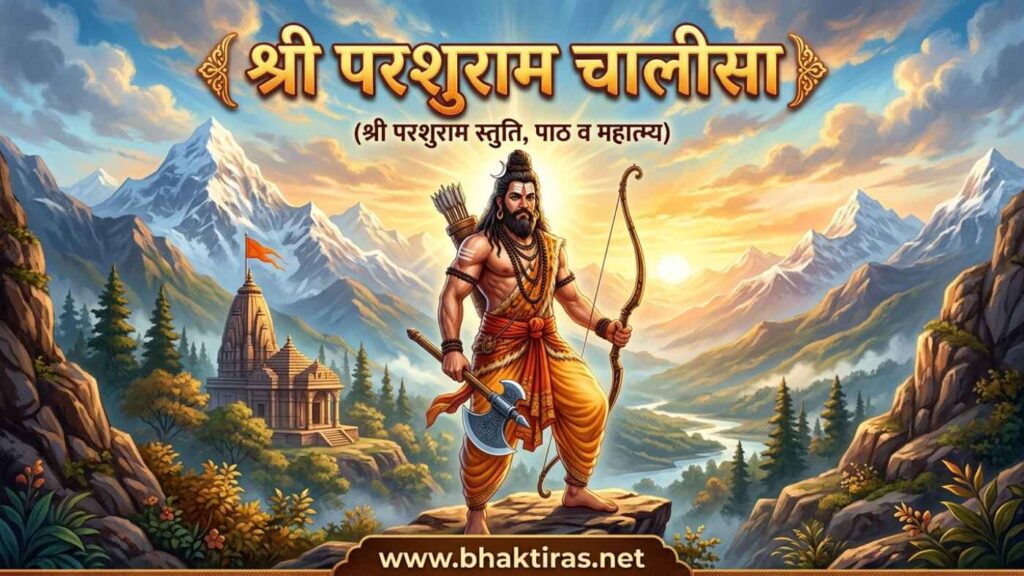
The Parashurama Chalisa is a forty-verse devotional hymn to Lord Parashurama, the sixth avatar of Vishnu and the only one who was a Brahmin trained in the warrior’s art. Born to sage Jamadagni and Renuka, he carried the divine axe gifted by Shiva and is counted among the Chiranjeevis, the immortals said to live on in penance. This page gives the full Chalisa in easy English transliteration with an original meaning for every verse, so you can recite it and follow the sense at the same time.
Parashurama Chalisa Lyrics in English (Transliteration)
Roman transliteration for easy chanting. Tap “Meaning” under any verse for the English translation.
Shri guru charan saroj chhavi, nij man mandir dhaari
Sumari Gajanan Sharada, gahi aashish Tripurari
Meaning
I hold the bright image of my Guru's lotus feet within the shrine of my mind. Calling on Ganesha and Saraswati, I take the blessing of Shiva before I begin.
Buddhihin jan jaaniye, avagunon ka bhandaar
Baranon Parashuram suyash, nij mati ke anusaar
Meaning
Knowing myself to be slow of wit and a store of faults, I still set out to sing the noble fame of Parashurama, as far as my own small understanding allows.
Jai Prabhu Parashuram sukh sagar
Jai muneesh gun gyan diwakar
Meaning
Victory to Lord Parashurama, an ocean of joy. Victory to the master of sages, the sun who lights up virtue and wisdom.
Bhrigu kul mukut vikat randheera
Kshatriya tej mukh sant shareera
Meaning
You are the crown jewel of the Bhrigu line and a fierce, steady fighter in war. The fire of a warrior burns in you, yet your body keeps the calm of a sage.
Jamadagni sut Renuka jaya
Tej pratap sakal jag chhaya
Meaning
You are the son of Jamadagni, born to Renuka. Your splendour and power spread across the whole world.
Maas Baisakh sit pachchh udara
Tritiya punarvasu manuhara
Meaning
You appeared in the bright fortnight of Vaishakha, on the third lunar day, under the gentle Punarvasu star, a most pleasing moment.
Prahar pratham nisha sheet na ghama
Tithi pradosh vyapi sukhdhama
Meaning
Your birth came in the first watch of the night, when the air was neither cold nor hot. It was the Pradosh tithi, a time that carries ease and happiness.
Tab rishi kuteer rudan shishu keenha
Renuka kokhi janam hari leenha
Meaning
Then, in the sage's hut, the newborn gave his first cry. Lord Hari himself took birth from Renuka's womb.
Nij ghar uchch grah chhah thaade
Mithun rashi rahu sukh gaade
Meaning
At your birth six planets stood exalted in their own signs. Your moon-sign was Gemini, and the placing of Rahu set deep good fortune in place.
Tej-gyan mil nar tanu dhara
Jamadagni ghar brahm avatara
Meaning
Joining brilliance with wisdom, you took a human form. In the house of Jamadagni, the Supreme itself was born.
Dhara Ram shishu paavan naama
Naam japat jag lah vishrama
Meaning
As a child you were given the pure name Rama. By chanting that holy name the world finds rest and peace.
Bhala tripund jata sir sundar
Kandhe munj janeu manahar
Meaning
Three lines of sacred ash mark your brow, and matted locks crown your head. The munja-grass sacred thread on your shoulder is lovely to behold.
Manju mekhala kati mrigchhala
Rudra mala bar vaksh vishala
Meaning
A fine girdle of deerskin wraps your waist. A Rudraksha rosary rests across your broad chest.
Peet basan sundar tanu sohen
Kandh tuneer dhanush man mohen
Meaning
Your handsome form shines in yellow cloth. The quiver and bow on your shoulder win over every heart.
Ved-puran-shruti-smriti gyata
Krodh roop tum jag vikhyata
Meaning
You know the Vedas, Puranas, Shrutis and Smritis through and through. The world knows you as anger given form, anger raised to guard dharma.
Dayen hath shriparshu uthava
Ved-sanhita bayen suhava
Meaning
In your right hand you lift the holy axe. In your left you hold, with grace, the Vedic scripture.
Vidyavan gun gyan apara
Shastra-shastra dou par adhikara
Meaning
You are deeply learned, with virtue and knowledge beyond measure. You hold full command over both the scriptures and the weapons.
Bhuvan charidas ar navkhand
Chahun dishi suyash pratap prachand
Meaning
Across the fourteen worlds and the nine regions, in every direction, your fame and fierce power are felt.
Ek baar Ganpati ke sanga
Jujhe Bhrigukul kamal patanga
Meaning
Once you came to blows with Lord Ganesha. You are like the bee circling the lotus of the Bhrigu line, ever devoted to its honour.
Daant tod ran keenh virama
Ek dant Ganapati bhayon naama
Meaning
You broke one of Ganesha's tusks and so ended the fight. From that day Ganesha carried the name Ekadanta, the one-tusked lord.
Kartavirya Arjun bhoopala
Sahasrabahu durjan vikarala
Meaning
King Kartavirya Arjuna, the ruler with a thousand arms, was a cruel and dreadful tyrant.
Sura gau lakh Jamadagni pahin
Rakhihahun nij ghar thani man mahin
Meaning
Seeing the divine wish-granting cow at Jamadagni's hermitage, he resolved in his heart to seize it for his own palace.
Mili na maangi tab keenh ladai
Bhayo parajit jagat hansai
Meaning
When asking did not win him the cow, he started a battle. He was defeated, and the whole world laughed at his folly.
Tan khal hriday bhai ris gadhi
Riputa muni soun atisay badhi
Meaning
The wicked king's heart filled with hardened rage. His hatred toward the sage Jamadagni swelled beyond bounds.
Rishivara rahe dhyan lavalina
Tinha par shaktighaat nrip kinha
Meaning
The great sage sat lost in deep meditation. The king struck him down with his weapon in that defenceless moment.
Lagat shakti Jamadagni nipata
Manahu kshatrikul baam vidhata
Meaning
As the weapon landed, Jamadagni fell. It was as if fate itself had turned against the warrior clans that day.
Pitu-badh matu-rudan suni bhara
Bha ati krodh man shok apara
Meaning
Hearing of his father's killing and his mother's heavy weeping, Parashurama's mind filled with fierce anger and endless grief.
Kar gahi tikshyan parashu karala
Dusht hanan kinheu tatkala
Meaning
Taking up his sharp and terrible axe, he struck down the wicked king at once.
Kshatriya rudhir pitu tarpan kinha
Pitu-badh pratishodh sut linha
Meaning
He offered the blood of the warriors as a libation for his father. So the son repaid the murder of his father.
Ikkis baar bhu kshatriya bihini
Chhin dhara bipranh kahan dini
Meaning
Twenty-one times he cleared the earth of its tyrant warriors. The land he won he then gave away to the Brahmins.
Juga treta kar charit suhai
Shiva-dhanu bhang kinh raghurai
Meaning
In the Treta age a beautiful deed unfolded, when Lord Rama of the Raghu line broke the great bow of Shiva.
Guru dhanu bhanjak ripu kari jana
Tab samul nash tahi thana
Meaning
Taking the one who broke his Guru's bow for an enemy, you resolved to destroy him root and branch.
Kar jori tab ram raghurai
Binay kinhi puni shakti dikhai
Meaning
Then Rama of the Raghu line joined his palms in respect and spoke humbly, and afterwards quietly revealed his own divine strength.
Bhishma Drona Karna balvanta
Bhaye shishya dwapar mahan ananta
Meaning
The mighty Bhishma, Drona and Karna all became your pupils in the Dvapara age.
Shastra vidya deh suyash kamava
Guru pratap digant phirava
Meaning
You gave them the knowledge of weapons and scripture, and they earned great renown. Through their teacher's glory their fame travelled to every horizon.
Charon yug tav mahima gai
Sur muni manuj danuj samudai
Meaning
In all four ages your greatness has been sung, by gods and sages, by humans and demons alike.
De Kashyap so sampada bhai
Tap kinha mahendra giri jai
Meaning
You gave all your wealth to the sage Kashyapa and withdrew to the Mahendra mountain to perform penance.
Ab lau lin samadhi natha
Sakal lok navai nit matha
Meaning
Even now, O Lord, you remain absorbed in deep meditation. Every world bows its head to you each day.
Charon varn ek sam jana
Samdarshi prabhu tum bhagvana
Meaning
You regard all four social orders as one and the same. You are the Lord whose vision is even toward all.
Lalahin chari phal sharan tumhari
Dev danuj nar bhup bhikhari
Meaning
All who take refuge in you gain the four aims of life, righteousness, wealth, desire and liberation, whether god or demon, human, king or beggar.
Jo yah padhein shri parshu chalisa
Tinh anukool sada gaurisa
Meaning
For whoever recites this Shri Parashurama Chalisa, Lord Shiva, consort of Gauri, stays forever favourable.
Purnendu nisi basar swami
Basahu hriday prabhu antaryami
Meaning
O Lord, who is to the night as the full moon, dweller within all hearts, please come and live in mine.
Parashuram ko charu charit, metat sakal agyan
Sharan pade ko det prabhu, sada suyash samman
Meaning
The fair life-story of Parashurama wipes away all ignorance. To those who surrender to him the Lord ever grants fame and honour.
Benefits of Reciting the Parashurama Chalisa
Devotees turn to the Parashurama Chalisa for inner steadiness and the courage to stand by what is right. Regular, sincere recitation is associated with the following:
- Courage and protection: it is recited to shed fear and to feel guarded against ill-will and unseen enemies.
- Strength of will: the hymn’s warrior-sage imagery is drawn on for confidence, discipline and the resolve to face hard situations.
- Clarity of mind: Parashurama is honoured as a master of both scripture and skill, so the Chalisa is chanted for focus, learning and sound judgement.
- Help with obstacles: many recite it before exams, contests, disputes or any test that demands nerve and effort.
- Stability and prosperity: devotees seek relief from money worries and a steadier footing in work and home life.
- Devotion and calm: beyond any worldly aim, the verses settle the heart and turn attention toward dharma and surrender.
When and How to Chant the Parashurama Chalisa
The most auspicious day to recite the Parashurama Chalisa is Parashurama Jayanti, which falls on Akshaya Tritiya in the bright fortnight of Vaishakha (April or May); Pradosh evenings are also favoured, and many recite it daily in the early-morning Brahma Muhurta. Bathe first, sit facing east or north, light a lamp and incense before an image of the Lord, and set a simple intention. Then recite the verses slowly and clearly, with a calm and devoted heart; a single round, or three, seven, or 108 rounds, may be offered, and some add the short mantra Om Parashuramaya Namah. The spirit matters more than the count.
About the Parashurama Chalisa
The Parashurama Chalisa follows the classic Chalisa form: opening dohas (couplets), forty chaupai verses, and a closing doha, composed in the Awadhi-tinged devotional Hindi of the bhakti tradition. Its verses trace the life of the sixth Vishnu avatar, his birth to Jamadagni and Renuka, his learning and his axe from Shiva, the war with Kartavirya Arjuna that avenged his father, his role across the Treta and Dvapara ages, and his ongoing penance as an immortal. On this page the text is presented in Roman transliteration with an original English meaning beside each verse, so the sense stays clear for readers who do not read Devanagari.
Frequently Asked Questions
What is the Parashurama Chalisa?
It is a forty-verse devotional hymn praising Lord Parashurama, the sixth avatar of Vishnu, who was a Brahmin sage and a warrior carrying the axe given by Shiva. The verses recount his birth, his deeds and his place among the immortals.
What are the benefits of reciting the Parashurama Chalisa?
Devotees recite it for courage, protection from ill-will, confidence and discipline, clarity of mind, and steadiness in difficult situations such as exams, contests or disputes. It is also chanted for devotion and inner calm.
Which day is best to recite the Parashurama Chalisa?
Parashurama Jayanti, which falls on Akshaya Tritiya in April or May, is the most auspicious day. Pradosh evenings are also favoured, and many recite it every day during the early-morning Brahma Muhurta.
How many verses are in the Parashurama Chalisa?
It has forty main chaupai verses, framed by opening couplets (dohas) and a closing doha, which is the standard Chalisa structure.
Can the Parashurama Chalisa be recited in English?
Yes. This page provides the full text in Roman transliteration, so anyone who does not read Hindi or Sanskrit can recite it with correct pronunciation while following an English meaning for each verse.
Is Lord Parashurama still alive?
In Hindu tradition Parashurama is a Chiranjeevi, one of the immortals, and is believed to remain in deep penance in the Mahendra mountains rather than having left the world.
॥ Parashurama Chalisa ॥