
ॐ
Khandoba Chalisa
श्री खंडोबा चालीसा
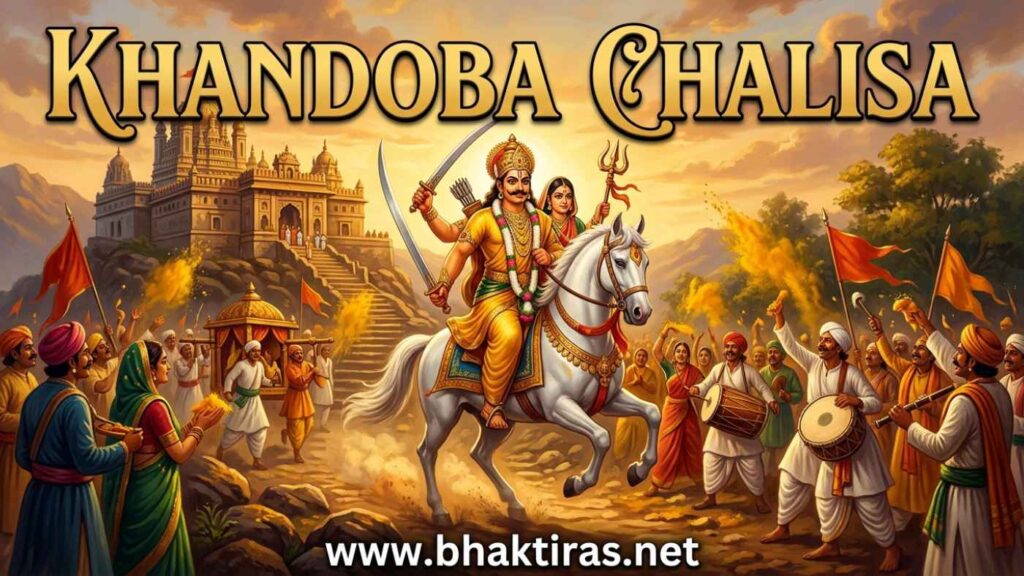
The Khandoba Chalisa is a devotional hymn to Khandoba, the warrior-god of the Deccan who is worshipped as a folk form of Lord Shiva. Also called Malhari, Martand Bhairava and Mailara, he rides a horse, is followed by a faithful dog, and presides from his hill-fort shrine at Jejuri in Maharashtra. This page gives the full text in easy Roman transliteration together with a clear, original English meaning for every verse, so you can both chant the lines and understand what each one says.
Khandoba Chalisa Lyrics in English (Transliteration)
Roman transliteration for easy chanting. Tap “Meaning” under any verse for the English translation.
Shri Ganapati Guru-pad kamal, dhari hiy dhyan anoop |
Khandoba ki Chalisa, gaoon Shiv ke roop ||
Meaning
Holding in my heart a matchless meditation on the lotus feet of Lord Ganesha and my Guru, I begin to sing the Chalisa of Khandoba, who is himself a form of Shiva.
Jay jay jay Khandoba Deva | Bhakt karat nit tumri seva ||
Meaning
Victory, victory, victory to you, Lord Khandoba. Your devotees offer you worship and loving service every single day.
Malhari Martand kahavahu | Mani Mall daity ko maar giravahu ||
Meaning
You are called Malhari and Martand, radiant as the sun. It was you who struck down and destroyed the demons Mani and Malla.
Jejuri gadh mein aap viraje | Svarn mukut mastak par saaje ||
Meaning
You are seated in glory on the fort-hill of Jejuri, a golden crown resting gracefully upon your head.
Bhaal tilak bhandara sohai | Dekhat hi bhaktan man mohai ||
Meaning
A tilak of sacred turmeric powder (bhandara) glows on your forehead, and a single glance at your form captivates the hearts of your devotees.
Gal mundmaal sundar chhavi chhaajai | Kar trishul damaru ati raajai ||
Meaning
A garland around your neck lends your form a striking beauty, while the trident and damaru drum in your hands shine with power.
Neelay ghode aswaar tihaare | Bhaktan ke sankat sab taare ||
Meaning
Mounted on your blue horse, you ride to the aid of those who call you, carrying every trouble of your devotees away.
Mhalsa sang mein maatu viraje | Banai sang shobha gaaje ||
Meaning
Mother Mhalsa is seated by your side, and with Banai beside you too, your divine presence radiates even greater splendour.
Dushtan ko tum dand sunaao | Bhaktan ko aanand pahunchaao ||
Meaning
You hand out just punishment to the wicked while filling the lives of your true devotees with joy and peace.
Bhakt pukaare jabahi tumhaari | Dauday aavat kripalu Murari ||
Meaning
The moment a devotee cries out to you, you the compassionate Lord come running to their side to help.
Ann dhan ke tum bhandar bharoho | Sab vidhi sankat door karoho ||
Meaning
You fill our stores with grain and wealth, and you remove our hardships in every possible way.
Jo jan sharan tumhari aavai | So nar sakal padarth paavai ||
Meaning
Whoever takes shelter at your feet obtains everything worth having in life.
Tumhari mahima ved bakhane | Mahima amit na koi jaane ||
Meaning
The Vedas themselves praise your greatness, yet your glory is so boundless that no one can measure it fully.
Praat uthat jo tumko dhyavai | Janam janam ke paap nasavai ||
Meaning
Those who rise at dawn and meditate on you see the sins of many lifetimes wiped away.
Puja thaal saja kar laavai | Dhoop deep naivedya chadhavai ||
Meaning
Those who bring a well-arranged worship plate and offer you incense, lamps and food are blessed by your grace.
Jay Malhar jay Malhari | Bhaktan ki karo rakhvari ||
Meaning
Victory to Malhar, victory to Malhari. Keep watch over your devotees and always guard them from harm.
Tum ho deenan ke pratipaalak | Dukh bhanjan tum jag ke paalak ||
Meaning
You are the protector of the poor and the helpless, the breaker of sorrows, and the sustainer of the whole world.
Jo jan paath karai Chalisa | Ta par kripa karain Khandisa ||
Meaning
Any devotee who recites this Chalisa receives the abundant grace of Khandisa, the Lord Khandoba.
Sadaanand ka jo jaykara | Pooran hoy kaam sab saara ||
Meaning
Whoever raises the victory cry of the ever-blissful Lord finds all their important tasks brought to a successful completion.
Elkot jay Malhar kahi, nit uth sumirai naam |
Khandoba sab bhakt ke, pooran karain sab kaam ||
Meaning
By calling out 'Elkot, victory to Malhar' and remembering his name each morning on waking, Khandoba surely fulfils every wish and task of his devotees.
Benefits of Reciting the Khandoba Chalisa
Devotees turn to the Khandoba Chalisa for courage and protection, and to keep the mind steady in difficult times. Regular recitation is associated with these blessings:
- Protection: It is chanted to seek shelter from enemies, negativity and unseen dangers.
- Courage: As a warrior-god, Khandoba is invoked for fearlessness, strength and resolve.
- Prosperity: Verses ask for full granaries and wealth, so farmers and families recite it for abundance.
- Relief from trouble: The lines repeatedly describe him carrying away his devotees’ crises and obstacles.
- Inner peace: Daily recitation is said to ease mental stress and settle a restless mind.
- Freedom from past faults: Morning meditation on Khandoba is linked with the fading of long-standing karmic burdens.
When and How to Chant the Khandoba Chalisa
The Khandoba Chalisa is best recited in the early morning after a bath, and it is especially favoured on Sundays and during the Champa Shashthi festival, which is central to Khandoba worship. Sit facing east or north in a clean spot, keep an image of Khandoba on his horse before you, light a lamp, and offer a little turmeric (bhandara) if you have it. Chant slowly and clearly with genuine devotion; reciting once daily is enough for regular practice, while some repeat it seven, eleven or twenty-one times when seeking help with a particular need.
About the Khandoba Chalisa
The Khandoba Chalisa follows the familiar chaupai-and-doha pattern of Hindi devotional verse: an opening couplet, a set of rhyming quatrains, and a closing couplet. This version carries eighteen chaupais framed by two dohas rather than the full forty verses of some chalisas. Its lines name Khandoba’s most loved forms and stories, Malhari and Martand, his slaying of the demons Mani and Malla, his blue horse, his consorts Mhalsa and Banai, and his hill shrine at Jejuri, and they close with the traditional war-cry ‘Elkot, Jay Malhar’.
Frequently Asked Questions
What is the Khandoba Chalisa?
The Khandoba Chalisa is a short devotional hymn praising Khandoba, the Deccan warrior-god worshipped as a folk form of Shiva and known as Malhari, Martand and Mailara. Its verses recall his deeds, his shrine at Jejuri, and his role as protector of devotees.
What are the benefits of reciting the Khandoba Chalisa?
Devotees recite it for protection from enemies and negativity, for courage and fearlessness, and for prosperity and relief from troubles. It is also chanted to calm the mind and to seek freedom from past faults.
Which day is best to recite the Khandoba Chalisa?
Sundays are considered especially auspicious, and the Champa Shashthi festival is the most important occasion for Khandoba worship. Many devotees also recite it every morning as part of daily practice.
How many verses are in the Khandoba Chalisa?
This version has eighteen main verses (chaupais) framed by an opening and a closing doha, rather than a full forty verses. Every verse on this page is given in Roman transliteration with an English meaning.
Can the Khandoba Chalisa be recited in English?
Yes. This page presents the full text in simple Roman transliteration so anyone who cannot read Devanagari can still chant it accurately, along with a clear English meaning for each verse.
॥ Khandoba Chalisa ॥