
ॐ
Annapurna Chalisa
श्री अन्नपूर्णा चालीसा
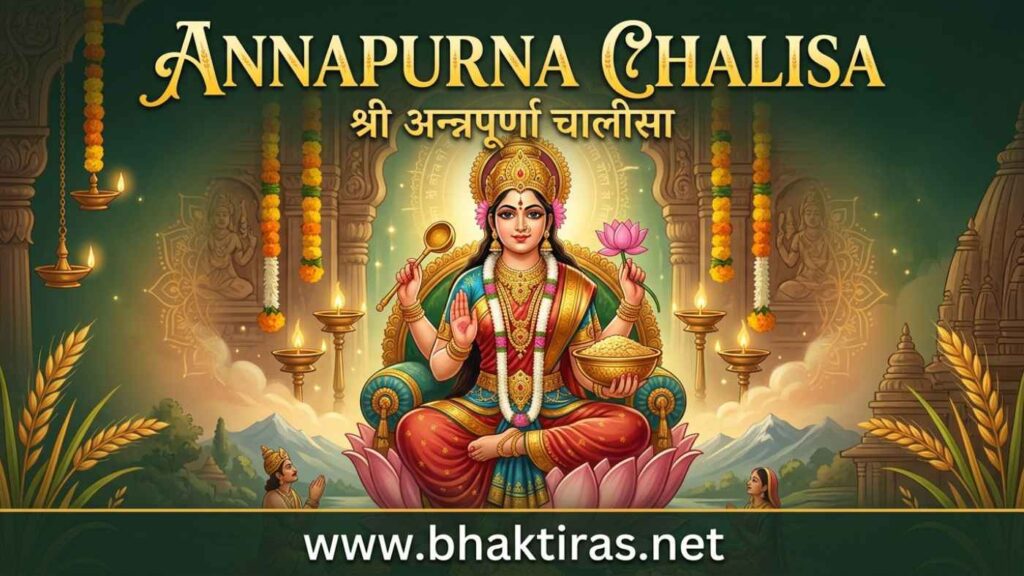
The Annapurna Chalisa is a forty-verse hymn to Goddess Annapurna, the goddess of food and nourishment worshipped at Kashi (Varanasi). A gentle form of Parvati, she is honoured as the one who keeps every kitchen and grain-store full. This page gives the complete chalisa in easy English transliteration, with a clear, original meaning under each verse so you can both recite the lines and understand what you are saying.
Annapurna Chalisa Lyrics in English (Transliteration)
Roman transliteration for easy chanting. Tap “Meaning” under any verse for the English translation.
Vishweshvar padapadam ki raj nij shish lagay,
Annapurne, tav suyash baranaun kavi matilay.
Meaning
Placing the dust of Lord Vishweshvara's (Shiva's) lotus feet upon my head, I, a poet of modest understanding, begin to sing the glory of Goddess Annapurna.
Nitya aanand karini mata,
var aru abhay bhav prkhyata.
Meaning
O Mother, you give joy that never ends; you are widely known as the one who grants both blessings and freedom from fear.
Jay! soundary sindhu jag janani,
akhil pap har bhav harani.
Meaning
Victory to you, ocean of beauty and mother of the world. You wash away every sin and end the dread of worldly life.
Shvet badan par shvet basan puni,
santan tuv pad sevat rishimuni.
Meaning
Bright of face and dressed in white, you are served at your feet by saints, sages and seers.
Kashi puradhishvari mata,
maheshvari sakal jag trata.
Meaning
O Mother, you are the sovereign goddess of the city of Kashi, the great Maheshwari who shelters the whole world.
Vrishbharudh nam rudrani,
vishav viharini jay! kalyani.
Meaning
Riding the bull, you bear the name Rudrani; you move through the universe at will. Victory to you, giver of all that is good.
Patidevta sutit shiromani,
padavi prapat kinh giri nandini.
Meaning
O daughter of the mountain king, devoted to your lord above all, you rose to the highest of all stations.
Pati vichoh dukh sahi nahi pava,
yog agni tab badan jarava.
Meaning
Unable to endure the grief of separation from your husband, you gave up your body in the fire of yoga.
Deh tajat shiv charan snehu,
rakhehu jat himgiri ghehu.
Meaning
Leaving that body out of love for Shiva's feet, you were received once more into the home of the Himalayas.
Prakati girija nam dharayo,
ati anand bhavan manh chayo.
Meaning
You appeared again under the name Girija, and great happiness spread through the whole house.
Narad ne tab tohin bharamayhu,
byah karan hit path pdhayhu.
Meaning
Then sage Narada came to you and taught you the way that would lead to your marriage.
Brahma varun kuber ganaye,
devraj aadik gaye.
Meaning
Brahma, Varuna, Kubera, Indra the king of gods and the other deities all sang in your honour.
Sab devan ko sujas bakhani,
mati palatan ki man thani.
Meaning
Having praised all the gods, Narada then set his mind on testing the firmness of your resolve.
Achal rahin tum pran par dhanya,
kihani siddh himachal kanya.
Meaning
You stood unshaken in your vow, O blessed daughter of the Himalayas, and so proved your steadfast will.
Nij ko tab narad ghabaraye,
tab pran puran mantra pdhaye.
Meaning
When Narada grew uneasy about his own scheme, he then taught you the mantra that fulfils the breath of life.
Karan hetu tap tohi updeshu,
sant vachan tum satya parekhehu.
Meaning
He counselled you to undertake penance for a purpose, and you put the words of the holy ones to the test of truth.
Gagangira suni tari na tare,
Brahma tav tum pas padhare.
Meaning
Hearing the voice from the sky that could not be set aside, Lord Brahma himself came to you.
Kaheu putri var mangu anupa,
dehun aaj tuv mati anurupa.
Meaning
He said, "O daughter, ask for a boon beyond compare; today I shall grant whatever your heart desires."
Tum tap kinh alokik bhari,
kasht uthayahu ati sukumari.
Meaning
You performed penance of an extraordinary, almost unearthly kind, bearing great hardship though so tender and delicate.
Ab sandeh chhadi kacchu moson,
hai sogandh nahi chhal toson.
Meaning
"Now set aside any doubt about me; I give you my word, there is no trickery in what I say."
Karat ved vid brahma janhu,
vachan mor yeh sancha manhu.
Meaning
"Know that Brahma acts in keeping with the Vedas; take these words of mine to be wholly true."
Taji sankoch kahahu nij iccha,
dehon mai manmani bhiksha.
Meaning
"Letting go of all hesitation, tell me your wish; I will grant the very boon your mind longs for."
Suni Brahma ki madhuri bani,
mukh son kachu musukaye bhavani.
Meaning
Hearing Brahma's gentle, sweet words, Goddess Bhavani let a faint smile cross her face.
Boli tum ka kahahu vidhata,
tum to jag ke sashtradhata.
Meaning
She said, "What should I ask of you, O Creator? You are the very upholder of the world."
Mam kamna gupt nahin toson,
kahvava chahahu ka moson.
Meaning
"My wish is no secret to you; what is it you wish to hear me say aloud?"
Daksh yayg mahn marati bara,
shambhunath puni hohin hamara.
Meaning
"When I gave up my life at Daksha's sacrifice, Shambhunath (Shiva) once again became mine."
So aab milhin mohin manbhaye,
kahi tathastu vidhi dham sidhaye.
Meaning
"May he now be joined to me as my heart desires." Saying "So be it," Brahma returned to his own abode.
Tab girija shanker tav bhayu,
phal kamna sanshyo gayau.
Meaning
Then Girija was united with Shankara, and every doubt about the fruit of her wish was dispelled.
Chanderkoti ravi koti prakasha,
tab aanan mahn karat nivasa.
Meaning
With the light of a million moons and a million suns, such radiance shines forth in your face.
Mala pustak ankush sohe,
kar mahn apar pash man mohen.
Meaning
A rosary, a book and a goad grace your hands, and the boundless noose you hold captivates the mind.
Annpurne! sadapurne,
aaj aanvagh anant purne.
Meaning
O Annapurna, ever full and ever complete, today you stand boundless and overflowing with plenty.
Kripa sagari kshemkari man,
bhav vibhuti aanand bhari man.
Meaning
You are an ocean of grace and a bringer of safety; your heart brims with sacred glory and joy.
Kamal vilochan vilsit bhale,
devi kalike chandi karale.
Meaning
Lotus-like eyes shine upon your fair brow, O Goddess Kalika, the fierce Chandi.
Tum kailash mahin hai girija,
vilsi anand sath sindhuja.
Meaning
On Mount Kailash you dwell as Girija, delighting in bliss alongside Lakshmi, born of the ocean.
Svarag mahalakshmi kahalayi,
martey lok lakshmi padpayi.
Meaning
In heaven you are called Mahalakshmi, and in the mortal world you bestow the wealth that Lakshmi brings.
Vilsi sab mahn sarv sarupa,
sevat tohin amar pur bhupa.
Meaning
You are present in all things and take every form; even the kings of the immortal realm serve you.
Jo padhihhi yeh tav chalisa,
phal pahin shubh sakhi isa.
Meaning
Whoever recites this chalisa of yours wins favourable fruits, with the Lord himself as witness.
Parat samay jo jan man layo,
padhinhi bhakti suruchi adhikayo.
Meaning
The devotee who recites it at the right hour with a settled mind, full of devotion and earnest love,
Stri kalatr pati mitr putr yut,
paramashverya labh lahi adhabhut.
Meaning
gains wonderful, abundant fortune, blessed in the company of spouse, friends and children.
Raj vimukh ko raj divave,
jas tero jan sujas badhavei.
Meaning
You restore a kingdom to the one who has lost it, and you cause your devotee's good name to grow.
Path maha mud mangal data,
bhakt manovanchit nidhi pata.
Meaning
This recitation grants deep joy and well-being, and to the devotee it yields, like a hidden treasure, the very thing the heart has wished for.
Jo yeh chalisa subhag, padhi naveigen math,
Tineke karaj siddh, sab sakhi kashi nath.
Meaning
Those who reverently recite this fortunate chalisa and bow their heads find all their tasks fulfilled, with Lord Shiva of Kashi as their witness.
Benefits of Reciting the Annapurna Chalisa
Devotees turn to the Annapurna Chalisa when they pray for sufficiency, security and a settled household. Regular recitation is associated with these blessings:
- Food and plenty: As the goddess of nourishment, Annapurna is invoked so that no home goes short of grain or a cooked meal.
- A stable household: The verses ask for harmony and provision for spouse, children and friends, supporting family life.
- Relief from want and fear: The chalisa names her as the remover of fear and worldly distress, offering reassurance in hard times.
- Prosperity and dignity: Identified with Lakshmi, she is sought for honest wealth and the restoration of lost standing or work.
- Inner calm: Reciting the lines with attention steadies the mind and turns the heart toward gratitude.
- Auspicious beginnings: Many recite it before festivals such as Annakut and before feeding others, dedicating the act of giving food to her.
When and How to Chant the Annapurna Chalisa
The Annapurna Chalisa can be recited on any day, as nourishment is needed daily, and it is especially fitting around Annakut and Annapurna Jayanti, and before offering food to guests or the needy. Recite after a bath, in a clean spot before an image or picture of the goddess, ideally with a lamp and a small offering of cooked food or grain. Read at an unhurried pace, following the meaning, and end by sharing food with someone, which is the truest form of her worship.
About the Annapurna Chalisa
The Annapurna Chalisa follows the classic chalisa form: an opening doha, forty chaupai verses, and a closing doha. Its language is simple Hindi in the devotional style, here given in Roman transliteration for easy reading. The verses retell how Parvati gave up her body in grief and was reborn as Girija, daughter of the Himalayas, before her reunion with Shiva, and they praise her at Kashi as Annapurna, the giver of food, who is also recognised as Rudrani, Kalika and Mahalakshmi. The text is traditional and has no single named author.
Frequently Asked Questions
What is the Annapurna Chalisa?
It is a devotional hymn of forty verses praising Goddess Annapurna, the goddess of food and nourishment worshipped at Kashi (Varanasi). She is a form of Parvati, and the chalisa asks her for sufficiency, prosperity and the well-being of the household.
What are the benefits of reciting the Annapurna Chalisa?
Devotees recite it to pray for food and plenty, a stable and harmonious home, relief from want and fear, honest prosperity, and peace of mind. It is also chanted before offering or sharing food.
Which day is best to recite the Annapurna Chalisa?
It can be recited on any day, since nourishment is a daily need. It is considered especially auspicious around Annakut and Annapurna Jayanti, and before feeding guests or those in need.
How many verses are in the Annapurna Chalisa?
It has forty chaupai verses framed by an opening doha and a concluding doha, the standard structure of a chalisa.
Can the Annapurna Chalisa be recited in English?
Yes. This page provides the full chalisa in Roman (English) transliteration with the meaning of each verse, so it can be read and understood by those who do not read Devanagari.
॥ Annapurna Chalisa ॥