
ॐ गं गणपतये नमः
Ashtavinayak: One Circuit, Eight Faces of Ganesha
Eight self-manifested Ganesha shrines circle Pune in western Maharashtra, and pilgrims have walked between them in a fixed order for centuries. This guide covers every temple, the map, the route, and the little details that make each stop different.
What is the Ashtavinayak Yatra, in short?
The Ashtavinayak Yatra is a pilgrimage to eight ancient Ganesha temples around Pune, Maharashtra, each holding a swayambhu (self-manifested) murti with its own name and legend. Tradition fixes the order: Morgaon, Siddhatek, Pali, Mahad, Theur, Lenyadri, Ozar, Ranjangaon, then back to Morgaon to close the circle. The full road circuit runs roughly 720 km and most pilgrims complete it in two to three days.
Where the eight shrines sit
All eight temples lie within a day’s drive of Pune. Tap any numbered pin to see that temple’s photo, its one-line story, and the link to its full guide. The dashed line traces the traditional darshan order.
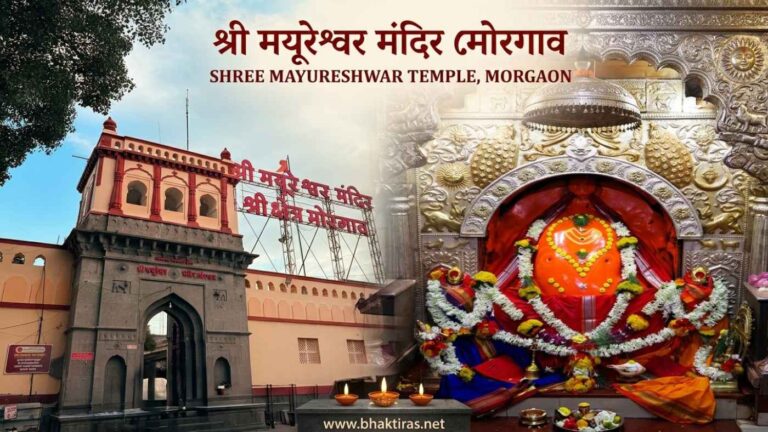
Mayureshwar, Morgaon
Morgaon village, Pune district
Ganesha is said to have ridden a peacock here to defeat the demon Sindhu. Every Ashtavinayak Yatra opens at this east-facing shrine, and tradition asks you to come back and close it here too.
Read the full temple guideTip: use Tab and Enter to move between pins with a keyboard.
The 8 Ashtavinayak temples, in the traditional order
Each shrine keeps a self-manifested murti with its own name, direction, and story. Mark the ones you have visited and the counter above will keep your score. Every card links to our full guide for that temple.
1Start & finish of the yatraMayureshwar, Morgaon
Morgaon, Pune district · Mayura means peacock
Ganesha rode a peacock into battle here to subdue the demon Sindhu. The idol sits behind a Nandi, unusual for a Ganesha shrine, with a cobra hood sheltering its head. Four gates face the four directions, and the yatra both opens and closes at this temple.
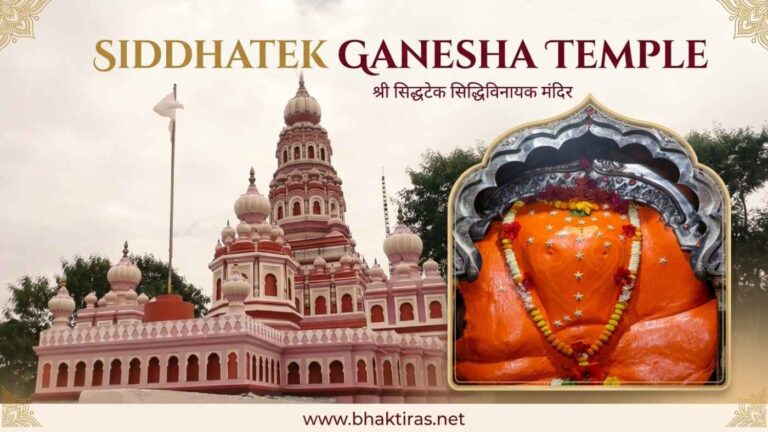 2Only right-turned trunk
Siddhivinayak, Siddhatek
Siddhatek, Ahmednagar district · on the Bhima river
Vishnu is said to have won the siddhi to defeat the demons Madhu and Kaitabha after worshipping here. This is the only Ashtavinayak murti whose trunk turns right, a form treated as especially exacting, and the stone sanctum was raised by Queen Ahilyabai Holkar.
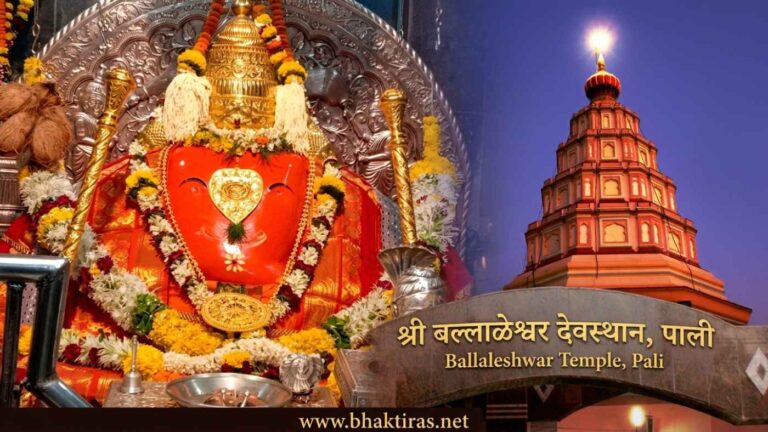 3Named after a devotee
Ballaleshwar, Pali
Pali, Raigad district · below Sarasgad fort
A boy named Ballal refused to stop worshipping Ganesha even when his own father beat him for it, and the lord took the boy’s name in return. It is the only Ashtavinayak called after a devotee, and in winter the rising sun reaches the murti directly. The prasad here is besan laddu rather than modak.
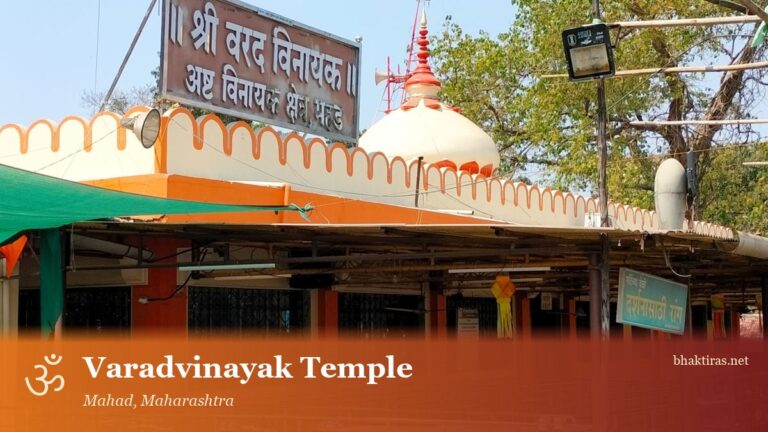 4Lamp burning since 1892
Varadvinayak, Mahad
Mahad, Raigad district · the boon-giver
The murti was recovered from a lake in 1690, and an oil lamp inside the sanctum, the nandadeep, is said to have stayed lit since 1892. This is the one Ashtavinayak temple where devotees may walk into the sanctum and offer their respects to the idol personally.
 5Closest to Pune
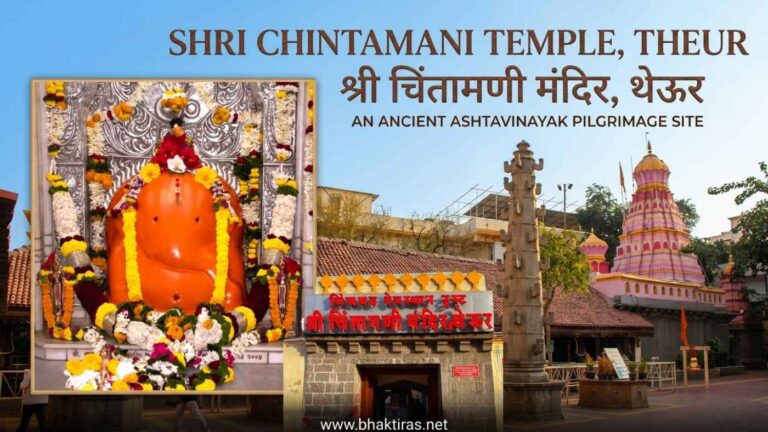
Chintamani, Theur
Theur, Pune district · at the Mula-Mutha confluence
Chintamani is the Ganesha who takes away chinta, the churn of worry. The Peshwa rulers treated him as their family deity: Madhavrao I built much of the present complex and chose to spend his final days here in 1772. The wooden sabha mandap and its stone fountain date to that era.
 6Cave shrine · ~307 steps
Girijatmaj, Lenyadri
Lenyadri, Junnar, Pune district · a mountain cave
Girijatmaj means the son of Girija, that is Parvati, who is believed to have performed penance in these hills to receive Ganesha as her child. The shrine occupies one of about thirty ancient rock-cut caves, and the only way up is a stone stairway of roughly 307 steps. No vehicle reaches the sanctum.
 7Golden shikhara
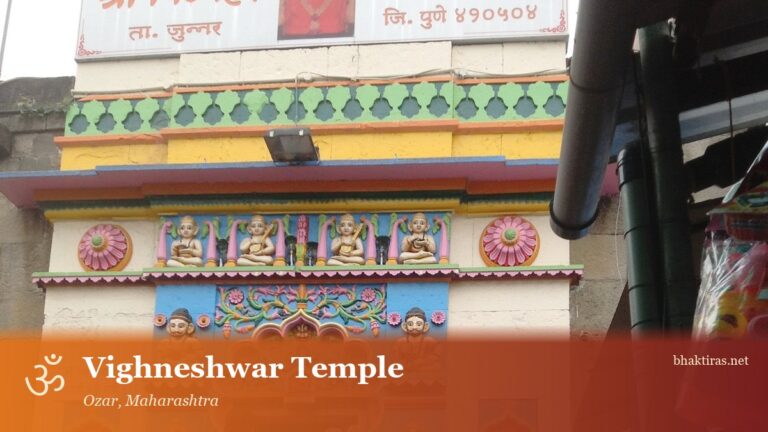
Vighneshwar, Ozar
Ozar, Junnar, Pune district · on the Kukadi river
Here Ganesha overpowered Vighnasura, the demon of obstacles, who surrendered on the condition that his name join the lord’s. The murti wears rubies in its eyes and a diamond on the forehead, and the temple’s gilded spire and fortified stone walls make it the most striking complex on the circuit.
 8Worshipped by Shiva
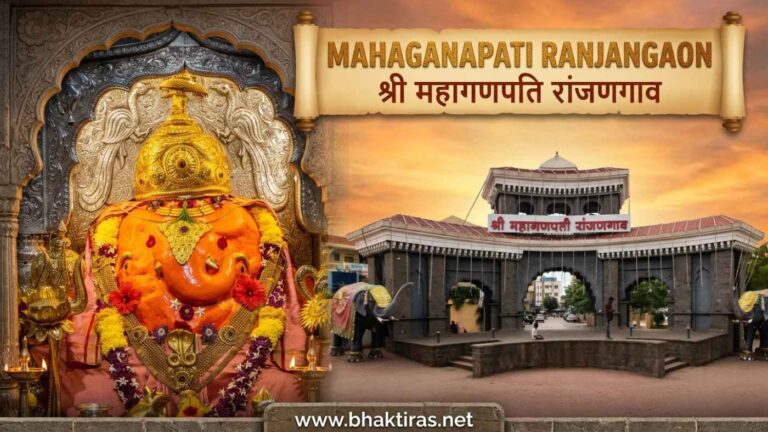
Mahaganapati, Ranjangaon
Ranjangaon, Pune district · Pune-Ahmednagar highway
Before destroying the triple cities of Tripurasura, Shiva himself is said to have invoked Ganesha at this spot, which makes Ranjangaon the only Ashtavinayak tied to a Shiva legend. Local tradition holds that a more powerful ten-trunked form of the murti lies concealed below the one you see.
Temple hours shift on festival days and Sankashti Chaturthi. Treat the timings above as typical and confirm locally on the day you travel.
How pilgrims actually do the circuit
The scriptural order zigzags across the map, so tour operators long ago settled on a geographic sequence that covers the same eight shrines with far less backtracking. Pick the plan that fits your time.
The classic 2-day, 1-night circuit
Roughly 650-720 km in total. This is the sequence most Pune operators run, with a night halt near Narayangaon or Ozar.
Day 1 · The eastern arc
- Pune → Morgaon (Mayureshwar): begin where the yatra must begin~64 km
- Morgaon → Siddhatek (Siddhivinayak): cross the Bhima to the right-trunk shrine~65 km
- Siddhatek → Theur (Chintamani): loop back west along the Daund road~75 km
- Theur → Ranjangaon (Mahaganapati): finish the day on the Ahmednagar highway~40 km
- Ranjangaon → Narayangaon: night halt on the Nashik road~55 km
Day 2 · North hills, then the Konkan side
- Narayangaon → Ozar (Vighneshwar): early darshan by the Kukadi~10 km
- Ozar → Lenyadri (Girijatmaj): climb the ~307 steps before the sun is high~15 km
- Lenyadri → Pali (Ballaleshwar): the long leg down toward the Konkan~165 km
- Pali → Mahad (Varadvinayak): step inside the sanctum, the only place you can~40 km
- Mahad → Pune, ideally via a closing darshan at Morgaon~110 km
3 days, 2 nights starting from Mumbai
Mumbai adds about 150 km each way, so the comfortable version takes the Konkan pair first and works clockwise, roughly 900-1000 km in total.
Day 1 · Konkan shrines on the way in
- Mumbai → Pali (Ballaleshwar) via the expressway and Khopoli exit~110 km
- Pali → Mahad (Varadvinayak)~40 km
- Mahad → Pune: night halt~85 km
Day 2 · The eastern arc
- Pune → Morgaon → Siddhatek → Theur → Ranjangaon, the same eastern sweep as the classic route~245 km
- Ranjangaon → Narayangaon: night halt~55 km
Day 3 · Hill shrines, then home
- Narayangaon → Ozar → Lenyadri: two darshans before lunch~25 km
- Lenyadri → Mumbai via Malshej Ghat, one of Maharashtra’s prettiest drives~160 km
Only have a day? Take a cluster
The eight shrines fall into three natural clusters. Many families finish the yatra over three separate day trips, which is a perfectly accepted way to do it.
Loop A · Southeast of Pune (4 temples)
- Theur → Ranjangaon → Siddhatek → Morgaon, back to Pune by night~250 km
Loop B · The Junnar hills (2 temples)
- Ozar → Lenyadri along the Pune-Nashik road; add Shivneri fort if time allows~200 km round trip
Loop C · The Konkan pair (2 temples)
- Pali → Mahad, easy from either Mumbai or Pune via Khopoli~200 km round trip
Why these eight, and why the order matters
The Mudgala Purana and Ganesha Purana, the two texts devoted to Ganesha, describe eight episodes in which the lord took form to end a specific trouble: a demon subdued at Morgaon, a boon granted at Siddhatek, a devotee vindicated at Pali. At each spot, tradition says, a murti emerged of its own accord rather than being carved. These swayambhu images are why the eight shrines were grouped and ranked above the countless other Ganesha temples of Maharashtra.
The word itself is a plain compound: ashta means eight, vinayaka is Ganesha as the supreme guide. Saying “the Ashtavinayak” refers to the set, and the yatra is the act of seeing all eight in sequence.
Much of what stands today was built or rebuilt in the 1700s under the Peshwas, who governed from Pune and treated Ganesha as the family deity. Their ministers endowed sanctums, lamps, and land at nearly every shrine, and the saint Morya Gosavi’s line at Chinchwad kept the Morgaon worship running for generations. The circuit as pilgrims now drive it is, in a real sense, a Peshwa-era devotional map still in daily use.
The sequence, ending where it began, is the point. Completing the circle at Morgaon is held to seal the yatra’s merit, a quiet reminder that with Ganesha every ending is also the next beginning.
When to go
The circuit runs all year, but the experience changes a lot with the calendar. Three windows matter most.
October to February
The comfortable window
Cool, dry days between 15 and 28 degrees make the driving easy and the Lenyadri climb pleasant. Maghi Ganesh Jayanti (January or February) brings festive energy without the peak-season crush. If you can pick freely, pick this.
Ganesh Chaturthi
August – September · Bhadrapada
The temples are at their most alive, dressed in flowers with round-the-clock aartis. They are also at their most crowded: expect long queues at every shrine and book rooms weeks ahead. Go for the atmosphere, not for a quick darshan.
Angarki Sankashti
Any Sankashti Chaturthi on a Tuesday
When the monthly Sankashti Chaturthi lands on a Tuesday it is counted especially auspicious, and all eight temples see heavy single-day crowds. Join if you want the fervour; avoid those dates if you want quiet.
Small things that make the yatra smoother
Dress and temple etiquette
Modest, traditional wear is expected everywhere on the circuit: trousers or dhoti with a shirt for men, saree, salwar, or churidar for women. Shorts, sleeveless tops, and ripped jeans will get you polite refusals at several gates. Footwear comes off before every temple; free or token-charge stands sit at each entrance.
Darshan, aarti, and prasad
Morning kakad aartis start around 5 am at most shrines and are worth planning around at least once on the trip. Modak, Ganesha’s favourite sweet, is the standard prasad; Pali serves besan laddu instead. Only at Mahad’s Varadvinayak may you enter the sanctum and offer garlands with your own hands; everywhere else darshan is from outside the garbhagriha.
Photography is generally barred inside sanctums across all eight temples. Keep the phone away near the deity and nobody will need to remind you.
Getting there without your own car
Pune is the practical base: it has the nearest airport and the best bus connections to every cluster. Useful railheads are Daund for Siddhatek, Karjat for Pali and Mahad, and Jejuri for Morgaon, each followed by a short taxi or shared jeep. MSRTC buses reach all eight villages, and MTDC along with private operators run fixed 2-day Ashtavinayak bus packages from both Pune and Mumbai, typically priced from about Rs 1,500 to Rs 7,000 a seat depending on the coach.
Planning for elders and children
Seven of the eight shrines are easy on the knees; Lenyadri is the exception with its ~307-step climb and no vehicle access to the cave. Take it slowly in the early morning, carry water, and use the rest landings. The steps are wide and railed for most of the way. If someone in the group cannot climb, they can wait at the base while the rest go up; the round trip takes about an hour at an unhurried pace.
Doing the yatra “correctly”
The shastra order is Morgaon, Siddhatek, Pali, Mahad, Theur, Lenyadri, Ozar, Ranjangaon, then Morgaon again. In practice most pilgrims follow the geographic route and simply make sure of two things: the yatra starts at Morgaon and ends with a return darshan there. Splitting the circuit over separate weekends is fully accepted; the tradition cares about completing the circle, not the stopwatch.
Ashtavinayak Yatra: questions pilgrims ask
What is the Ashtavinayak Yatra?
It is a pilgrimage to eight ancient Ganesha temples around Pune in Maharashtra, each enshrining a swayambhu (self-manifested) murti with its own legend. The eight are Morgaon, Siddhatek, Pali, Mahad, Theur, Lenyadri, Ozar, and Ranjangaon.
Which temple do you visit first on the Ashtavinayak Yatra?
Mayureshwar Temple at Morgaon is the traditional starting point, and the yatra is completed by returning to Morgaon for a closing darshan after the other seven shrines.
Can the Ashtavinayak Yatra be completed in one day?
Not comfortably. All eight temples span roughly 720 km of driving, so the standard plan is two days from Pune or three days from Mumbai. In one day you can cover a single cluster of two to four temples and finish the rest on later trips.
How many kilometres is the full Ashtavinayak circuit?
About 650 to 720 km starting and ending at Pune, depending on the exact route and night halt. From Mumbai the round trip grows to roughly 900 to 1000 km.
Which Ashtavinayak temple has a right-turned trunk?
Only Siddhivinayak at Siddhatek. A right-turned trunk is considered an especially powerful and demanding form of Ganesha, which is why this shrine is associated with strict observance.
Which Ashtavinayak temple lets devotees touch the idol?
Varadvinayak at Mahad is the only one of the eight where devotees may enter the sanctum and personally offer their respects to the murti. At the other seven, darshan is from outside the garbhagriha.
What is the best time to do the Ashtavinayak Yatra?
October to February offers the most comfortable weather. Ganesh Chaturthi (August-September) is the most festive but also the most crowded, and Angarki Sankashti Chaturthi dates draw heavy single-day crowds at all eight temples.
Is there a government bus package for the Ashtavinayak Yatra?
Yes. MTDC and MTDC-approved operators, along with MSRTC and many private companies, run scheduled 2-day Ashtavinayak packages from Pune and Mumbai. Seats typically range from about Rs 1,500 to Rs 7,000 depending on the coach and duration.
Why do pilgrims return to Morgaon at the end of the yatra?
Tradition holds that the yatra is complete only when the circle closes where it began. A final darshan at Morgaon’s Mayureshwar seals the pilgrimage’s merit, so the circuit is treated as a loop rather than a line.