
Bathukamma – The Flower Goddess of Telangana
బతుకమ్మ
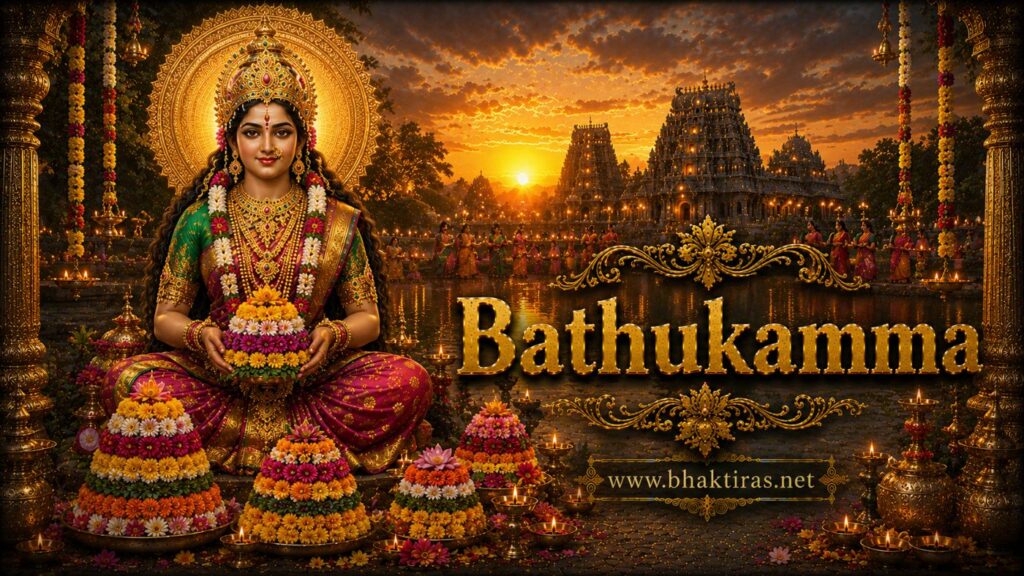
Bathukamma is the floral form of the Mother Goddess Gauri, worshipped across Telangana as a symbol of life, fertility and marital well-being. Women build beautiful conical stacks of seasonal flowers and honour her over nine days in the Bathukamma festival, singing to her and finally sending the flowers into water with prayers for a blessed, thriving life.
Who Is Bathukamma?
Bathukamma is the Mother Goddess worshipped in the form of flowers – a living, blooming shape of Gauri, the gentle aspect of the Divine Mother whom devotees also know as Parvati. The very name carries a blessing: Bathukamma means come alive, mother, a call to the goddess to grant long life and vitality to the women who worship her and to their families.
She is honoured chiefly by the women of Telangana, for whom the festival of Bathukamma is one of the most cherished occasions of the year. Rather than a stone idol, the goddess is made present in a tall, colourful arrangement of seasonal flowers, freshly gathered and stacked with care. In this floral form she is understood as Maha Gauri, the radiant mother of life and auspiciousness.
Bathukamma is closely tied to womanhood – to health, marriage, motherhood and the wish for a flourishing home. Her worship is joyful and social, filled with song, colour and the company of women who gather each evening to honour her together.
Goddess of Life and Well-Being
As the flower goddess, Bathukamma represents life at its most abundant and hopeful. Women pray to her for good health, long life for their husbands and children, happy marriages, and the fertility and prosperity of the household. The seasonal flowers themselves carry the message: they bloom in the fields after the monsoon, at the height of nature’s fullness, and so they stand for life renewing itself.
In her identity as Gauri, the pure and auspicious form of Parvati, Bathukamma also holds the ideal of the devoted, life-giving mother. Her worship overlaps with the Navaratri season, connecting the intimate, women-led folk celebration of Telangana with the wider reverence for the Mother Goddess. In spirit she belongs to the same world of local mother worship as the region’s other beloved Gramadevata.
How Bathukamma Is Worshipped
Bathukamma worship is a nine-day celebration of colour, song and togetherness. Each day, women prepare a floral arrangement, gather in a circle around it, sing traditional Bathukamma songs, and honour the goddess with clapping and graceful movement. The devotion is warm and communal, passed from mothers to daughters.
The Flower Stack
The heart of the worship is the Bathukamma itself – a conical, tiered arrangement of seasonal flowers such as marigold, celosia (gunugu), tangedu (senna) and chrysanthemum, built up ring by ring on a wide brass or bamboo plate. A lump of turmeric shaped as Gauri is placed at the very top, making the goddess present in the bloom.
Songs and Circle
In the evenings women gather in an open courtyard or before a home, place the Bathukamma in the centre, and move around it singing folk songs that tell of the goddess, of family life, and of the joys and sorrows of women. The songs are as important as the flowers – a shared voice offered to the mother.
Immersion in Water
At the end of each day’s worship, the flower stack is carried in procession to a nearby lake, tank or river and gently set upon the water. This immersion returns the flowers to nature and carries the women’s prayers to the goddess, echoing the seasonal cycle of bloom and renewal that Bathukamma embodies.
The Bathukamma Festival
The Bathukamma festival is the beating heart of this goddess’s worship and one of the great cultural celebrations of Telangana. It unfolds over nine days in the month of Ashwin, beginning around the time of Mahalaya and running alongside Navaratri, when fields are heavy with wild seasonal flowers.
Each of the nine days has its own name, mood and special food offering (naivedyam), and the arrangements grow in size and splendour as the festival builds. Women dress in their finest, often in new saris and traditional jewellery, and the celebration draws whole neighbourhoods of women and girls together evening after evening.
The festival reaches its climax on the ninth day, known as Saddula Bathukamma, when the largest and most elaborate flower stacks are made. On this final evening women gather in great numbers, sing late into the dusk, and then carry their Bathukammas to the water for a grand collective immersion. Sweet offerings such as maleeda are shared, blessings are exchanged, and the festival closes as a celebration of life, sisterhood and the enduring grace of the Mother Goddess.
Why She Matters
Bathukamma matters as one of the clearest expressions of women’s own spirituality in India. This is a festival made by women, for women, needing no priest or temple – only flowers, song and each other. In honouring the flower goddess, women celebrate their own strength, their bonds of friendship and family, and their hopes for the ones they love.
The festival also carries a deep ecological and cultural wisdom. It ties devotion to the rhythm of the land, using the very flowers that bloom after the rains and returning them respectfully to the water. For Telangana it is a proud emblem of regional identity and heritage. Above all, Bathukamma keeps alive a joyful, life-affirming vision of the divine – the mother who is asked, quite simply, to come alive and to let life flourish.
Traditions and Living Practice
Come alive, mother
The name Bathukamma is itself a folk prayer. Across generations, women have understood the festival as a plea to the goddess for bathuku – life, in the fullest sense: health, children, a lasting marriage and a home that thrives. Each evening’s song and each flower placed on the stack is a way of speaking this wish aloud, together, so that the mother hears and grants it.
Daughters, mothers and the home
Bathukamma is a season of homecoming. Married daughters often return to their parents’ homes for the festival, and grandmothers, mothers and girls build the flower stacks side by side, teaching the songs and the craft as they go. This yearly gathering renews family ties and passes the tradition on intact, which is why the festival has stayed alive and heartfelt for so long.
Frequently Asked Questions
Who is Bathukamma?
Bathukamma is the Mother Goddess worshipped in the form of flowers, understood as Gauri or Maha Gauri, the auspicious form of Parvati. She is honoured mainly by the women of Telangana during the Bathukamma festival as a goddess of life, fertility and well-being.
What does the name Bathukamma mean?
In Telugu, Bathukamma means come alive, mother – a blessing and prayer for long life and vitality. It expresses the festival's core wish: that the goddess grant health, prosperity and flourishing life to her devotees and their families.
How is the Bathukamma festival celebrated?
Over nine days in the month of Ashwin, women build conical stacks of seasonal flowers, gather in circles to sing traditional Bathukamma songs, and immerse the flower arrangements in water each evening. It coincides with Navaratri and is a joyful, women-led celebration.
What is Saddula Bathukamma?
Saddula Bathukamma is the ninth and final day of the festival, its grand climax. Women make the largest, most elaborate flower stacks, gather in great numbers to sing, share sweet offerings such as maleeda, and carry the Bathukammas for a final collective immersion in water.
Which goddess is worshipped as Bathukamma?
Bathukamma is a floral form of Gauri, the gentle and auspicious aspect of Parvati, the Mother Goddess. Some traditions also connect the celebration with the related figure Boddemma. In the flower stack, a piece of turmeric shaped as Gauri represents the goddess herself.
May Bathukamma bless every home with life, joy and flowering good fortune.