
Gramadevata – The Village Guardian Deities
ग्रामदेवता
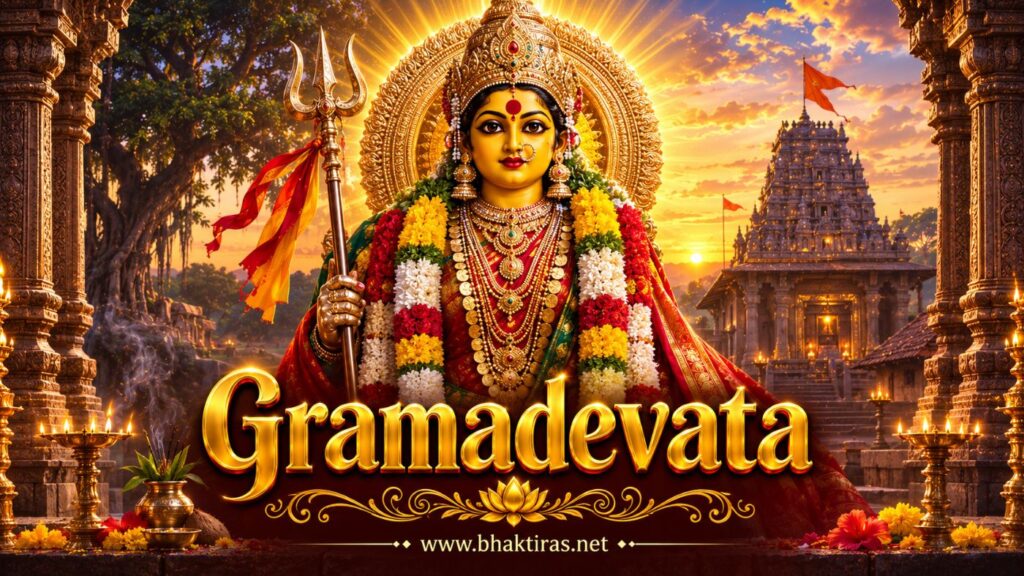
A Gramadevata is the guardian deity of a village in Hindu tradition, worshipped locally to protect the community, its land, cattle, and crops from disease, drought, and misfortune. Usually a village goddess such as Mariamman or a fierce protector like Ayyanar, the deity is honoured at a simple village shrine through folk offerings, seasonal festivals, and boundary rituals.
What Is a Gramadevata?
A Gramadevata is the deity a village looks to as its own protector. The Sanskrit word joins grama (village) with devata (deity), and that pairing says almost everything – this is not a god of the whole cosmos but a god of one place and its people. Where a temple deity like Vishnu or Shiva belongs to all Hindus everywhere, a Gramadevata belongs to a specific settlement, its fields, its wells, and the families who live there.
Most village guardians are goddesses, often called Grama Devi or simply Amman (mother) in the south. Others are fierce male protectors who patrol the edges of the village and keep harm from crossing in. Their shrines are usually plain – a stone smeared with turmeric and vermilion under an old tree, a small open-air platform, a terracotta horse or two – rather than the tall carved towers of a formal temple. That simplicity is the point. The deity lives close to daily life, reachable without priests or elaborate ritual.
What people ask of a Gramadevata is practical and immediate: keep the fever away, send the rains, guard the cattle, let the harvest come in, protect the children. In return the village offers what it grows and raises, and holds a festival when the season turns. This bond between a place and its guardian has held for centuries and is still living practice in thousands of villages today.
Common Village Deities
There is no single Gramadevata. Each region has its own guardians, and the same underlying idea takes many faces. A few of the most widely worshipped forms give a sense of the range.
Mariamman
The great village goddess of Tamil Nadu and much of the south, associated with rain, fertility, and protection from epidemic disease such as smallpox and pox-fevers. Her shrines are among the most common in the region, and her festivals draw whole villages together with drumming, fire-walking, and offerings of neem leaves and cooling foods.
Ayyanar
A male guardian of the boundaries, especially in Tamil villages, who rides the borders at night on horseback to keep the settlement safe. His shrines sit at the village edge or near water tanks, marked by rows of large terracotta horses given as vows by grateful worshippers.
Yellamma / Renuka
A fierce and beloved mother goddess of the Deccan, worshipped across Karnataka, Maharashtra, Telangana, and Andhra Pradesh. Tied to the story of Renuka, she is invoked for healing, fertility, and family welfare, and her hill shrines and folk festivals gather large gatherings of devotees.
How Gramadevatas Are Worshipped
Worship of a village deity is communal and seasonal rather than daily and formal. The shrine may be tended by a local caretaker or a hereditary non-Brahmin priest, and the deity is approached directly with folk offerings – cooked rice, jaggery, coconuts, neem, flowers, and sometimes animal offerings in older traditions, though many communities now favour vegetarian gifts.
The high point of the year is the village festival, often called a jatra or a village fair. For a few days the whole settlement turns toward its guardian: the deity is honoured with drumming and processions, vows are fulfilled, terracotta figures are placed at the shrine, and people who left for towns and cities return home to take part. Boundary rites are common too – the deity is carried or invoked at the four edges of the village to seal it against disease and ill fortune for the coming season. These moments do more than worship a god; they gather the community, settle disputes, and renew the sense that this place and its people are looked after.
Why Village Deities Matter
Gramadevatas hold a village together as much as they protect it. Belonging to a place often means sharing its guardian – the deity is a marker of local identity, and the annual festival is when that identity is felt most strongly. Families who have moved to distant cities still trace their roots back to the village shrine and return for its fair.
Spiritually, these deities sit closer to the ground than the great gods of the classical pantheon. You do not need a formal temple, a trained priest, or Sanskrit chanting to reach them; you bring what you have and ask plainly. That accessibility is why the tradition has stayed alive among ordinary people for so long. The distinction from temple gods is real but not a rivalry – a family may worship Vishnu at the town temple and still turn to the village Amman for rain and health. One tradition speaks to the wider spiritual life; the other guards the fields, the cattle, and the front door.
Traditions and Living Practice
A boundary-guardian tradition
In many Tamil villages the guardian is believed to ride the borders after dark, watching the roads and fields while the settlement sleeps. Worshippers offer terracotta horses so the deity always has a fresh mount, and over generations these clay figures line up in rows at the shrine – some new and bright, others weathered to the colour of the earth. The horses are a promise kept: a vow made in a hard season and honoured when the trouble passed.
Bringing the daughters home
For many families the village festival is the one fixed point of the year. Children who married into other villages, sons working in the cities, elders who moved away – all try to return for the days when the Gramadevata is honoured. The festival becomes a family reunion held under the deity’s care, so that worshipping the guardian and coming home have grown into the same act.
Frequently Asked Questions
What is a Gramadevata?
A Gramadevata is the guardian or tutelary deity of a village in Hindu tradition. The deity – often a village goddess or a fierce male protector – is worshipped locally to safeguard the community, its land, cattle, health, and harvest, usually at a simple village shrine rather than a formal temple.
How is a Gramadevata different from a Kuladevata?
A Gramadevata protects a place – a whole village and everyone in it. A Kuladevata protects a family or clan and is passed down by lineage. You share a Gramadevata with your neighbours because you live in the same village; you inherit a Kuladevata from your ancestors regardless of where you live.
Are village deities always goddesses?
Not always, but many are. Village goddesses such as Mariamman, Yellamma, and Gangamma are especially widespread, particularly in southern India. There are also important male guardians like Ayyanar, Khandoba, and Bhairava who protect the boundaries and the community.
Where is a Gramadevata worshipped?
At a village shrine, which is often very simple – a sacred stone under an old tree, a small open platform, or a marker at the edge of the settlement. Offerings, seasonal festivals, and boundary rituals are performed there by the community, frequently without a formal temple or Brahmin priest.
Is worship of village deities still practised today?
Yes. Gramadevata worship remains a living tradition in thousands of villages across India. Annual festivals, jatras, and village fairs continue to draw whole communities together, and people who have moved to cities often return home to honour their village guardian.
Wherever a village keeps a shrine under its oldest tree, the Gramadevata still watches over the fields and the families who tend them.