
Goddess Pochamma
పోచమ్మ
Pochamma is a village mother goddess (Gramadevata) worshipped across Telangana and Andhra Pradesh, seen as a fierce yet caring guardian who shields her people from epidemics and grants health, rain and good harvests. Devotees honour her as a living form of Shakti at simple shrines, often beneath a neem tree, with offerings of turmeric, neem leaves and the sacred bonam rice pot.
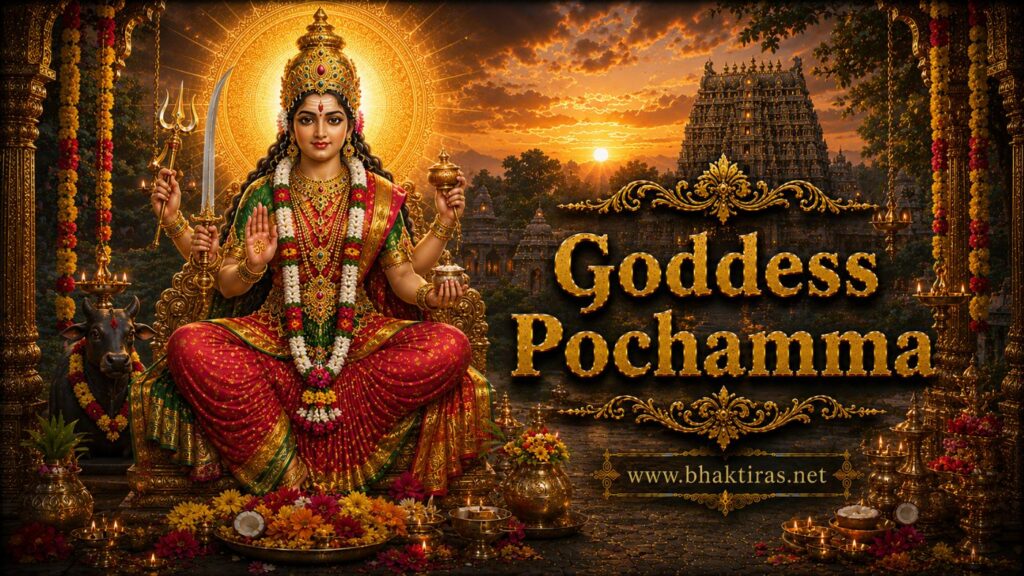
Who Is Goddess Pochamma?
Pochamma is one of the most loved village mothers of the Telugu-speaking heartland. In hundreds of hamlets across Telangana and parts of Andhra Pradesh, families turn to her first when a child falls sick, when the monsoon is late, or when the whole village needs looking after. She is not a distant sky deity but a close, motherly presence who lives at the edge of the village and keeps watch over everyone in it.
People understand her as a form of the great Mother, Shakti, taking a local shape so that ordinary villagers can reach her without priests, temples of stone, or Sanskrit ritual. Her name is often spoken with the affectionate word Talli, meaning mother, so she becomes Pochamma Talli – the mother who belongs to this place and these people.
Her worship is old and unbroken, passed down through generations of women who learned the songs and offerings from their own mothers and grandmothers. That living chain of faith is what keeps Pochamma at the centre of village life even today.
Guardian of the Village
Pochamma’s chief work is protection. In the memory of older generations she is above all the goddess who guards against smallpox, chickenpox, measles and other fevers that once swept through crowded villages. When such illness appeared, families would appeal to her not as a bringer of harm but as the mother who could cool the fever and lead the sickness back out of the door. Neem leaves and turmeric, both known for their cleansing and cooling qualities, became central to her worship for this reason.
Her care goes beyond disease. Villagers ask her for timely rain, healthy cattle, safe childbirth and a good harvest – the everyday needs on which rural life depends. This wide guardianship places her firmly within the Gramadevata tradition, the family of village deities who each protect a particular community and its land rather than the whole cosmos.
How Pochamma Is Worshipped
Worship of Pochamma is warm, communal and led largely by women. Her shrines are usually plain – a small platform, a carved stone or a simple idol, very often shaded by a neem tree that is itself treated as sacred. During festival days the whole neighbourhood gathers, and the air fills with drumming, folk song and the scent of turmeric.
The Bonam
The bonam is a decorated earthen or brass pot carried on the head, filled with cooked rice, jaggery, milk and curd, and topped with a small lamp and neem leaves. Women bring it in procession to Pochamma as a meal offered to the mother, a gesture of gratitude and of asking her to keep the household safe. The Bonalu festival takes its very name from this pot.
Neem and Turmeric
Fresh neem sprigs and a generous coating of turmeric are the signature marks of Pochamma worship. Turmeric water is sprinkled around the shrine and homes, and neem is worn, hung at doorways or laid before the goddess. Both carry the sense of purifying the body and the village and of drawing the goddess’s cooling, healing grace.
Village Shrine
Pochamma’s shrine sits close to daily life – near the village boundary, a tank, or a well-known neem tree. There is often no fixed roof or grand structure, which is part of the point: she is accessible to all, without gatekeepers. On Sundays and Tuesdays, and during jataras, devotees offer flowers, bangles, saris and simple food.
Why She Matters
Pochamma matters because she meets people exactly where they are. For families with little access to formal temples or costly ritual, she offers a direct line to the divine mother – a goddess who understands hunger, illness and worry, and who can be approached with a rice pot and an honest heart.
Her worship also binds communities together. A Pochamma festival is a shared effort in which neighbours cook, sing, walk and give thanks side by side, renewing the bonds of the village. And in the older layers of her tradition, her link with disease and healing reflects a folk wisdom that treated cleanliness, cooling herbs and collective care as protection. She remains a symbol of resilience and of the enduring faith of ordinary people.
Traditions and Living Practice
The mother who cools the fever
A well-loved folk understanding says that when illness enters a home, it is the goddess herself passing through, and the family’s task is to welcome her gently rather than fight her. Neem beds, turmeric baths and soft songs are offered so the mother is honoured and, satisfied, moves on – leaving the patient healed. This tender way of framing sickness turned fear into devotion and gave families a role of care rather than helplessness.
Vows kept at the neem tree
Many devotees still make a mokku, a vow to Pochamma, promising a bonam, new bangles or a small offering if she grants a wish – a child’s recovery, a safe delivery, a good crop. When the wish is fulfilled, the family returns to her neem-shaded shrine to keep the vow, often bringing the whole extended family. These repeated, personal exchanges are what keep her worship alive from one generation to the next.
Frequently Asked Questions
Who is Goddess Pochamma?
Pochamma is a village mother goddess (Gramadevata) worshipped mainly in Telangana and Andhra Pradesh. She is regarded as a form of Shakti who guards her community, protects against epidemics, and grants health, rain and prosperity.
What is Pochamma the goddess of?
She is associated with protection from disease – especially smallpox and chickenpox in older belief – as well as good health, timely rain, healthy cattle and safe childbirth. Her role is broadly that of a protective, life-sustaining village mother.
How is Pochamma worshipped?
Devotees, especially women, offer the bonam (a decorated pot of rice, jaggery and milk), turmeric and neem leaves at her shrine, often under a neem tree. The Bonalu festival and local jataras are the main occasions, marked by processions, folk songs and drumming.
Is Pochamma the same as Durga or Kali?
Pochamma is understood as a local form of the same universal Mother, Shakti, whom devotees also know as Durga or Kali. In practice she is a distinct village deity with her own shrines, offerings and folk traditions rooted in Telangana.
Why are neem and turmeric used in Pochamma worship?
Neem and turmeric are valued for their cooling and cleansing qualities and have long been linked to healing. In Pochamma worship they symbolise purifying the body and the village and inviting the goddess's soothing, protective grace.
May Pochamma Talli keep your home and village in health and peace.