
Goddess Mariamman
मारीअम्मन
Mariamman is the great mother goddess of South India, worshipped across Tamil Nadu, Karnataka and the Tamil diaspora as the village guardian. Her name joins Mari (rain) with Amman (mother). People turn to her for rain, fertility, protection and, above all, healing from pox, measles and fevers. She is the fierce yet caring mother of the village.
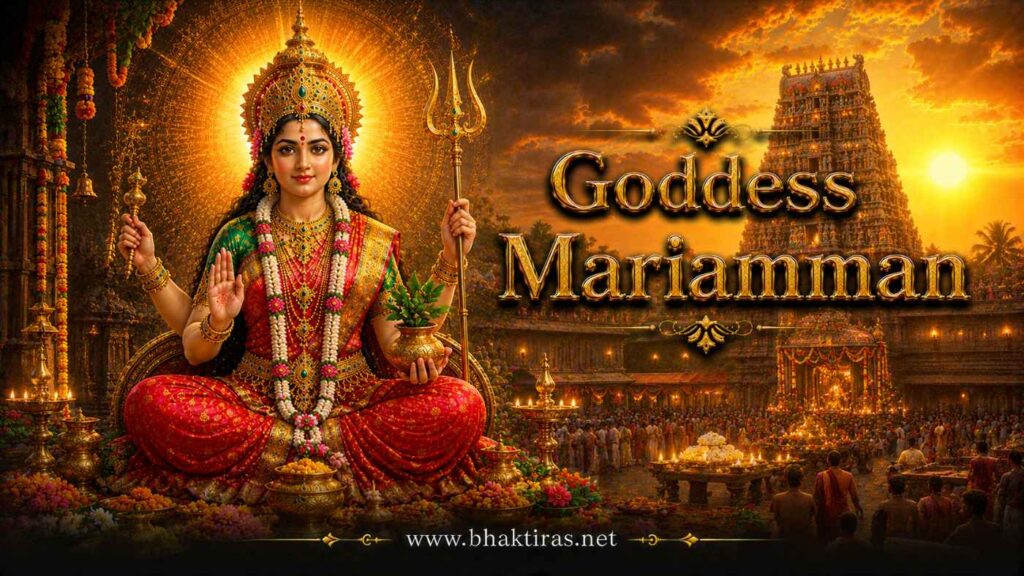
Who Is Goddess Mariamman
In the villages of the Tamil country, when the sky holds back its rain, when a child burns with fever, or when the crops need protection, people call on one mother above all – Mariamman. She is the amman, the mother, who sits at the edge of the village and watches over everything within it.Mariamman belongs to the family of grama devatas, the guardian goddesses who protect a single village or town rather than the whole cosmos. She is close, local, and personal. Farmers speak to her the way they would speak to their own mother – with respect, with fear when they have neglected her, and with deep affection. Her shrines are often simple: a raised platform under a neem tree, a red-smeared stone, a spear planted in the earth. Yet the devotion around her runs as deep as anything in the older temple traditions. Over centuries she has grown from a purely local mother into a goddess honoured across the South, from small hamlet shrines to the great temple at Samayapuram, and carried by Tamil families to Malaysia, Singapore, Fiji, South Africa and beyond. Wherever the Tamil diaspora settled, they built a home for their amman.The Mother of Rain and Healing
The oldest layer of Mariamman is written in her very name. Mari means rain, and Amman means mother – she is the mother who brings the rain. In a land that lived and died by the monsoon, a goddess who could open the clouds was the goddess who kept everyone alive.But rain and health are the same thing to a farming people. Water fills the tanks, feeds the paddy, and keeps the wells sweet; when it fails, hunger and sickness follow. So Mariamman became the mother of fertility and of the body’s health as much as of the fields. Her most tender and most misunderstood role is as the goddess of pox and fever. When smallpox, measles, chickenpox or a burning fever came to a village, people understood it as the goddess making herself felt in the body – her heat rising in the skin. And so they did not treat the illness as an enemy to be crushed. They cooled it, they soothed it, they honoured her. Neem leaves were laid on the patient, turmeric water was sprinkled, and the family prayed to the mother to be gentle. She was never a demon of disease. She was the healer-mother whose fever, treated with respect and cooling care, would pass and leave the child well again.Mariamman and Sheetala – North and South
Anyone who knows the goddesses of North India will feel a familiar presence in Mariamman. In the Gangetic plains, the mother who governs pox and fever is Sheetala Mata – her very name means the cool one, the goddess who cools the fever she sends. Mariamman is her southern sister.The two goddesses grew up in different languages and landscapes, yet they answer the same human need. Both are turned to when a child breaks out in pox. Both are cooled with the same logic – cooling foods, cooling leaves, cooling water – because the sickness is understood as heat that must be brought down gently rather than fought. Sheetala rides a donkey and carries a pot and a broom; Mariamman is more often shown fierce, with trident and lion, closer in mood to Durga and Kali. Yet the heart of the two is one: the mother who holds both the illness and the cure in her own hands, and who asks only to be remembered and honoured. To call Mariamman the Sheetala of the South is not to flatten either goddess, but to point to a shared and very old understanding – that healing is something you ask a mother for, not something you take by force.Neem, Turmeric and the Karagam
The worship of Mariamman is full of cooling, green, golden things. Every element of her rites carries the same message: bring down the heat, soothe the body, please the mother.Neem, the mother's leaf
Neem (vembu in Tamil) is Mariamman’s own tree and her own medicine. Its leaves are cooling and antiseptic, and folk healers have used them against skin eruptions for as long as anyone can remember. Devotees wear neem garlands, lay neem sprigs on the sick, and hang the branches at the door. In her temples the neem tree is often the goddess herself in living form.
Turmeric and kumkum
Turmeric, that healing golden root, is smeared on her image and given to devotees. It is antiseptic, auspicious, and the colour of the goddess. Women bathe in turmeric water on her days, and turmeric paste is offered along with red kumkum, the two colours – gold and red – that mark almost every Mariamman shrine.
The karagam pot
The karagam is a tall decorated pot, filled and crowned with neem and flowers, carried balanced on the head in a swaying dance. It holds the shakti of the goddess. Trained karagam dancers move through the streets during festivals, spinning and dipping without letting the pot fall – an act of devotion, skill and trance all at once.
Milk, water and cooling food
Pots of milk, pots of cool water, and simple cooling foods like pongal are offered to lower the goddess’s heat. During a pox season a family might pour cool water at her shrine and vow to keep the house calm and clean until the child recovers – practical care and prayer braided together.
The Festivals – Fire-Walking and the Aadi Month
Mariamman’s festivals, the thiruvizha, are among the most physical and heartfelt in South India. They are not quiet affairs. They fill the streets with drums, karagam dancers, processions and vows carried out in the flesh.The Tamil month of Aadi (roughly mid-July to mid-August) belongs to the amman. It falls just before the main harvest season and at the turn of the monsoon, and it is when villages gather to thank the mother and ask for her protection through the year ahead. During these festivals many devotees keep vows made in times of trouble – a promise given when a child was sick, or a field was failing. Some walk barefoot for miles. Some carry the karagam. And some walk across a bed of glowing embers in the fire-walking rite, timiti, having fasted and prayed and cooled themselves for days beforehand. The fire-walk is an act of surrender and trust: the devotee places their body in the mother’s hands, believing her cooling grace will carry them across unharmed. Onlookers pour milk and water, the drums build, and the whole village becomes one voice calling her name. Beneath the intensity is something simple and human – people showing the mother, with their own bodies, how far their gratitude and faith will go.Famous Temples of Mariamman
Though her true home is the neem tree at the village edge, Mariamman is also honoured in great temples that draw pilgrims from across the South and beyond.The Samayapuram Mariamman temple, a little north of Tiruchirappalli (Trichy) on the banks of the Kaveri, is perhaps her most famous seat. Its goddess is loved especially as a healer, and the sick and troubled come here in great numbers, offering pots of milk and small metal images of the body parts they hope she will mend. Her annual festival draws enormous crowds who walk the roads to reach her. The Punnainallur Mariamman temple near Thanjavur is another cherished shrine, its origins tied to a devotee who is said to have found the goddess in an anthill in a forest of punnai trees, from which the place takes its name. Beyond these, countless Mariamman temples dot Tamil Nadu and Karnataka, and the diaspora built grand ones far from home – the Sri Mariamman temples of Singapore and Kuala Lumpur among them. Whether it is a roadside stone or a temple with a towering gateway, the mother answers to the same name, and her children come with the same trust.Iconography & Symbols
The red-clad mother
Mariamman is most often shown as a seated or standing mother in red, her face calm but powerful, sometimes many-armed. Red is the colour of shakti and of the goddess’s protective heat, and her images are frequently smeared with red kumkum and golden turmeric.
Trident and drum
She carries the trishula, the three-pronged spear that marks her kinship with Shiva’s family and with Durga, and often a damaru, the small hourglass drum whose beat is the pulse of creation. The spear is planted at many of her simplest shrines as her living emblem.
The lion mount
Like Durga, Mariamman is linked with the lion as her vahana, a sign of fearless royal power. It shows that the gentle village mother is also a warrior who can meet any danger that threatens her children.
Neem, pot and snake
The neem tree, the karagam pot, and sometimes a serpent appear around her – each a symbol of cooling, of shakti held in a vessel, and of the earth’s fertile, healing power. Together they tell you at a glance whose shrine you are standing before.
How Goddess Mariamman Is Worshipped
Worship of Mariamman is warm, direct and often at home in the open air. Here are the ways devotees honour her:- Visit her shrine on Tuesdays and Fridays, her special days, with turmeric, kumkum and flowers.
- Offer neem leaves and garlands, hanging them at the door or laying them on anyone who is unwell.
- Light a lamp and offer cooling foods – pongal, milk, tender coconut and cool water – to soothe the mother.
- Bathe in turmeric water and wear yellow or red on her days as a sign of devotion and purity.
- Carry the karagam pot or join the procession during the Aadi month festivals if you have made a vow.
- Keep vows made in hard times – a barefoot walk, a fire-walk, or a simple offering – as thanks for her help.
- During a pox or fever, keep the house calm, cool and clean, and pray to the mother for a gentle recovery.
Prayers & Mantras
Her mantras are short and easy to hold in the heart, meant to be repeated at her shrine, at the lamp, or beside a sickbed.A simple and beloved prayer is: ॐ श्री मारीअम्मने नमः (Om Shri Mariammane Namah) – Salutations to the revered mother Mariamman. Repeated with a steady mind, it calls her cooling, protective presence near. Devotees also simply cry out her name – Amma, Mariamma – trusting that a mother always turns when her child calls.Frequently Asked Questions about Goddess Mariamman
Who is Goddess Mariamman?
Mariamman is the mother goddess of South India, a grama devata or village guardian worshipped across Tamil Nadu, Karnataka and the Tamil diaspora. Her name means rain mother. She is prayed to for rain, fertility, protection and healing from pox and fevers, and is loved as a fierce yet caring mother.
Is Mariamman the same as Sheetala?
They are close sisters, not identical. Sheetala is the northern goddess of pox and fever, and Mariamman is her southern counterpart. Both govern and cure the same illnesses and are soothed with cooling worship. Their forms and stories differ, but their role as the mother of healing is shared.
Why is neem used in her worship?
Neem, called vembu in Tamil, is Mariamman's sacred tree. Its leaves are cooling and antiseptic and have long been used against pox and skin illness. Devotees wear neem garlands, lay the leaves on the sick, and honour the tree as the goddess herself, since it embodies her cooling, healing grace.
Why is Mariamman linked with disease?
In folk understanding, illnesses like pox and fever were seen as the goddess making her heat felt in the body. She is not a bringer of harm but a healer-mother: treated with respect and cooling care, her fever passes and the child recovers. People honour her to ask for a gentle and swift healing.
What is the karagam and fire-walking?
The karagam is a decorated pot holding the goddess's shakti, balanced on the head in a swaying dance during festivals. Fire-walking, or timiti, is a vow in which devotees walk across glowing embers after days of fasting and prayer, trusting the mother's cooling grace to carry them safely across.
Which are the most famous Mariamman temples?
The Samayapuram Mariamman temple near Tiruchirappalli is her most renowned seat, loved as a place of healing. Punnainallur near Thanjavur is another cherished shrine. Countless temples across Tamil Nadu and Karnataka, and grand ones built by the diaspora in Singapore and Malaysia, also honour her.
When is Mariamman worshipped?
Tuesdays and Fridays are her special weekly days. Her great festivals fall in the Tamil month of Aadi, around mid-July to mid-August, just before harvest and at the turn of the monsoon. These thiruvizha bring processions, karagam dancing and fire-walking, as villages thank and honour the mother.
May the rain mother keep your fields green, your children well, and your home cool and safe. Om Shri Mariammane Namah.