
Sri Muthappan
മുത്തപ്പൻ
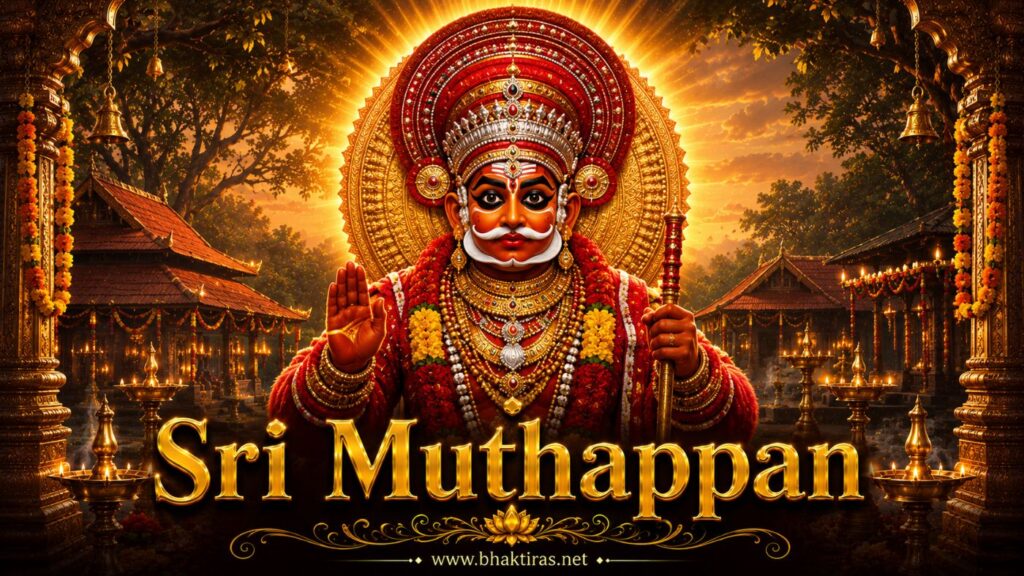
Sri Muthappan is a much-loved folk god of North Malabar in Kerala, worshipped through the living ritual theatre of Theyyam. Seen as a hunter-deity who blends the qualities of Vishnu and Shiva, he stands with the poor and the common folk, and his home shrine sits at Parassinikadavu near Kannur.
Who Is Sri Muthappan?
Muthappan is the guardian god of ordinary people across the northern Malabar coast of Kerala. Farmers, fishermen, toddy tappers and daily-wage workers turn to him first when life turns hard, and they speak of him not with distant awe but with the warm familiarity of a father who understands their troubles.
What sets him apart is the shape of his worship. He is not a temple idol hidden behind priestly ritual and food restrictions. He comes to his devotees in person, dancing as a Theyyam, speaking to them, listening to their worries and blessing them face to face. In his presence there is no high or low, and that promise of dignity is a large part of why people love him.
Devotees understand Muthappan as carrying two divine natures at once – the calm, protective side linked with Vishnu and the wild, untamed side linked with Shiva. He is a hunter who roams the forests, a friend of the poor, and a god who chose the company of common folk over the comfort of the wealthy.
Muthappan Theyyam
Theyyam is a sacred dance-worship of North Malabar in which a trained performer, after long preparation and prayer, becomes the living vessel of the god. When the drums rise and the costume is complete, devotees no longer see a man but Muthappan himself, moving and blessing among them. Muthappan appears in two joined forms during this ritual. Thiruvappana carries his Vishnu-like aspect, gentle and giving, while Vellatom carries his Shiva-like aspect, fierce and free. The two together tell his full story in a single night of performance. At Parassinikadavu the Theyyam is not reserved for one yearly festival – it is offered almost every day, so a devotee can arrive on an ordinary morning and still receive a direct word and blessing from the god. This daily nearness is unusual and is one reason pilgrims travel from far to stand before him.
Symbols and Character
Muthappan is pictured as a rugged forest hunter, and every emblem tied to him carries that plain, earthy character.
The Hunter
He roams the wooded hills as a hunter, dressed simply, at ease among trees and streams rather than in gilded halls. This forest-wandering image speaks to people who work the land and know the outdoors.
Bow and Arrow
His bow and arrow are his constant companions, marks of a god who provides and protects by his own effort. They also signal readiness to defend the weak against anyone who would wrong them.
God of the People
Toddy, dried fish and boiled gram are offered to him because they are the honest food and drink of working folk. A god who accepts these gifts is a god who sits among his devotees, not above them.
Worship and the Parassinikadavu Shrine
The heart of Muthappan worship is the Parassinikadavu Muthappan Temple, set beside the Valapattanam river near Kannur. Here the near-daily Theyyam draws a steady stream of devotees who come to watch the god dance and to receive his direct blessing. The offerings reflect his down-to-earth nature – toddy, fish, boiled gram (payankutti) and tea are given and shared, and every visitor is fed regardless of who they are or where they come from. From its early days the shrine has welcomed worshippers without caste barriers, treating rich and poor, high-born and humble as equal children of the god. That open door, along with the promise of a personal audience with the deity, gives the place a warmth that many pilgrims remember long after they leave.
Legends of Muthappan
The foundling by the pond
The best-loved story tells of a childless couple of the Ayyankara household who longed for a son. One day the wife found a radiant infant lying near a pond and raised him with joy. As the boy grew he behaved in ways no ordinary child would – he took to hunting, shared food and drink with the poor and the forest folk, and cared nothing for rules that divided people. When his true divine nature finally shone forth, his foster parents understood they had been given a god to raise, and the boy became Muthappan, the elder one worshipped by all.
The toddy and the archer
Another well-known tale describes Muthappan wandering as a hunter and befriending a toddy tapper. When the tapper found his pots mysteriously drained day after day, he lay in wait and shot an arrow toward the thief – only to discover it was the god himself, delighting in the simple drink of the working man. Moved by the tapper’s honesty and courage, Muthappan blessed him, and toddy became one of the god’s own offerings, a lasting sign that he honours the labour and life of common people.
Frequently Asked Questions
Who is Muthappan and which region worships him?
Muthappan is a folk god of North Malabar in Kerala, especially around Kannur. He is worshipped through the Theyyam ritual and is regarded as a protector of ordinary people, blending aspects of Vishnu and Shiva.
What are the two forms of Muthappan?
During the Theyyam ritual he appears as Thiruvappana, his gentle Vishnu-like form, and as Vellatom, his fierce Shiva-like form. Together the two present his complete character in a single performance.
Where is the main Muthappan temple?
The main shrine is the Parassinikadavu Muthappan Temple, beside the Valapattanam river near Kannur, where the Theyyam is performed on an almost daily basis.
What offerings are made to Muthappan?
Devotees offer toddy, dried fish, boiled gram (payankutti) and tea. These humble foods reflect his identity as a god of working folk, and prasadam is freely shared with everyone present.
Why is Muthappan worship said to have no caste barriers?
From its beginnings the tradition welcomed all devotees as equals, regardless of caste or standing. The god himself is remembered as one who chose the company of the poor, so his worship carries that spirit of openness.
May Sri Muthappan walk with the humble and guard every honest home.