
Kuladevata – The Family Ancestral Deity
कुलदेवता
A Kuladevata is the hereditary deity of a family or clan in Hindu tradition, passed down through generations as its ancestral protector. Each family has its own specific god or goddess to whom key life rituals – weddings, naming ceremonies, first offerings, and vows – are dedicated, keeping the lineage bound to a shared guardian across time.
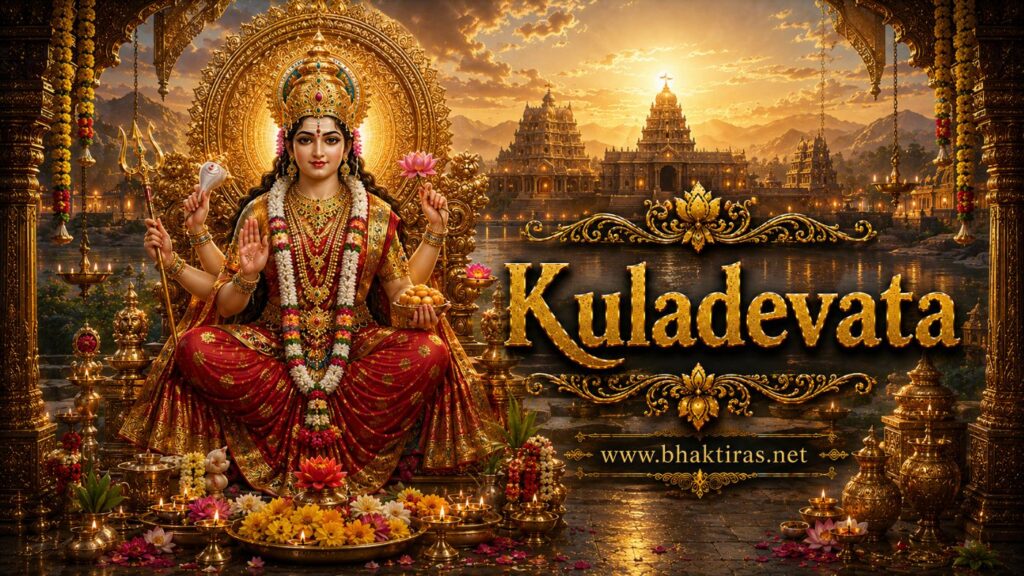
What Is a Kuladevata?
A Kuladevata is the deity a family has worshipped for generations as its own protector. The word joins kula (family, clan, or lineage) with devata (deity), and it names something very specific – not a god everyone worships, but the particular god or goddess handed down through your own bloodline. Two neighbours may follow the same broad faith yet answer to entirely different family deities, each inherited from their ancestors.
The Kuladevata is fixed by lineage, not by choice or location. A family carries the same deity even after it scatters across cities and countries, and the connection passes from parents to children the way a surname does. When the family gathers for its most important moments – a wedding, the naming of a newborn, the first grains of a harvest, the fulfilment of a long-held vow – it is the Kuladevata who is invoked first and thanked at the end.
A Kuladevata may be male, called Kuladeva, or female, called Kuladevi, and in many families a goddess holds this place. Across Maharashtra, Karnataka, and much of India, knowing and honouring your family deity is treated as a core part of who you are – which is why so many people go to real lengths to trace a Kuladevata that an earlier generation lost touch with.
Kuladeva and Kuladevi
A family deity can take a male or a female form, and both carry the same weight – the guardian of the lineage. The examples below are family deities for particular clans, not universal choices; another family may hold a completely different one.
Kuladevi – the family goddess
For a great many families, especially in Maharashtra and the Deccan, the ancestral deity is a goddess. Tuljabhavani of Tuljapur and Renuka of Mahur are among the most widely held Kuladevis, and families invoke them at weddings, name-givings, and in vows made during hard times. The goddess is treated as the mother of the whole lineage.
Kuladeva – the family god
Other families trace their guardian to a male deity, the Kuladeva. Khandoba, the folk form of Shiva revered across Maharashtra and Karnataka, is a well-known family god, as is Balaji (Venkateshwara) for many households. The Kuladeva is honoured at the same life rituals and at the family’s periodic pilgrimage to his principal shrine.
Kuladevata and Ishta Devata
These are related but distinct. The Kuladevata is inherited – you are born into its worship. The Ishta Devata is the personal deity a person chooses for their own devotion and inner practice. A woman may cherish an Ishta Devata of her own heart while still honouring the Kuladevata her family has kept for generations; the two do not compete.
How Families Identify or Rediscover Their Kuladevata
Many families, after generations in cities or after migration, no longer remember which deity was theirs. Rediscovering a Kuladevata is a common and very practical undertaking, and there are established ways to go about it.
The first and best source is the family itself – the oldest living relatives. Grandparents, granduncles and grandaunts often remember the deity’s name, the temple town, or the rituals performed at their own weddings. Old wedding invitations, ritual records, and photographs sometimes name the deity or its shrine directly. Ask specifically which temple the family visited after a marriage or a birth, since that first post-ritual pilgrimage is almost always to the Kuladevata.
Where family memory has faded, other trails help. Traditional priests and genealogy keepers – such as the pandas and record-keepers at pilgrimage centres who maintain family registers – can hold lineage records going back many generations. The family’s native village or region, gotra, and community traditions narrow the field considerably, since certain deities are strongly associated with particular clans and areas. When several sources point to the same deity and temple, families usually treat that as confirmation and resume worship with a first visit to the shrine.
Role in Weddings and Life Rituals
The Kuladevata is not worshipped only on festival days; it is woven into the turning points of family life. A wedding, in many traditions, is considered incomplete until the couple pays respects to the family deity – some families invoke the Kuladevata before the ceremony, and many make a pilgrimage to its temple soon after the marriage to seek blessings for the new household.
The same holds for other milestones. A newborn is often taken to the family shrine, or the deity is invoked at the naming ceremony, to place the child under ancestral protection from the start. First offerings after a harvest or a new venture, thanksgiving after recovery from illness, and vows made in difficult seasons are all directed to the Kuladevata. Because these rituals repeat with every generation, the family deity becomes the thread that ties grandparents, parents, and children into one continuous line – each new member formally introduced to the guardian the family has always kept.
Traditions and Living Practice
The pilgrimage after a wedding
In many Maharashtrian and Kannada families, the first journey a newly married couple makes together is to the Kuladevata’s temple. Dressed in their wedding finery, they offer the customary gifts, have the deity’s blessing invoked over the marriage, and often perform a small ritual of thanks. The trip formally welcomes the bride into the groom’s lineage and its guardian, and folds the new family into a practice their ancestors followed in the same temple.
Reviving a forgotten deity
It is common now for a family that lost its link to sit with the eldest relatives, piece together the temple town and the deity’s name from old memories and wedding records, and make a first pilgrimage to resume the worship. Families describe this return as setting something right – restoring a thread the earlier generations had let slip, and handing it on again to their own children.
Frequently Asked Questions
What is a Kuladevata?
A Kuladevata is the hereditary deity of a family or clan, passed down through generations as its ancestral protector. Each family has its own specific god (Kuladeva) or goddess (Kuladevi) to whom important life rituals such as weddings and naming ceremonies are dedicated.
How do I find my Kuladevata?
Start with the oldest living relatives, who often remember the deity's name or temple town. Old wedding invitations and ritual records, the temple visited after a family marriage, and lineage registers kept by traditional priests at pilgrimage centres all help. Your native region, community, and gotra narrow it further. When several sources agree on the same deity and shrine, families treat that as confirmed.
What is the difference between a Kuladevata and a Gramadevata?
A Kuladevata protects a family or clan and is inherited by lineage, so you carry it wherever you live. A Gramadevata protects a place – a whole village and everyone in it – and is shared by all who live there. One follows your bloodline; the other follows your address.
Is a Kuladevata the same as an Ishta Devata?
No, though they are related. A Kuladevata is inherited – you are born into its worship as part of your family. An Ishta Devata is the personal deity a person chooses for their own devotion. A person can honour both: the family guardian and a chosen deity of the heart.
Can a Kuladevata be a goddess?
Yes. A family deity can be male (Kuladeva) or female (Kuladevi), and for a great many families – especially in Maharashtra and the Deccan – the ancestral deity is a goddess such as Tuljabhavani or Renuka.
Knowing your Kuladevata is knowing where your family has always turned – a guardian handed down, and handed on again to the next generation.