
Kali Puja 2026 – The Midnight Worship of the Dark Goddess
काली पूजा
When is Kali Puja in 2026?
Kali Puja 2026 falls on Sunday, 8 November, on the new-moon night (Kartik Amavasya) that coincides with Diwali. The main worship happens after dark, peaking during the midnight Nishita Kaal window (roughly 11:39 PM to 12:31 AM). It is the biggest festival of the year across West Bengal, Assam, Odisha and Tripura, where devotees honour Goddess Kali instead of lighting lamps for Lakshmi.
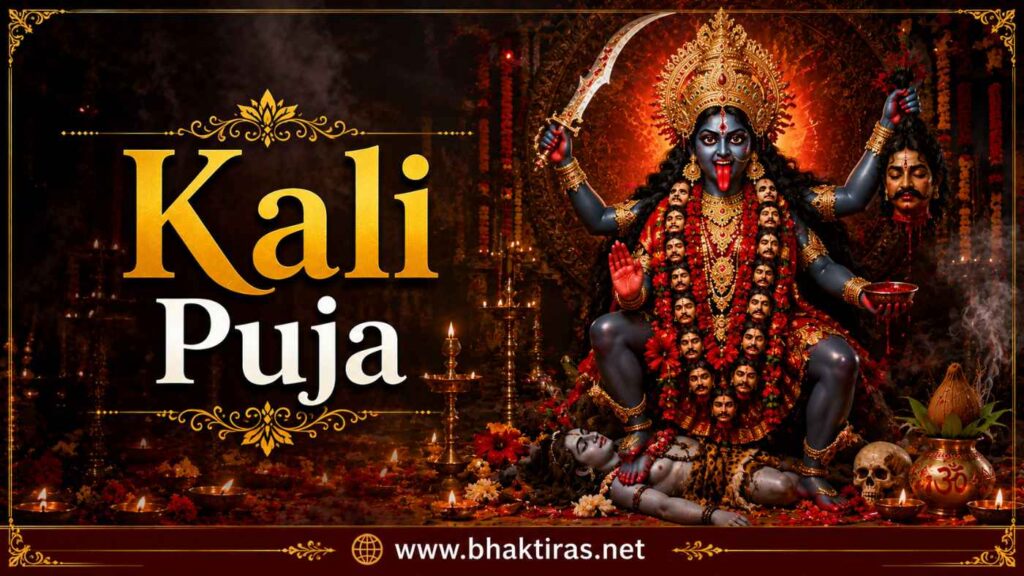
Kali Puja is the night Bengal turns to the fierce dark goddess. Held on Kartik Amavasya, the pitch-black new moon that also marks Diwali, it is the largest festival after Durga Puja across West Bengal, Assam, Odisha and Tripura. While much of India lights lamps for Lakshmi, here clay idols of Kali are installed in lamp-lit pandals and worshipped through the small hours, with the most charged moment falling at midnight. Red hibiscus, sweets and all-night vigils mark a worship that is equal parts tender and terrifying.
Kali Puja 2026-2028: Dates & Calendar
Kali Puja 2026 is on Sunday, 8 November. The date shifts each year because it follows the lunar new moon (Amavasya) of the month of Kartik, so it lands in late October or November.
| Year | Date | Day | Tithi |
|---|---|---|---|
| 2025 | 20 October | Monday | Kartik Amavasya |
| 2026 | 8 November | Sunday | Kartik Amavasya (next) |
| 2027 | 28 October | Thursday | Kartik Amavasya |
| 2028 | 17 October | Tuesday | Kartik Amavasya |
In 2026 the midnight Nishita Kaal, the most auspicious slot for the main puja, runs roughly from 11:39 PM on 8 November to 12:31 AM on 9 November. Confirm exact timings against a local panchang, since they change with your city.
Why Kali Puja Is Celebrated
Kali Puja honours Goddess Kali as the Adya Shakti, the primal energy who destroys evil, arrogance and the ego that keeps a devotee bound. It is held on the darkest night of the year because Kali is worshipped as the light that shines even when there is none.
The rest of the country lights Diwali lamps for Lakshmi and prosperity on this same new moon. Bengal, Assam, Odisha and Tripura turn instead to the mother in her fierce form, asking not for wealth but for protection, courage and freedom from fear. Both worships share the night; the focus is simply different.
Two streams meet in this festival. The Tantric tradition sees Kali as the ultimate reality beyond form, worshipped at night with intense, disciplined rites. The Bhakti tradition, carried into homes and public pandals, approaches her as a loving mother whose frightening appearance hides infinite tenderness for her children.
The mother behind the fierce face
Kali looks terrifying, yet devotees address her as Ma, mother. Her dark form and battlefield imagery represent the destruction of evil and the dissolving of the ego, not cruelty. Worshippers believe she guards those who surrender to her with a fierceness reserved for a mother protecting her child.
Worship at the darkest hour
The main puja is performed at night, peaking during the midnight Nishita Kaal. The new-moon darkness is not something to fear here; it is the setting in which Kali’s presence is felt most strongly, which is why lamps, incense and chanting fill pandals through the small hours.
Ramakrishna and Dakshineswar
The 19th-century saint Sri Ramakrishna Paramhansa served as priest at the Dakshineswar Kali Temple near Kolkata, where his intense devotion to Ma Bhavatarini shaped how many Bengalis relate to the goddess. His life gave the worship of Kali a deeply personal, loving character that endures in the region today.
Deities & Figures Worshipped
The festival is dedicated to Goddess Kali, also called Shyama (the dark one) and revered as Adya Shakti, the first energy from which creation unfolds. Her consort Shiva is present in the imagery, lying calm beneath her feet.
Kali (Shyama)
Kali is depicted with dark or black skin, standing on the reclining body of Shiva, wearing a garland of severed heads and a skirt of arms, with her tongue drawn out. Each element carries meaning: her darkness is the formless infinite, the heads are the ego and negative tendencies she cuts away, and her tongue is often read as a gesture of restraint on realising she stands over her own lord. She is worshipped as the mother who removes fear and grants liberation.
Shiva
Shiva lies still beneath Kali’s feet, the calm, unmoving consciousness on which her dynamic power dances. His presence balances her fierceness and reminds devotees that energy (Shakti) and consciousness (Shiva) are inseparable. He is not a lesser figure here but the ground of the whole vision.
Lakshmi (elsewhere the same night)
On this same Amavasya night, most of India worships Lakshmi for wealth and light as part of Diwali. Understanding this contrast helps explain Kali Puja: it is the same date and lunar moment, but Bengal chooses the fierce protective mother over the goddess of fortune.
Key Rituals, Step by Step
Kali Puja is largely a night-time observance, moving from the installation of the idol in the evening to the charged midnight worship and an immersion the following day.
- Set up the pandal and idol. Communities build temporary pandals, some plain and devotional, others elaborate and themed, and install a clay idol of Kali crafted by local artisans, often from the potters’ quarter of Kumartuli in Kolkata.
- Purify and invoke. The priest cleanses the space, performs the pran pratishtha to invite the goddess into the idol, and lights lamps and incense. Homes set up smaller shrines and do the same on a modest scale.
- Offer red hibiscus and flowers. Devotees present red hibiscus, which is especially sacred to Kali, along with other flowers, vermilion, sweets and fruit. Some traditional and Tantric lineages include their own specific offerings performed by trained priests.
- Perform the midnight Nishita puja. The heart of the observance is the worship during the Nishita Kaal around midnight, when mantras are chanted, the aarti is offered and the goddess’s presence is believed to be strongest.
- Keep the all-night vigil (jagran). Devotees stay awake through the night, singing devotional songs, chanting and taking part in the worship, since staying alert in the goddess’s presence is part of the observance.
- Distribute bhog and prasad. Food offered to the goddess, often khichuri and sweets, is shared as prasad among devotees and visitors, and pandals open to the public through the night.
- Immerse the idol. On the day after the puja the idol is carried in a procession and immersed in a river, pond or the sea, marking the goddess’s return and the close of the festival.
Special Foods of Kali Puja
Food offered to Kali is shared as bhog and prasad, ranging from simple vegetarian fare to preparations specific to certain temple and family traditions.
Khichuri bhog
A comforting one-pot dish of rice and lentils cooked with spices, often served with fried vegetables, a mixed curry (labra) and chutney. It is the most common bhog offered at pandals and shared warm with the crowd.
Bengali sweets
Sandesh, rosogolla, malpua and payesh (a rice-and-milk pudding) are offered to the goddess and passed around as prasad. Sweets are central to almost every Bengali festival, and Kali Puja is no exception.
Seasonal fruit and offerings
Bananas, coconut and other seasonal fruit are laid before the idol along with sweets. The autumn timing means fresh harvest produce features in many household offerings.
Traditional lineage offerings
Some traditional and Tantric lineages, and certain old temples, follow their own prescribed offerings carried out by trained priests. These vary by temple and family custom and are not part of ordinary home worship.
Regional Names & Variations
Kali Puja is strongest in the eastern states, where it overshadows the Lakshmi-focused Diwali of the north and west, but it takes on a local character in each region.
Kolkata & West Bengal
The festival reaches its peak in Kolkata, with grand public pandals, artistic idols from Kumartuli and huge crowds moving between them all night. The Dakshineswar Kali Temple and the Kalighat temple, one of the 51 Shakti Peethas, draw enormous numbers of devotees.
Assam
Kali Puja is widely observed across Assam, held on the same Kartik Amavasya night alongside Diwali celebrations. Temples and community pandals mark the night with worship of the goddess and lamp-lighting.
Odisha
In Odisha the new-moon night is observed with worship of Kali at temples and household shrines, blending the goddess-centred tradition of the east with the wider Diwali observance.
Tripura
Kali Puja is a major festival in Tripura, where the Tripura Sundari temple and other shrines see large gatherings. The state’s strong Shakta tradition makes this one of its most important nights of the year.
Kali Puja Do's and Don'ts
A few simple points help you observe the night respectfully, whether at home or visiting a pandal.
Do
- Offer red hibiscus flowers, which are especially dear to Kali.
- Keep the main worship for the night, ideally around the midnight Nishita Kaal.
- Light lamps and keep the shrine clean and calm.
- Approach the goddess as Ma, the protective mother, with sincerity.
- Share bhog and prasad with family, neighbours and visitors.
Avoid
- Do not treat the fierce imagery as something to fear or mock; it is symbolic.
- Avoid rushing the puja; the night vigil is part of the observance.
- Do not attempt Tantric rites yourself; leave those to trained priests.
- Avoid confusing it with Lakshmi Puja; the focus here is Kali.
- Do not skip the respectful immersion if you install a home idol.
Frequently Asked Questions
When is Kali Puja in 2026?
Kali Puja 2026 falls on Sunday, 8 November, on the Kartik Amavasya new-moon night that coincides with Diwali. The main worship is performed after dark, peaking during the midnight Nishita Kaal, roughly 11:39 PM to 12:31 AM. It is the biggest festival of the year in West Bengal and much of eastern India.
When is Kali Puja in 2027 and 2028?
Kali Puja 2027 falls on Thursday, 28 October, and Kali Puja 2028 falls on Tuesday, 17 October. The date moves each year because it follows the lunar Kartik Amavasya, which can land in late October or in November.
Why is Kali Puja celebrated?
Kali Puja is celebrated to honour Goddess Kali as the Adya Shakti, the primal energy who destroys evil, arrogance and the ego. It is held on the darkest night of the year because devotees see her as the light and protection that remain even in total darkness. In eastern India she is worshipped as a fierce yet loving mother who removes fear.
How is Kali Puja related to Diwali?
Kali Puja falls on the very same new-moon night as Diwali (Kartik Amavasya). While most of India lights lamps for Goddess Lakshmi and prosperity that night, West Bengal, Assam, Odisha and Tripura worship Goddess Kali for protection and strength instead. It is the same lunar date with a different deity as the focus.
Which goddess is worshipped on Kali Puja?
Kali Puja is dedicated to Goddess Kali, also known as Shyama and revered as Adya Shakti. She is depicted with dark skin, standing on Shiva, wearing a garland of heads with her tongue out, imagery that represents the destruction of ego and evil. Despite the fierce form, she is worshipped as a protective mother.
What is Nishita Kaal in Kali Puja?
Nishita Kaal is the midnight window during which the main Kali Puja is performed, believed to be when the goddess’s energy is at its peak. In 2026 it runs roughly from 11:39 PM on 8 November to 12:31 AM on 9 November. The exact timing shifts by year and city, so it is best confirmed against a local panchang.
Is Kali Puja the same as Naraka Chaturdashi?
No, they are close but distinct. Naraka Chaturdashi (Choti Diwali) falls on the fourteenth lunar day just before the new moon, while Kali Puja is held on the Amavasya new-moon night itself. Some traditions also mark Kali Chaudas around the same time, but the main Bengali Kali Puja is the midnight Amavasya worship.
Where is Kali Puja celebrated most grandly?
Kali Puja is celebrated most grandly in Kolkata and across West Bengal, with elaborate public pandals and artistic clay idols. The Dakshineswar Kali Temple, linked to Sri Ramakrishna, and the Kalighat temple, one of the 51 Shakti Peethas, draw the largest crowds. Assam, Odisha and Tripura also observe it on a major scale.
May Ma Kali watch over your home this new-moon night and clear the path ahead. Shubho Kali Pujo.