
Jagaddhatri Puja 2026 – The Serene Mother Who Bears the World
जगद्धात्री पूजा
When is Jagaddhatri Puja in 2026?
Jagaddhatri Puja falls on Wednesday, 18 November 2026, on the Navami (ninth day) of the bright fortnight of Kartik. The main worship is on Navami, though Chandannagar and Krishnanagar in West Bengal keep the celebration going across roughly four days, from Saptami to Dashami.
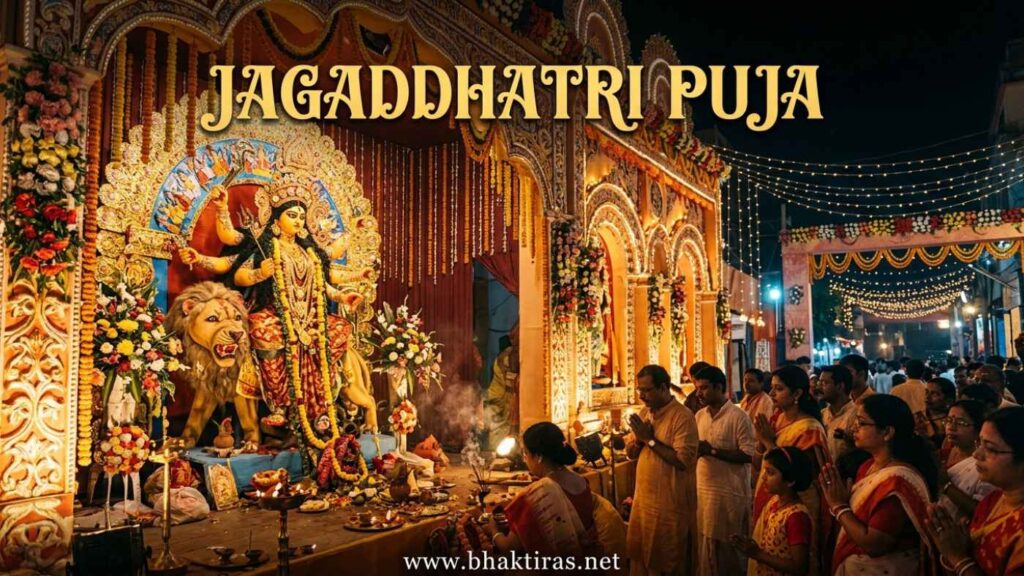
Jagaddhatri Puja honours a calm, golden form of the Mother Goddess who sits upright on a lion, one foot pressing down a fallen elephant demon. Her name means the one who holds and sustains the whole world. Celebrated mainly across West Bengal on the Navami of Kartik’s bright fortnight, in 2026 it falls on 18 November. The two towns that made it famous are Chandannagar, known for its towering idols and electric illumination, and Krishnanagar in Nadia, where the public worship is said to have begun.
Jagaddhatri Puja 2026-2028: Dates & Calendar
The next Jagaddhatri Puja is on 18 November 2026. Because the festival follows the lunar Kartik month, the English date shifts by a few days each year.
| Year | Navami (main day) | Day | Notes |
|---|---|---|---|
| 2026 | 18 November | Wednesday | Next occurrence; Chandannagar keeps Saptami to Dashami |
| 2027 | 7 November | Sunday | Kartik Shukla Navami |
| 2028 | 26 October | Thursday | Falls earlier as the lunar month shifts |
In practice the celebration is not a single day. Chandannagar and Krishnanagar open pandals and begin worship on Saptami, reach the peak on Navami, and end with immersion on Dashami. In 2026 that window runs roughly from 16 to 20 November.
Why Jagaddhatri Puja Is Celebrated
Jagaddhatri Puja celebrates the goddess as the sustainer of creation, worshipped for her serene power rather than her fury. It also marks a devotional and civic tradition tied to Nadia’s royal court in the 18th century.
In the Shakta tradition Jagaddhatri is a form of Durga, but her mood is different. Where Durga is caught mid-battle, Jagaddhatri is shown after the fight is won, seated calmly, holding the world in balance. She is often linked to a passage in the Chandi where the gods are humbled by a mysterious presence they cannot overpower, teaching them that all their strength flows from the Mother.
There is a quiet moral built into her image. The elephant she has defeated, Karindrasura, is read as the swollen ego, and the lion she rides is disciplined devotion. Taming the elephant is taming the puffed-up self. This is why many devotees describe her worship as a lesson in humility more than a victory celebration.
The sustainer of the world
Jagaddhatri means the one who bears and holds the universe. She is worshipped as the force that keeps creation steady, which is why her puja carries a tone of gratitude and calm rather than dramatic combat.
Taming the elephant of ego
The demon Karindrasura takes an elephant form, and the elephant is understood as unchecked pride. The goddess subduing it is a reminder to keep the ego in check; devotion, shown as her lion, is what puts pride in its place.
Raja Krishnachandra and Nadia
Public Jagaddhatri Puja is traditionally traced to Raja Krishnachandra Roy of Krishnanagar in the 18th century. Indranarayan Choudhury of Chandannagar is credited with popularising it there, and both towns turned it into a community festival.
A festival with its own identity
Coming a few weeks after Durga Puja and Kali Puja, Jagaddhatri Puja is not a repeat of them. Its serene iconography, the Kartik timing, and the Chandannagar illumination give it a distinct place in the Bengali festival calendar.
Deities & Figures Worshipped
The single presiding deity is Jagaddhatri, a serene form of Durga. Her iconography is precise and carries layers of meaning.
Jagaddhatri
She is shown golden-hued and youthful, with four arms carrying a conch, discus, bow and arrow. She sits upright on a lion, and beneath the lion lies the slain elephant demon Karindrasura. Her posture is composed, not fierce.
The three eyes
Like other forms of the Devi, Jagaddhatri has three eyes, representing the sun, the moon and fire, or past, present and future. The third eye marks her as an all-seeing power who perceives beyond ordinary sight.
The naga sacred thread
A distinctive detail is her sacred thread, or upavita, worn not as ordinary cord but as a serpent, the naga-yajnopavita. This snake-thread sets her apart from Durga and signals her yogic, ascetic dimension.
Key Rituals, Step by Step
The worship unfolds over roughly four days, from Saptami to Dashami, with the fullest rites on Navami. Here is how the celebration typically moves.
- Idol making and installation. In the weeks before, clay idols are sculpted, some rising several storeys in Chandannagar. On Saptami the deity is installed in the pandal and given life through the pran pratishtha ritual.
- Saptami and Ashtami worship. The first two days carry preliminary puja, offerings and aarti. Priests recite from the Chandi, and devotees visit pandals through the day and into the night.
- Navami, the main worship. On Navami the goddess receives her fullest offerings of flowers, fruit and cooked bhog. Many households and pandals perform all three phases of worship, sometimes compressing the Durga Puja’s three days into this one day.
- Sandhi puja. As in Durga Puja, a special sandhi puja is offered at the junction of two tithis, a charged moment believed to be when the goddess’s power is at its height.
- Bhog and distribution. Cooked offerings such as khichuri and vegetable dishes are presented to the goddess and then shared as prasad among devotees and visitors.
- Chandannagar illumination. After dark the famous aloksojja switches on. Skilled light artists turn whole streets into animated tableaux, drawing crowds who tour the pandals late into the night.
- The processions. On Dashami the idols are carried out in long, brightly lit processions through Chandannagar and Krishnanagar, a signature spectacle of the festival.
- Immersion. The celebration closes with visarjan, the immersion of the idols in the river, sending the goddess home until the next year.
Special Foods of Jagaddhatri Puja
The offerings are classic Bengali vegetarian bhog, cooked without onion or garlic and shared as prasad.
Khichuri
The centrepiece bhog is bhoger khichuri, a soft, mildly spiced dish of rice and moong dal cooked together. It is the dish most associated with the goddess’s offering and is served warm to everyone.
Vegetable bhog
Alongside the khichuri come seasonal vegetable preparations such as labra, a mixed vegetable stew, and fried accompaniments like begun bhaja. These round out the savoury part of the meal.
Luchi and aloor dom
Deep-fried luchi, the Bengali puffed bread, is often paired with a spiced potato curry. It is a festive breakfast and offering favoured across many pandals and homes.
Sweets
Bengali sweets round off the bhog, from sandesh and rosogolla to naru and payesh. Sweets are offered to the goddess first and then handed out generously to visitors.
Regional Names & Variations
Jagaddhatri Puja is celebrated most intensely in a few pockets of West Bengal, each with its own flavour.
Chandannagar
This former French town in Hooghly is the most famous host of the festival. It is known for very tall idols and for aloksojja, elaborate electric-light shows that animate the streets, along with grand immersion processions.
Krishnanagar
In Nadia district, Krishnanagar is regarded as the birthplace of the public puja under Raja Krishnachandra. Its clay-idol artisans of Ghurni are celebrated, and its processions are a major local event.
Kolkata and beyond
Kolkata and other parts of Bengal hold their own pujas, quieter than Chandannagar’s but heartfelt. Bengali communities elsewhere in India and abroad also organise Jagaddhatri Puja on the Kartik Navami.
Jagaddhatri Puja Do's and Don'ts
A few simple points help you take part respectfully.
Do
- Dress modestly and remove footwear before entering a pandal or shrine.
- Accept and eat the bhog prasad with both hands as a mark of respect.
- If visiting Chandannagar for the lights, plan for large late-night crowds.
- Keep quiet and attentive during aarti and the sandhi puja.
- Support the local artisans by buying Krishnanagar clay work if you can.
Avoid
- Do not offer onion, garlic or non-vegetarian food as bhog.
- Do not touch or lean on the idols while taking photos.
- Do not block processions or immersion routes for pictures.
- Do not treat the pandal tour purely as sightseeing; it is a place of worship.
- Do not litter around pandals or the immersion ghats.
Frequently Asked Questions
When is Jagaddhatri Puja in 2026?
Jagaddhatri Puja is on Wednesday, 18 November 2026. This is the Navami of the bright fortnight of Kartik, the main day of worship. In Chandannagar and Krishnanagar the wider celebration runs from Saptami to Dashami, roughly 16 to 20 November 2026.
When is Jagaddhatri Puja in 2027 and 2028?
Jagaddhatri Puja falls on Sunday, 7 November 2027 and on Thursday, 26 October 2028. The date moves each year because it is fixed to the Kartik Shukla Navami in the lunar calendar rather than to a fixed English date.
How is Jagaddhatri different from Durga?
Jagaddhatri is a form of Durga, but she is shown calm and seated after victory rather than mid-battle. She rides a lion that stands on a defeated elephant demon, carries four weapons, wears a serpent as her sacred thread, and is worshipped in Kartik, weeks after Durga Puja. Her mood is serenity and sustenance rather than combat.
Why is Jagaddhatri Puja celebrated?
Jagaddhatri Puja celebrates the goddess as the bearer and sustainer of the world, worshipped for keeping creation in balance. The image of her taming an elephant demon is read as the taming of ego by devotion. The festival also honours a civic tradition begun in 18th-century Nadia under Raja Krishnachandra.
Which god is worshipped during Jagaddhatri Puja?
The presiding deity is Goddess Jagaddhatri, a serene four-armed form of Durga. She is depicted golden-hued, seated on a lion above a slain elephant demon called Karindrasura, with three eyes and a serpent as her sacred thread.
Why is Chandannagar famous for Jagaddhatri Puja?
Chandannagar in Hooghly is famous for its very tall Jagaddhatri idols and its aloksojja, dazzling electric-light displays that turn streets into moving light tableaux. Its grand illuminated immersion processions draw visitors from across the region, making it the festival’s best-known host.
What foods are offered during Jagaddhatri Puja?
The main offering is bhoger khichuri, a rice-and-dal dish, served with vegetable preparations like labra, luchi with potato curry, and Bengali sweets such as sandesh and rosogolla. The bhog is vegetarian, cooked without onion or garlic, and shared as prasad.
How long does Jagaddhatri Puja last?
The main worship is on Navami, but the full celebration spans about four days from Saptami to Dashami. Idols are installed on Saptami, the fullest rites and bhog fall on Navami, and the festival closes with processions and immersion on Dashami.
May the calm gaze of Jagaddhatri steady your heart this Kartik. Jagaddhatri Mayer joy.