
Khandoba Jejuri Yatra 2026 – Champa Shashti of the Golden God
खंडोबा जेजुरी यात्रा (चंपाषष्ठी)
When is the Khandoba Jejuri Champa Shashti festival in 2026?
Champa Shashti, the great Khandoba festival at Jejuri, falls on Tuesday, 15 December 2026. It is a six-day celebration that begins on Margashirsha Amavasya and ends on Shashti, the sixth day of the bright fortnight, marking Khandoba’s victory over the demons Mani and Malla. On the final day devotees shower golden turmeric powder (bhandara) over the hilltop shrine and shout “Yelkot Yelkot Jai Malhar”.
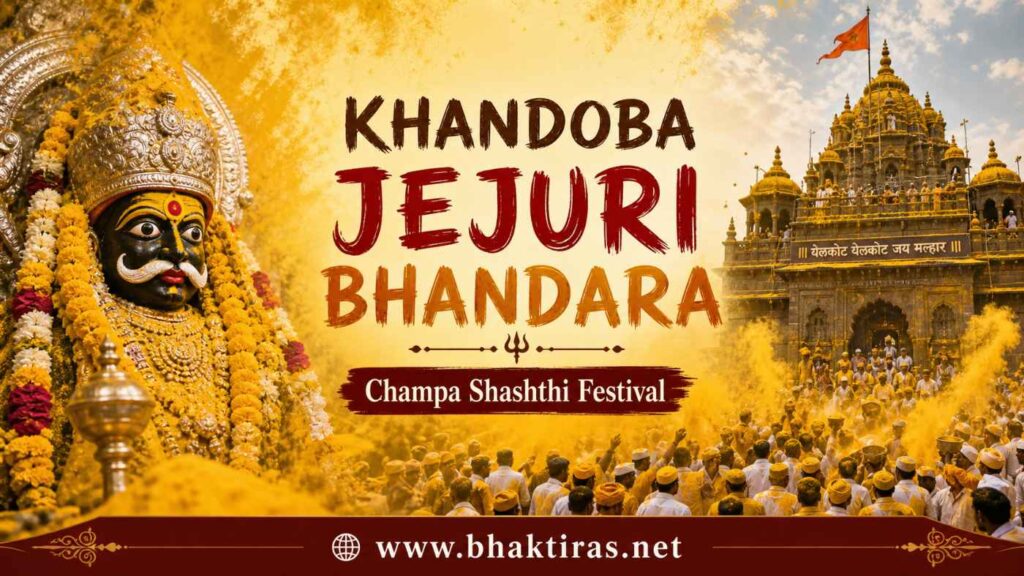
Champa Shashti is the biggest festival of Khandoba, the warrior-god of the Deccan whom countless Maharashtrian and Karnataka families keep as their kuldaivat. Over six days of Margashirsha, ending on the sixth bright day, the hilltop temple at Jejuri near Pune turns almost entirely gold as pilgrims fling handfuls of turmeric powder into the air. The festival remembers Khandoba’s six-day battle against the demon brothers Mani and Malla, and the hills ring with the folk cry “Yelkot Yelkot Jai Malhar”.
Khandoba Jejuri Champa Shashti 2026-2028: Dates & Calendar
The next Champa Shashti falls on 15 December 2026. Because it follows the lunar Margashirsha month, the calendar date shifts by up to three weeks each year.
| Year | Champa Shashti | Day | Notes |
|---|---|---|---|
| 2026 | 15 December | Tuesday | Next occurrence – main Jejuri yatra day |
| 2027 | 4 December | Saturday | Six-day observance from 29 November |
| 2028 | 22 November | Wednesday | Earlier as the lunar month advances |
The six days leading up to Shashti are kept as a fast by many devotees, who break it the following day with a communal meal called Champasashthiche parne, regarded as an invitation from Khandoba himself.
Why the Khandoba Jejuri Festival Is Celebrated
Champa Shashti marks Khandoba’s victory over the demon brothers Mani and Malla after a battle that lasted six days, ending on Shashti of Margashirsha. It is the day the god’s devotees renew their family bond with their kuldaivat.
The Mani-Malla legend
The brothers Malla and Mani won a boon of near-invincibility from Brahma and began tormenting sages and villages across the Deccan. Shiva descended as Martand Bhairav, riding a white horse, and fought them for six days. The demons were slain on Shashti; the dying Mani asked that his name be joined to the god’s and that his turmeric-yellow horse be honoured, which is why bhandara powder colours the whole festival.
A god of the common folk
Khandoba belongs to farmers, shepherds, hunters and soldiers rather than to a priestly elite. He is the kuldaivat, or family deity, of a huge number of households across Maharashtra and northern Karnataka, so families travel to Jejuri to fulfil vows, offer the first honours of a wedding, or give thanks for a child.
The golden bhandara
Turmeric is Khandoba’s sacred substance, tied to his solar name Martand. During Champa Shashti pilgrims buy sacks of bhandara and throw it over the steps, the shrine and each other until stone, cloth and skin all glow yellow. The rain of gold is both a blessing and a re-enactment of the god’s triumph.
The Yelkot cry
The festival has its own sound. Instead of a quiet chant, crowds roar “Yelkot Yelkot Jai Malhar” as they climb the temple steps and lift ritual dishes. Malhar and Mailar are among Khandoba’s Deccan names, and the shout is the folk equivalent of a war cry turned into worship.
Deities & Figures Worshipped
The festival centres on Khandoba, a folk form of Shiva known as Martand Bhairav, worshipped at Jejuri with his two chief consorts and his companions the horse and the dog.
Khandoba (Martand Bhairav)
Khandoba is honoured as a manifestation of Shiva, his name Martand Bhairav joining a solar epithet with Shiva’s fierce Bhairav form. He is usually shown as a warrior on a white horse, sword raised, a dog at his side, carrying a damaru, trident and a bowl of bhandara. In the Deccan he is also called Malhari Martand, Malhar, Mailar and Mailara.
Mhalsa
Mhalsa, drawn from the merchant Lingayat community, is Khandoba’s principal wife and rides beside him in many icons. Her presence links the god to the trading and farming households who keep him as kuldaivat.
Banai (Banubai)
Banai belongs to the Dhangar shepherd community, and her marriage to Khandoba binds the pastoral herders of the Deccan to the god. The two consorts together let very different communities each claim a family tie to Khandoba.
The horse and the dog
Khandoba’s white horse and his dog appear in almost every image and shrine. The horse carries the warrior-god into battle against Mani-Malla, and the dog is his faithful companion; the Waghya devotees identify themselves with these dogs.
Champa Shashti Rituals at Jejuri, Step by Step
The observance runs for six days, opening on Amavasya and building to the Shashti climax, with fasting, palkhi processions and the great shower of bhandara.
- Ghatasthapana. On the first day many households and the temple install a ghata, a consecrated pot, and light a lamp that is kept burning through the six days, much as in Navratri.
- Six-day fast. Devotees keep a partial or full fast across the six days, reading the Khandoba katha and offering daily worship to his image or a symbolic lingam at home.
- Journey to Jejuri. Pilgrims climb the long stone stairway up the Jejuri hill to the Kadepathar and main gadikot shrines, often carrying vows made through the year.
- Palkhi procession. The god’s palanquin is carried in procession accompanied by drums, the tutari horn and continuous cries of Yelkot Yelkot Jai Malhar.
- Bhandara showering. On Shashti the whole temple is bathed in turmeric powder as crowds fling bhandara over the steps, the deity and one another until the hilltop shines gold.
- Tali bharne and offerings. Devotees lift the ritual dish, or tali, chanting Yelkot, and offer bhandara, coconut, puran poli and other bhog to Khandoba, Mhalsa and Banai.
- Aarti and darshan. The day closes with lamp aarti before the golden shrine, after which pilgrims take darshan and carry home a pinch of blessed bhandara as prasad.
- Parne feast. The following day the fast is broken with the Champasashthiche parne, a shared meal treated as a personal invitation from Khandoba.
Special Foods of the Khandoba Festival
Offerings are simple, warming Maharashtrian dishes suited to a winter festival, shared as prasad after the god has been honoured.
Puran poli
A soft flatbread stuffed with a sweet paste of jaggery and split chickpea and served with warm ghee. It is the classic festive offering placed before Khandoba and shared at the parne feast.
Bharit and rodga
A rustic offering of bharit, a mash of roasted brinjal and onion, eaten with rodga, a thick flatbread of jowar or bajra. This is the everyday food of the farming and shepherd families who worship Khandoba.
Bhandara prasad
Turmeric powder itself is the signature prasad of the festival. A pinch of the blessed bhandara is carried home, dabbed on the forehead and kept as a token of the god’s protection through the year.
Coconut and jaggery bhog
Whole coconuts, pieces of jaggery and seasonal offerings are placed before the deity and later distributed. Many households also prepare a simple naivedya of rice and dal for the family meal.
Regional Names & Variations
Khandoba is a Deccan deity, and his worship stretches from Maharashtra into northern Karnataka under several names, with Jejuri as its most famous centre.
Jejuri, Maharashtra
The hilltop temple at Jejuri in Pune district is the best known Khandoba shrine and draws the largest Champa Shashti crowds, its steps and courtyards turning gold under the bhandara.
Northern Karnataka
In the Kannada country Khandoba is worshipped as Mailara or Mailar, with major temples such as Mailara near Bellary. The demon battle is re-enacted here too, giving the god his southern identity.
Across the Deccan
Hundreds of Khandoba temples run from Nashik in the north down to the Davangere region in the south, so families in villages far from Jejuri keep the six-day observance at local shrines and home altars.
Waghya and Murali devotees
Traditional bards called Waghya, who identify with Khandoba’s dogs, and Murali singers form a distinct devotional tradition, carrying the god’s songs and stories through the festival crowds.
Khandoba Jejuri Festival Do's and Don'ts
A few simple courtesies help you take part in the yatra with respect for the shrine and fellow pilgrims.
Do
- Join the Yelkot Yelkot Jai Malhar chant as you climb the temple steps.
- Buy bhandara from the shrine and offer it with a clean, respectful spirit.
- Keep the six-day observance simply if you fast, and break it at the parne meal.
- Cover your head and remove footwear before entering the sanctum.
- Carry a little water and pace yourself on the long hill stairway.
Avoid
- Do not treat the bhandara showering as mere play; it is a form of worship.
- Do not waste or trample offerings of food and coconut on the temple floor.
- Do not photograph the deity or rituals where the temple asks you not to.
- Do not push on the crowded steps during peak Shashti hours.
- Do not offer prohibited items; keep temple offerings vegetarian as the shrine directs.
Frequently Asked Questions
When is the Khandoba Jejuri Champa Shashti festival in 2026?
The Khandoba Champa Shashti festival at Jejuri falls on Tuesday, 15 December 2026. It is the sixth day of the bright fortnight of Margashirsha and the climax of a six-day observance that begins on the preceding Amavasya.
When is Champa Shashti in 2027 and 2028?
Champa Shashti falls on Saturday, 4 December 2027 and on Wednesday, 22 November 2028. The date moves each year because it is fixed to Margashirsha Shukla Shashti in the lunar calendar rather than to a solar date.
Why is Champa Shashti celebrated?
Champa Shashti celebrates Khandoba’s victory over the demon brothers Mani and Malla after a six-day battle that ended on Shashti of Margashirsha. Devotees honour their kuldaivat, or family god, and re-enact his triumph by showering golden turmeric powder called bhandara.
Which god is Khandoba?
Khandoba is a folk warrior-god of the Deccan worshipped as a manifestation of Shiva, known as Martand Bhairav, Malhari Martand and Mailar. He is usually shown mounted on a white horse with a dog at his side and a sword raised, and is the family deity of many Maharashtra and Karnataka households.
What is the bhandara ritual at Jejuri?
Bhandara is turmeric powder, Khandoba’s sacred substance, and showering it is the central ritual of Champa Shashti. Pilgrims throw handfuls over the temple steps, the shrine and one another until the whole Jejuri hilltop glows gold, and a pinch of blessed bhandara is carried home as prasad.
What does Yelkot Yelkot Jai Malhar mean?
Yelkot Yelkot Jai Malhar is the traditional cry of Khandoba’s devotees, roared while climbing the Jejuri steps and lifting ritual dishes. Malhar is one of Khandoba’s Deccan names, so the shout is a joyful victory salute to the god, part war cry and part hymn.
Who are Khandoba's consorts Mhalsa and Banai?
Mhalsa and Banai are Khandoba’s two chief wives. Mhalsa comes from the merchant Lingayat community and Banai from the Dhangar shepherd community, so the two marriages link farmers, traders and herders alike to the god as their kuldaivat.
What foods are offered during the festival?
Puran poli, a sweet jaggery-and-gram flatbread, is the main festive offering, along with the rustic bharit of roasted brinjal and onion eaten with jowar rodga. Coconut, jaggery and the blessed bhandara are also offered and shared as prasad.
May Khandoba shower his golden blessings on your home this Champa Shashti. Yelkot Yelkot Jai Malhar!