
Saraswati Puja 2026 (South India) – Navratri Worship of the Goddess of Learning
सरस्वती पूजा
When is Saraswati Puja in South India in 2026?
South Indian Saraswati Puja falls on Mahanavami, Tuesday 20 October 2026, the ninth day of Sharadiya Navratri, with the Vidyarambham writing initiation the next morning on Wednesday 21 October 2026. Books, musical instruments and tools of work are placed before Goddess Saraswati and worshipped, and study pauses until they are taken back on Vijayadashami.
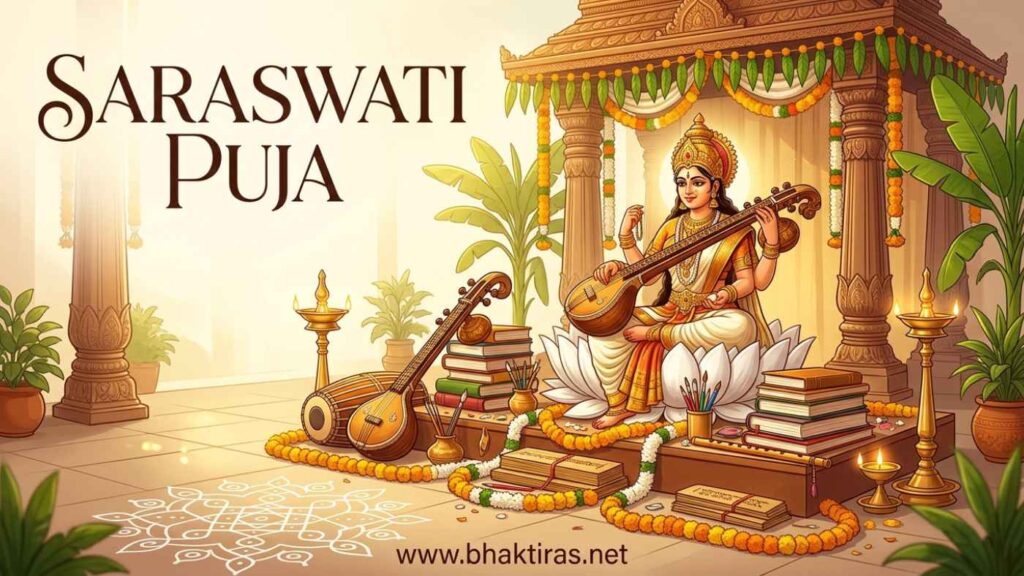
In the South, Saraswati Puja is woven into the last three days of Sharadiya Navratri rather than into Basant Panchami as in the North. Families gather their books, pens, veenas, mridangams and even work tools, arrange them before an image of Goddess Saraswati, and set learning aside so the goddess of knowledge can bless them. The worship peaks on Mahanavami, and the following morning, Vijayadashami, brings Vidyarambham – the day little children in Kerala trace their very first letters in a plate of rice.
Saraswati Puja (South India) 2026-2028: Dates & Calendar
The next South Indian Saraswati Puja is on Mahanavami, 20 October 2026, with Vidyarambham the following morning. Because it follows the lunar Ashwin month, the dates shift each year against the Gregorian calendar.
| Year | Saraswati Puja (Mahanavami) | Vidyarambham | Notes |
|---|---|---|---|
| 2026 | 20 October (Tue) | 21 October (Wed) | Next occurrence |
| 2027 | 8 October (Fri) | 10 October (Sun) | Vijayadashami 9 October |
| 2028 | 26 September (Tue) | 28 September (Thu) | Vijayadashami 27 September |
Books and instruments are placed before the goddess on Ashtami evening (Pooja Vaipu), worshipped through Navami, and taken back on Vijayadashami morning, when Vidyarambham is performed. In Kerala and Tamil Nadu the main puja sits on Navami; in parts of Karnataka and Andhra Pradesh the emphasis shifts to Dashami.
Why Saraswati Puja Is Celebrated in the South
Saraswati Puja honours the goddess of learning, music and the arts during the final stretch of Navratri, when devotees deliberately rest their books and instruments so the source of all knowledge can be thanked directly.
The autumn Navratri divides its nine nights among three goddesses – Durga for strength, Lakshmi for prosperity, and Saraswati for wisdom. The southern tradition gives Saraswati the closing days, tying her worship to Ayudha Puja, when weapons, machines and instruments of every craft are also honoured. Resting the tools of learning alongside the tools of labour makes a single point: skill and study are gifts, not personal achievements.
Knowledge as the highest wealth
Placing books and instruments before Saraswati is an act of humility. For two days learning stops, reminding students and teachers that knowledge is received rather than owned, and asking the goddess to keep the mind clear and the memory sharp.
The Navratri and Ayudha link
In the South, Saraswati Puja shares its days with Ayudha Puja. Carpenters clean their chisels, drivers garland their vehicles, and musicians rest their instruments, all worshipped together. Study tools sit in the same sacred category as the craftsman’s implements.
Vidyarambham, a beginning of letters
The morning after the puja is Vijayadashami, considered the most auspicious day to begin any learning. In Kerala this becomes Vidyarambham or Ezhuthiniruthu, when children aged around three to five write their first letters, formally opening their education.
Deity Worshipped: Goddess Saraswati
The festival is dedicated to Saraswati, the goddess of learning, speech, music and the fine arts, worshipped in her serene white form seated on a lotus.
Saraswati
Saraswati is shown dressed in white, seated on a white lotus, holding a veena in two hands to signify music and the arts, a book of the Vedas for knowledge, and a mala for meditation. Her mount is the hamsa, the swan said to separate milk from water, a symbol of clear discernment. She is worshipped as the presiding power over speech, scholarship and creativity.
Key Rituals, Step by Step
The southern Saraswati Puja runs across three days, from arranging the books to the child’s first letters. Here is the usual sequence.
- Pooja Vaipu (Ashtami evening). On the eighth day, books, notebooks, pens, veenas, tabla, tools and even office ledgers are cleaned, stacked and placed before an image or picture of Saraswati, often on a bed of fresh flowers.
- Invocation of the goddess. A lamp is lit and the goddess is invited to reside in the arranged books and instruments, with an offering of turmeric, kumkum, flowers and incense.
- Worship on Mahanavami. On the ninth day the family performs the main puja with flowers, sandal paste, fruit and prepared sweets, and reads or chants the Saraswati stotra. No one studies, reads for work or plays the rested instruments on this day.
- Ayudha Puja alongside. In the same session vehicles, machines and craft tools are garlanded and blessed, since southern custom worships the instruments of learning and labour together.
- Taking back the books (Vijayadashami). Early on the tenth day the puja is completed, the goddess is thanked, and the books and instruments are ceremonially picked up again, marking the return to study and work.
- Vidyarambham / Ezhuthiniruthu. Young children are seated on an elder’s or a guru’s lap and guided to write their first letters in a tray of raw rice, and sometimes on the tongue with a gold ring, usually writing Hari Shree Ganapataye Namah.
- Prasad and blessings. Sundal, payasam and other offerings are shared, and elders bless students and children for a year of steady learning.
Special Foods of Saraswati Puja
Offerings lean towards simple, sattvic dishes made from rice, lentils, coconut and jaggery, later shared as prasad.
Sundal
A dry, lightly spiced dish of boiled chickpeas or other pulses tempered with mustard seeds, curry leaves and grated coconut. It is a staple Navratri offering and the most common prasad handed to visitors.
Payasam
A sweet pudding of rice or vermicelli simmered in milk or jaggery with cardamom, cashews and raisins. Ada pradhaman and semiya payasam are favourites offered to the goddess.
Sweet Pongal (Sakkarai Pongal)
Rice and moong dal cooked with jaggery, ghee, cashews and cardamom into a rich, sticky sweet. It is a classic festival naivedyam presented before Saraswati.
Fruit and coconut
Bananas, freshly broken coconut and betel leaves are placed before the goddess as a plain, auspicious offering that is easy to prepare and widely used.
Regional Names & Variations
The core idea of resting the books before Saraswati is shared across the South, but the emphasis differs by state.
Kerala
Kerala is where Vidyarambham is most vivid. On Vijayadashami, temples such as Panachikkadu Dakshina Mookambika near Kottayam and Kollur Mookambika just across the Karnataka border host thousands of children writing their first letters in rice, guided by priests and teachers from before dawn.
Tamil Nadu
Households keep a Golu, a tiered display of dolls and figurines, through the nine nights. Saraswati Puja on Navami sits alongside Ayudha Puja, with books and instruments arranged before the goddess and sundal shared with guests who visit the Golu.
Karnataka
As part of the grand Dasara season, Saraswati is worshipped with books and veenas, and in some areas the puja and the taking back of the books lean towards the tenth day, Vijayadashami, rather than Navami.
Andhra Pradesh & Telangana
Saraswati is honoured in the closing days of Dasara, with students placing textbooks before her image and seeking blessings before returning to studies on Vijayadashami.
Saraswati Puja Do's and Don'ts
A few simple customs keep the observance respectful and in keeping with the southern tradition.
Do
- Clean and neatly arrange your books, notebooks and instruments before placing them for worship
- Light a lamp and keep the space calm and tidy during the two days
- Prepare sattvic offerings such as sundal, payasam or sweet pongal
- Take part in or attend a Vidyarambham to begin a child’s learning on Vijayadashami
- Handle instruments and books gently when taking them back and thank the goddess
Avoid
- Do not study, read for work or use the books and instruments while they rest with the goddess
- Do not step over or place the books on the floor without a clean cloth or flowers beneath
- Avoid non-vegetarian food and alcohol during the puja days
- Do not treat the arranged tools carelessly or use them for other tasks
- Do not skip taking the books back on Vijayadashami, which marks the return to learning
Frequently Asked Questions
When is Saraswati Puja in South India in 2026?
South Indian Saraswati Puja falls on Mahanavami, Tuesday 20 October 2026, the ninth day of Sharadiya Navratri. The books and instruments are worshipped that day, and Vidyarambham, the first-letters ceremony, is held the next morning on Wednesday 21 October 2026.
When is Saraswati Puja in 2027 and 2028?
In 2027 the southern Saraswati Puja on Mahanavami is on Friday 8 October, with Vidyarambham on Sunday 10 October after Vijayadashami on 9 October. In 2028 it falls on Tuesday 26 September, with Vijayadashami on 27 September and Vidyarambham the following day.
How is South Indian Saraswati Puja different from Basant Panchami Saraswati Puja?
The two are separate festivals for the same goddess. North and East India worship Saraswati on Basant Panchami in spring (Magha month), while South India worships her in autumn during the last three days of Sharadiya Navratri, ending on Mahanavami. See our Basant Panchami page for the spring celebration.
Which god is worshipped during South Indian Saraswati Puja?
Goddess Saraswati is worshipped, the deity of learning, speech, music and the arts. She is shown in white, seated on a lotus, holding a veena, a book and a mala, with the swan as her mount, and she is honoured as the giver of knowledge and skill.
What is Vidyarambham?
Vidyarambham, also called Ezhuthiniruthu or Aksharabhyasam, is the ceremony of a child’s first writing, held on Vijayadashami. A child aged around three to five is helped to trace letters in a tray of raw rice, usually the words Hari Shree Ganapataye Namah, formally beginning their education.
Why are books not read during Saraswati Puja?
Books and instruments are rested because they are placed before the goddess for worship from Ashtami evening until Vijayadashami morning. Setting learning aside is a mark of humility, acknowledging that knowledge comes from Saraswati, and study resumes once the books are ceremonially taken back.
What foods are offered during Saraswati Puja?
Simple sattvic dishes are offered, mainly sundal (spiced chickpeas with coconut), payasam (rice or vermicelli pudding), sweet pongal, fruit and coconut. These are presented to the goddess and later shared as prasad among family and visitors.
Where is Vidyarambham celebrated most famously?
Kerala hosts the largest Vidyarambham gatherings, especially at the Panachikkadu Dakshina Mookambika temple near Kottayam and the Kollur Mookambika temple. Thousands of children are initiated into writing there from the early hours of Vijayadashami.
May the goddess of learning keep your books, your music and your mind clear this Navratri. Saraswati Namastubhyam.