
Chitra Vichitra Fair 2027 – Gujarat's Great Tribal Gathering
चित्र विचित्र मेला
When is the Chitra Vichitra Fair in 2027?
The Chitra Vichitra Fair falls on 6 April 2027 (Tuesday), on the Amavasya new moon a fortnight after Holi. It is held at Gunbhakhari village in Sabarkantha district, Gujarat, where Bhil and Garasia families gather for a night of mourning followed by a colourful day of dance, courtship and folk celebration.
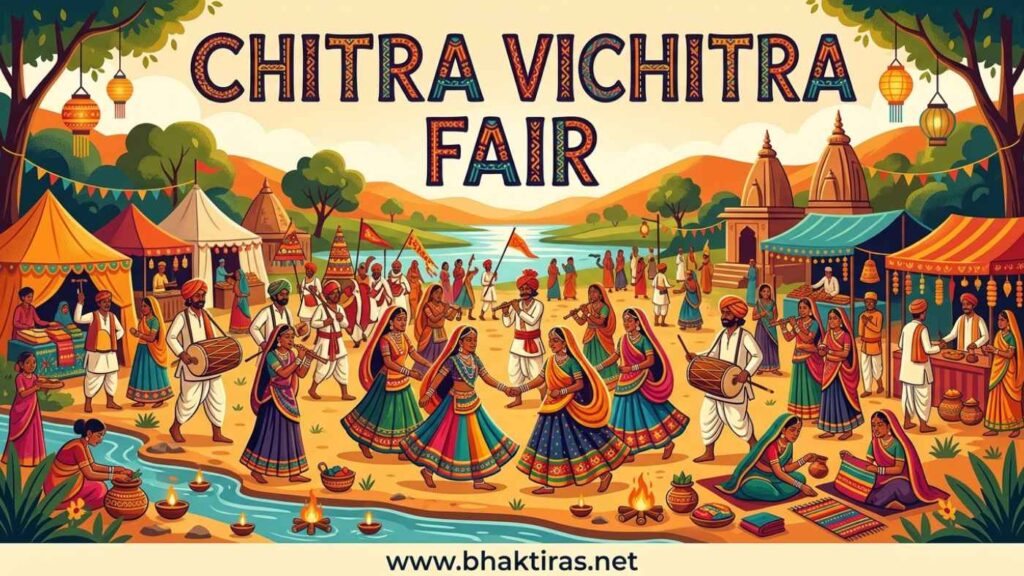
The Chitra Vichitra Fair is one of Gujarat’s largest tribal gatherings, drawing tens of thousands of Bhil and Garasia adivasis to Gunbhakhari village in Sabarkantha, near the Gujarat-Rajasthan border. It unfolds over a night and a day around the Amavasya new moon, a fortnight after Holi. What sets it apart is its two-part rhythm: it opens with women grieving their departed relatives on the riverbank, then turns into a lively fair of folk dance, finery, food stalls and young people meeting to choose life partners.
Chitra Vichitra Fair 2026-2028: Dates & Calendar
The next Chitra Vichitra Fair is on 6 April 2027. The date shifts each year because it tracks the Amavasya (new moon) that follows Holi, so it moves with the Hindu lunar calendar.
| Year | Fair days | Main night | Notes |
|---|---|---|---|
| 2026 | 18-19 March | Wednesday | Held a fortnight after Holi 2026 |
| 2027 | 5-6 April | Tuesday | Next occurrence – Chaitra Amavasya |
| 2028 | 25-26 March | Sunday | Follows Holi in mid-March 2028 |
The fair traditionally begins after dusk on the eve of the new moon, when families reach the riverbank for the mourning vigil, and continues through the following day as the celebration takes over.
Why the Chitra Vichitra Fair Is Held
The Chitra Vichitra Fair is primarily a social gathering of the Bhil and Garasia tribes, blending remembrance of the dead with community bonding and matchmaking. Its name comes from the Mahabharata brothers Chitravirya and Vichitravirya, who are said to have found healing at this river confluence.
A tribal meeting ground
For scattered Bhil and Garasia families across the Gujarat-Rajasthan hills, the fair is a rare chance to reunite once a year. Relatives who live days apart meet at Gunbhakhari, exchange news, settle community matters and renew ties that a hard, dispersed life makes difficult to keep.
Grief before joy
The fair deliberately places mourning first. On the opening night, women who have lost someone in the past year gather by the water to weep and remember, releasing their grief together. Only after this shared farewell does the mood lift into celebration, so the two feelings sit side by side rather than in conflict.
The Chitravirya-Vichitravirya legend
The fair takes its name from Chitravirya and Vichitravirya, sons of King Shantanu in the Mahabharata. Local belief holds that the brothers rested at this confluence and were cured of illness by its waters, which is why the riverside shrine and the sacred bathing spot carry weight for pilgrims alongside the tribal crowd.
Courtship and identity
Much of the fair’s energy comes from its role in matchmaking. Young men and women dress in their finest, dance and talk, and many couples settle on marriage here. For the adivasi communities it is also a proud, public assertion of language, dress, music and a way of life that stands apart from the mainstream.
Legend & Figures Honoured
The fair is a tribal social event rather than a temple festival, but two Mahabharata figures give it its name and its riverside shrine draws worshippers.
Chitravirya & Vichitravirya
The brothers Chitravirya and Vichitravirya, sons of King Shantanu and half-brothers of Bhishma, are the figures the fair is named after. Tradition says they were healed by the waters here, and a small shrine at the river confluence marks the spot.
The river confluence
The Triveni-style meeting of the Sabarmati with its tributary streams (locally called Akul and Vyakul, the Wakal and its feeders) is treated as holy ground. Pilgrims bathe here and immerse the ashes of the dead, which is why the mourning rite is tied to this exact site.
What Happens, Night to Day
The fair moves in a clear sequence, from a solemn riverbank vigil on the first night to a full day of colour, dance and courtship.
- Arrival at dusk. Bhil and Garasia families travel in from villages across Sabarkantha and neighbouring Rajasthan, reaching the riverbank at Gunbhakhari as the light fades on the eve of the new moon.
- The mourning vigil. Women who have lost a relative in the past year gather at the water’s edge to weep and remember through the night, grieving together in a shared, public farewell.
- Immersion and ritual bath. Families immerse the ashes of the departed at the sacred confluence, and many take a ritual dip at dawn, believed to cleanse and honour the dead.
- The day of colour. As morning comes the mood changes completely. People change into bright traditional dress – heavy silver jewellery, colourful skirts and turbans – and the fairground fills with energy.
- Folk dance and music. Drums, flutes and folk songs set the rhythm as groups form circles to dance. The performances are open, communal and go on for hours.
- Meeting and courtship. Young men and women move through the crowd, talk, dance and size up matches. Many marriages begin with a meeting made on this day.
- Stalls and feasting. Rows of stalls sell sweets, snacks, bangles, trinkets and everyday goods, and families eat together before the long journey home.
Food at the Fair
Eating is part of the day, mixing simple tribal fare with familiar Gujarati fair-ground sweets and snacks sold from the stalls.
Maize rotla & local grains
Everyday adivasi cooking leans on maize and millet, so thick maize or bajra rotla eaten with a little chutney, jaggery or seasonal vegetable is the plain, filling food many families carry or share.
Jalebi & fried sweets
Stall vendors fry up hot jalebi and other syrup-soaked sweets on the spot, a treat that draws children and adds the smell of hot oil and sugar to the fairground.
Ganthiya & farsan
Crisp gram-flour ganthiya and other savoury farsan snacks are classic Gujarati fair food, sold by weight and eaten straight from the paper.
Jaggery & seasonal treats
Jaggery-based sweets and roasted or seasonal snacks appear on the stalls, cheap and popular with the large village crowd.
Tea and cold drinks
Endless cups of sweet, milky tea keep the night-long vigil going, while cold drinks and cut fruit sell through the warmer daytime hours.
Where & Who: The Local Picture
This is a strongly local fair rooted in one place and two communities, though it draws visitors and photographers from far beyond.
Gunbhakhari, Sabarkantha
The fair is held at Gunbhakhari village in Poshina taluka, in the north of Sabarkantha district close to the Rajasthan border, on the banks of the river where three streams meet. The nearest town of any size is Khedbrahma, and the site sits in the foothills of the Aravalli range.
The Bhil community
The Bhil are one of India’s largest adivasi groups, spread across Gujarat, Rajasthan and Madhya Pradesh. For Bhil families in this belt the fair is a fixed point in the year, a place to meet kin and mark both loss and new beginnings.
The Garasia community
The Garasia, closely tied to this Gujarat-Rajasthan border country, join the Bhil in large numbers. Their dress, jewellery and folk dances are a defining sight of the fair, and courtship here shapes many Garasia marriages.
Visitors and onlookers
The colour and scale of the gathering, with crowds often numbering tens of thousands, draw domestic and foreign tourists, researchers and photographers, who come to watch the dances and the finery rather than to take part in the rites.
Chitra Vichitra Fair Do's and Don'ts
This is a living community event and a place of real grief on the first night, so visitors should tread gently.
Do
- Treat the mourning vigil with quiet respect and keep your distance from grieving families.
- Ask before photographing individuals, especially women and anyone in mourning.
- Dress modestly and comfortably for a rural, open-air setting.
- Carry cash, water and a torch, as facilities are basic and it runs into the night.
- Support the fair by buying food, tea or crafts from the local stalls.
Avoid
- Do not point cameras at the riverbank mourning as if it were a spectacle.
- Do not treat the adivasi crowd or their dress as a costume for your own photos.
- Do not disturb or crowd the dancing and courtship groups.
- Do not litter the riverbank or the sacred bathing spot.
- Do not arrive expecting hotels or transport on site; plan your stay from Khedbrahma or nearby towns.
Frequently Asked Questions
When is the Chitra Vichitra Fair in 2027?
The Chitra Vichitra Fair is on 6 April 2027 (Tuesday), held over the eve and day of the Amavasya new moon that falls a fortnight after Holi. It takes place at Gunbhakhari village in Sabarkantha district, Gujarat.
When was the fair in 2026 and when is it in 2028?
The Chitra Vichitra Fair was held on 18-19 March 2026 and is expected on 25-26 March 2028. The date moves each year because it follows the new moon after Holi on the Hindu lunar calendar, so it can fall in either March or early April.
Where is the Chitra Vichitra Fair held?
The Chitra Vichitra Fair is held at Gunbhakhari village in Poshina taluka, Sabarkantha district, in northern Gujarat near the Rajasthan border. The site sits on a riverbank where three streams meet, in the foothills of the Aravalli hills, with Khedbrahma as the nearest town.
Which communities attend the fair?
The fair is a gathering of the Bhil and Garasia adivasi (tribal) communities from Gujarat and neighbouring Rajasthan. It regularly draws crowds of tens of thousands, making it one of the largest tribal fairs in the state.
Why is it called Chitra Vichitra?
The fair is named after Chitravirya and Vichitravirya, the sons of King Shantanu in the Mahabharata and half-brothers of Bhishma. Local tradition says the brothers were healed by the waters at this river confluence, which is why the site carries their name.
What actually happens at the fair?
The fair opens at night with women mourning relatives who died in the past year on the riverbank, along with the immersion of ashes and a ritual bath. The following day turns into a colourful celebration of folk dance, music, food stalls and courtship, where young Bhil and Garasia people meet and often choose life partners.
Is the Chitra Vichitra Fair a religious festival?
The Chitra Vichitra Fair is mainly a tribal social and cultural gathering rather than a temple festival, though it carries a strong sacred element. The mourning rites, ash immersion and ritual bathing at the holy confluence, tied to the Chitravirya-Vichitravirya legend, give it real spiritual weight for the communities involved.
Can tourists visit the fair?
Yes, visitors are welcome and the fair draws domestic and foreign tourists for its dances and traditional dress. Come with respect, ask before photographing people, avoid intruding on the mourning vigil, and plan lodging and transport from Khedbrahma or nearby towns, as the site itself has only basic facilities.
May the Chitra Vichitra Fair carry both remembrance and joy in equal measure for every Bhil and Garasia family that gathers by the river.