
Kurukshetra Gita Mahotsav 2026 – Where the Gita Was Spoken
अंतरराष्ट्रीय गीता महोत्सव
When is the Kurukshetra Gita Mahotsav in 2026?
The International Gita Mahotsav at Kurukshetra runs for roughly a fortnight through late November and December 2026, peaking on Gita Jayanti – Sunday, 20 December 2026. Organised by Haryana Tourism at Brahma Sarovar, it marks the spot where Krishna is believed to have spoken the Bhagavad Gita to Arjuna, with the grand Deep Daan, maha-aarti, Gita recitation and cultural fairs.
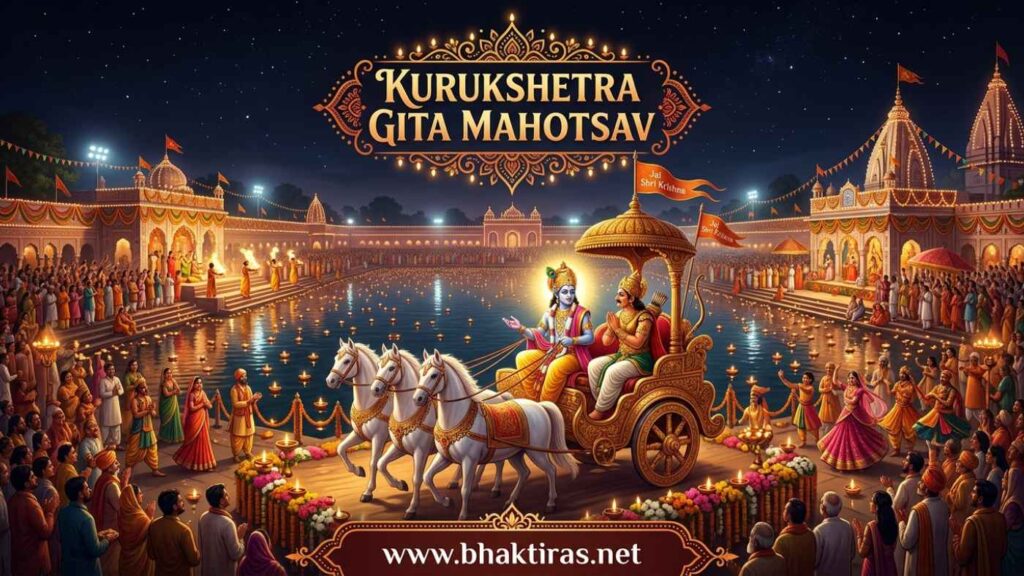
The Kurukshetra Gita Mahotsav, formally the International Gita Mahotsav, is Haryana’s flagship spiritual and cultural festival, held on the very plain where the Bhagavad Gita is said to have been spoken. Spread over roughly a fortnight and centred on the Brahma Sarovar ghats, it builds towards Gita Jayanti – the tithi marking the day Krishna counselled Arjuna. Lakhs of earthen lamps, a thunderous evening maha-aarti, Gita recitation, discourses, folk performances and a large crafts mela draw pilgrims and visitors from across India and abroad.
Kurukshetra Gita Mahotsav 2026-2028: Dates & Calendar
The Mahotsav is timed around Gita Jayanti, which falls on Margashirsha Shukla Ekadashi (Mokshada Ekadashi). Because it follows the lunar calendar, the peak day shifts each year – it lands on Sunday, 20 December in 2026.
| Year | Gita Jayanti (peak day) | Day | Festival window (approx.) |
|---|---|---|---|
| 2026 | 20 December | Sunday | Next edition – roughly late Nov to Dec |
| 2027 | 9 December | Thursday | Around late Nov to mid-Dec |
| 2028 | 27 November | Monday | Around mid to late November |
The exact opening and closing dates, partner state and partner country are announced by Haryana Tourism a few months ahead. The single most important evening is Gita Jayanti itself, when the Deep Daan and maha-aarti take place at Brahma Sarovar.
Why the Kurukshetra Gita Mahotsav Is Celebrated
The festival honours Kurukshetra as the birthplace of the Bhagavad Gita, the 700-verse dialogue in which Krishna answered Arjuna’s despair on the battlefield with a teaching on duty, detachment and devotion.
More than a religious observance, the Mahotsav is a meeting point of the spiritual and the cultural. Haryana Tourism uses the occasion to present the Gita’s message alongside folk art, crafts and cuisine from across the country, turning a sacred tithi into a broad public celebration.
The land of the Gita
Kurukshetra, also called Dharmakshetra, is where the Mahabharata war was fought and where Krishna is believed to have delivered the Gita to Arjuna. Celebrating the text on this soil gives the festival a rootedness that no other venue can claim.
Deep Daan on Brahma Sarovar
On Gita Jayanti evening, lakhs of diyas are lit along the vast Brahma Sarovar and floated on its water after the maha-aarti. This Deep Daan, or offering of lamps, is the emotional high point of the whole event.
A message for daily life
The Gita’s counsel – act without attachment to results, do your duty, keep the mind steady – is read out and discussed through the festival. Discourses connect the ancient verses to everyday questions of work, choice and grief.
Culture meets pilgrimage
By pairing Gita recitation with a partner state, a partner country, craft stalls and stage performances, the Mahotsav brings pilgrims and tourists to the same ghats, sustaining Kurukshetra’s identity as a living centre of pilgrimage.
Deities & Figures Worshipped
The festival centres on Krishna in his role as teacher of the Gita, with Arjuna as the questioning disciple and the Bhagavad Gita itself venerated as sacred scripture.
Krishna
Krishna, the eighth avatar of Vishnu, is worshipped here as Gitacharya – the giver of the Gita. Standing as Arjuna’s charioteer, he reveals the path of karma, bhakti and jnana. Images of Krishna guiding Arjuna’s chariot are central to the festival’s imagery.
Arjuna
The Pandava prince Arjuna, overcome with doubt at the sight of his kinsmen arrayed for war, is the listener whose questions draw out the Gita. His crisis and resolution mirror the human struggles the festival’s discourses address.
The Bhagavad Gita
The Gita, part of the Mahabharata’s Bhishma Parva, is honoured as living scripture. Copies are read aloud, offered aarti and carried in procession, treating the book itself as an object of reverence during the celebrations.
What Happens: Key Rituals, Step by Step
The Mahotsav unfolds over about a fortnight, with quieter recitation and cultural programmes leading up to the intense rituals of Gita Jayanti day.
- Ritual bathing. Pilgrims take a holy dip in the sacred tanks of Brahma Sarovar and the nearby Sannihit Sarovar, considered especially meritorious around Gita Jayanti.
- Gita Yagya and puja. The festival is formally opened with a Gita Yagya and worship at Brahma Sarovar, invoking Krishna and consecrating the sacred text.
- Gita recitation. Verses of the Bhagavad Gita are chanted daily, sometimes in mass collective recitation, keeping the scripture at the heart of the gathering.
- Discourses and seminars. Spiritual leaders and scholars give talks on the Gita’s teachings, with an international academic seminar often held at Kurukshetra University.
- Cultural evenings. Folk troupes from many states and the partner country perform music and dance on stages set around the ghats each evening.
- Crafts and Saras mela. Artisans sell handloom, handicrafts and regional food at a large fair, with dedicated pavilions for the partner state and the host and guest cultures.
- Maha-aarti. On Gita Jayanti evening a grand aarti is performed on the western bank of Brahma Sarovar, at Purushottampura Bagh, before a huge crowd.
- Deep Daan and Deepotsav. Immediately after the maha-aarti, lakhs of diyas are lit around the Sarovar and across the 48-kos tirthas, and lamps are floated on the water – the festival’s crowning moment.
Special Foods of the Gita Mahotsav
Food at the Mahotsav ranges from simple sattvic offerings tied to the Ekadashi fast to hearty Haryanvi dishes sold at the mela stalls.
Ekadashi vrat food
Because Gita Jayanti coincides with Mokshada Ekadashi, many devotees fast, avoiding grains and pulses. They eat fruit, milk, kuttu (buckwheat) or singhara (water-chestnut) flour dishes and sabudana instead.
Langar and prasad
Free community kitchens serve simple sattvic langar – khichdi, dal, seasonal vegetables and halwa – to pilgrims through the festival, in the spirit of seva.
Haryanvi fare
Stalls at the mela offer local winter favourites such as bajra khichdi, besan masala roti, kadhi, churma and jaggery-rich sweets that suit the December cold of the region.
Mela sweets and snacks
The Saras mela lines fill with jalebi, gajak, revari and hot pakoras. Sesame and jaggery treats are common, in keeping with the north Indian winter season.
Kurukshetra & the Surrounding Region
Though the Mahotsav is a Kurukshetra event, its rituals reach across the wider sacred landscape of the district and draw participants from many states.
Brahma Sarovar
The huge rectangular tank at the centre of Kurukshetra is the festival’s main stage. Its ghats host the maha-aarti, the Deep Daan and most cultural programmes, and pilgrims bathe here for merit.
Sannihit Sarovar
A second sacred tank nearby, believed to be a gathering place of tirthas, where pilgrims also bathe. A dip here around the Mahotsav is considered highly auspicious.
Thanesar and the tirthas
The old town of Thanesar and dozens of tirtha sites across Kurukshetra join the celebration, many lit with lamps during the Deepotsav so the whole area glows on Gita Jayanti night.
The 48-kos parikrama
Kurukshetra’s sacred zone spans a 48-kos circuit dotted with pilgrimage spots linked to the Mahabharata. Committees from across this region take part, some bringing soil and water from their local tirthas.
Partner state and country
Each edition invites a partner Indian state and a partner nation, whose artists and cuisine feature prominently – recent editions have hosted Odisha and countries such as Tanzania, giving the festival its international character.
Gita Mahotsav Do's and Don'ts
A little planning makes a visit to the crowded, cold December ghats far more comfortable.
Do
- Arrive early on Gita Jayanti evening to find a good spot for the maha-aarti and Deep Daan.
- Dress warmly – Kurukshetra can be cold and foggy in December.
- Keep the ghats clean and use bins; avoid throwing waste into the sacred Sarovar.
- Carry cash for the mela stalls, and small change for offerings.
- Respect the queues and instructions at the ritual bathing steps.
Avoid
- Do not push into ritual or aarti areas; let the priests and volunteers manage the flow.
- Do not light your own diyas in unauthorised spots during the Deepotsav.
- Do not litter or wash items in the tanks used for holy bathing.
- Do not bring alcohol or non-vegetarian food to the festival grounds.
- Do not lose sight of children or belongings in the very large crowds.
Frequently Asked Questions
When is the Kurukshetra Gita Mahotsav in 2026?
The Kurukshetra Gita Mahotsav in 2026 peaks on Gita Jayanti, Sunday, 20 December 2026. The full festival, organised by Haryana Tourism at Brahma Sarovar, runs for roughly a fortnight, typically opening in late November or early December and closing around the Gita Jayanti weekend.
Is the Gita Mahotsav the same as Gita Jayanti?
No, they are related but not identical. Gita Jayanti is the single tithi (Margashirsha Shukla Ekadashi) marking the day the Bhagavad Gita was spoken. The Kurukshetra Gita Mahotsav is a multi-day state festival built around that day, adding Deep Daan, cultural shows and a crafts mela over about two weeks.
Where is the Gita Mahotsav held?
The Gita Mahotsav is held in Kurukshetra, Haryana, on the plain where Krishna is believed to have delivered the Bhagavad Gita to Arjuna. Its main venue is the Brahma Sarovar, with events also at the nearby Sannihit Sarovar, Thanesar and tirthas across the 48-kos sacred region.
What is the Deep Daan at Brahma Sarovar?
The Deep Daan is the offering of lamps on Gita Jayanti evening, when lakhs of earthen diyas are lit around Brahma Sarovar and floated on its water after the maha-aarti. This Deepotsav, often spread across the surrounding tirthas too, is the most spectacular moment of the whole festival.
Which god is worshipped at the Gita Mahotsav?
Krishna is the central deity, honoured as Gitacharya – the giver of the Bhagavad Gita – in his form as Arjuna’s charioteer and teacher. The Gita itself is revered as sacred scripture, and Arjuna features as the disciple whose questions draw out its message.
What happens during the Gita Mahotsav?
The Gita Mahotsav features holy bathing at Brahma and Sannihit Sarovars, a Gita Yagya, daily Gita recitation, spiritual discourses and seminars, folk performances, a large Saras crafts mela, and a partner state and partner country pavilion. It culminates in the grand maha-aarti and Deep Daan on Gita Jayanti evening.
When is the Gita Mahotsav in 2027 and 2028?
The festival peaks on Gita Jayanti, which falls on Thursday, 9 December 2027 and Monday, 27 November 2028. The multi-day festival window in each year is set by Haryana Tourism and usually opens a couple of weeks before that peak day.
How many days does the Gita Mahotsav last?
The International Gita Mahotsav usually runs for around 15 to 18 days, though the exact length varies by year. It builds gradually towards Gita Jayanti, when the maha-aarti and Deep Daan take place, and then closes soon after.
May the words Krishna spoke on this soil steady your mind and lighten your heart. Jai Shri Krishna.