
Surajkund International Crafts Mela 2027 – India's Great Handloom Fair
सूरजकुंड मेला
When is the Surajkund International Crafts Mela in 2027?
The Surajkund International Crafts Mela runs from 1 to 16 February 2027 at Surajkund in Faridabad, Haryana, about 15 km south of Delhi. It is one of the world’s largest handloom and handicraft fairs, bringing together master artisans from every Indian state and dozens of partner countries, along with folk music, dance and regional food.
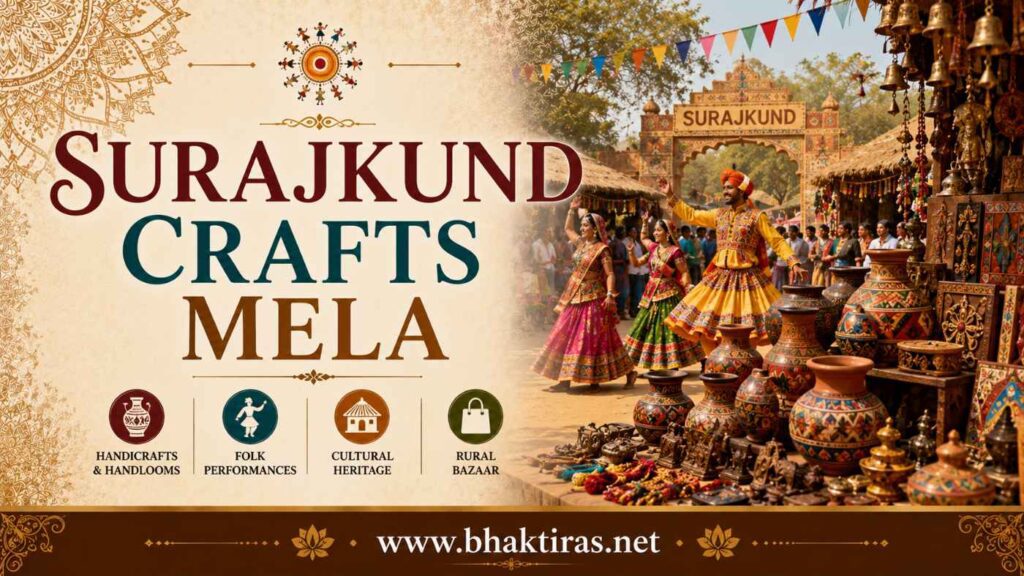
The Surajkund International Crafts Mela is a fortnight-long celebration of Indian handloom, handicraft and folk culture held each February at Surajkund, a lake town in Faridabad on the southern edge of Delhi. Since 1987 it has grown into one of the largest crafts fairs anywhere, spreading thatched village-style huts across a wooded site where weavers, potters, metalworkers and painters sell their work directly to visitors. Every edition spotlights a theme state and a partner nation, and the open-air Chaupal stages carry live music and dance from morning until evening.
Surajkund Mela 2026-2028: Dates & Calendar
The next Surajkund Mela is expected from 1 to 16 February 2027. The fair follows a fixed civil-calendar window rather than a lunar tithi, so it opens on 1 February most years.
| Year | Dates | Duration | Notes |
|---|---|---|---|
| 2026 | 1-16 February | 16 days | Held annually |
| 2027 | 1-16 February | 16 days | Next occurrence (approximate) |
| 2028 | 1-16 February | 16 days | Expected (approximate) |
The mela is open on all 16 days, typically from around 10 am until 8 pm. Weekdays are quieter and easier for talking to artisans; weekends draw the biggest crowds and the fullest cultural programme on the Chaupal stages.
Why the Surajkund Mela Matters
The Surajkund Mela exists to give India’s traditional craftspeople a direct market and a national stage, keeping handmade skills alive in an age of mass production.
The fair began in 1987 as an effort to bring rural artisans face to face with urban buyers, cutting out middlemen so that weavers and craftworkers earn a fairer price for their labour. Over the decades it has become a working showcase of India’s living craft traditions, from Kashmiri pashmina to Odisha’s palm-leaf engraving.
A direct market for artisans
Craftspeople sell straight from their own huts, so buyers meet the maker and the money reaches the workshop rather than a chain of traders. For many families the fortnight’s earnings are a meaningful share of the year’s income.
Theme state and partner nation
Each edition honours one Indian state as its theme, recreating its architecture, cuisine and folk arts, and one or more partner countries. This rotation keeps the fair fresh and gives smaller craft regions their turn in the spotlight.
Keeping skills alive
By drawing lakhs of visitors and steady sales, the mela gives young people a reason to learn crafts their parents feared were dying out. Award-winning National and State artisans are regular participants, and their presence lifts the standing of the trade.
How to Enjoy the Mela, Step by Step
The mela rewards a slow, unhurried visit. Here is a sensible way to work through the grounds.
- Book and arrive. Buy tickets online or at the gate; reach by mid-morning on a weekday to beat the rush, using the Delhi Metro to Badarpur or Tughlakabad and a short cab ride on from there.
- Start with the theme-state pavilion. Each year’s featured state recreates its streetscapes, crafts and food in one zone, so it is the richest place to begin.
- Walk the apna ghar huts. Move state by state through the thatched huts, talking to artisans about how each piece is made before you buy.
- Watch the crafts in progress. Many stalls demonstrate live weaving, pottery, block-printing or metalwork; watching first helps you judge quality.
- Break at a food court. Regional food courts serve dishes from across India, so pause for a plate before the afternoon heat.
- Catch the Chaupal performances. Head to an open-air Chaupal stage for folk and classical music and dance, checking the day’s schedule at the entrance.
- Buy in the cooler evening. Prices often soften later in the day; carry cash, a cloth bag and small change, and confirm packing for fragile pieces before you leave.
Food at the Surajkund Mela
The mela’s food courts are a fair in themselves, gathering street food and regional specialities from across the country in one place.
North Indian street food
Chaat, tikki, kulcha, chole bhature and tandoori snacks are the everyday favourites, along with hot jalebi and gajar ka halwa that suit the February chill.
Regional thalis
The featured state usually runs a food zone serving its signature dishes, so a Rajasthani year might bring dal-baati-churma while a southern theme brings dosa and appam.
Momos and hill food
Steamed and fried momos, thukpa and other hill dishes have become a mela staple, reflecting the artisans and cultures represented from the mountain states.
Sweets and hot drinks
Kulfi, rabri, and regional sweets sit alongside masala chai and hot coffee that visitors nurse while wandering the huts on cold mornings.
What You Will Find Across the Grounds
The huts are laid out by state and craft, so a single walk takes you across the country’s textile and handicraft map.
Textiles and handloom
Banarasi and Kanchipuram silks, Kashmiri pashmina and embroidery, Kutchi mirror-work, Odisha ikat, Bengal kantha and Phulkari from Punjab fill row after row of the fair.
Pottery and terracotta
Blue pottery from Jaipur, black clay from Manipur and terracotta figures from Bengal and Tamil Nadu show how differently a single material is handled across regions.
Wood, metal and stone
Channapatna toys, Saharanpur woodcarving, Moradabad brassware, Bidri metal inlay and stone carving from Rajasthan and Odisha are among the durable crafts on sale.
Partner-country stalls
Artisans from the partner nations and other invited countries bring their own textiles, rugs, jewellery and handicrafts, giving the fair its international character.
Surajkund Mela Do's and Don'ts
A little planning makes a long day at the fair far more comfortable.
Do
- Carry cash and small change; not every hut accepts cards or UPI.
- Wear comfortable shoes; the grounds are large and mostly on foot.
- Go on a weekday morning if you want to browse and bargain in peace.
- Talk to the artisans about their craft; it enriches the visit and often the price.
- Bring a cloth bag and ask for careful packing of anything fragile.
Avoid
- Don’t expect fixed prices; polite bargaining is normal and expected.
- Don’t rush; a proper visit needs three to four hours at least.
- Don’t photograph an artisan’s stall or work without asking first.
- Don’t visit only at the crowded weekend peak if you dislike big crowds.
- Don’t forget water and sun cover; February days can turn warm by afternoon.
Frequently Asked Questions
When is the Surajkund International Crafts Mela in 2027?
The Surajkund International Crafts Mela is expected from 1 to 16 February 2027 at Surajkund in Faridabad, Haryana. The fair usually opens on 1 February and runs for 16 days. Exact dates are confirmed each season by Haryana Tourism and may shift by a day or two.
When is the Surajkund Mela in 2026 and 2028?
The Surajkund Mela runs from 1 to 16 February in both 2026 and, on current pattern, 2028. It is an annual fair that follows a fixed February window rather than a moving lunar date, so the dates stay close to the start of the month each year.
Where is the Surajkund Mela held?
The Surajkund Mela is held at Surajkund in Faridabad, Haryana, roughly 15 km south of central Delhi. The site is reachable by road and via the Delhi Metro to Badarpur or Tughlakabad stations, followed by a short cab or auto ride.
What is the Surajkund Mela famous for?
The Surajkund Mela is famous as one of the world’s largest handloom and handicraft fairs. Artisans from every Indian state and many partner countries sell their work directly from thatched village-style huts, alongside folk and classical performances, regional food and a recreated rural-India setting.
Who organises the Surajkund Mela?
The Surajkund Mela is organised by Haryana Tourism together with the Union Ministry of Textiles and other central bodies. It has been held annually since 1987 and now carries international status, with partner countries taking part each year.
What is the theme state and partner nation?
Each edition of the Surajkund Mela features one Indian state as its theme and one or more countries as partner nations. The theme state recreates its crafts, architecture and cuisine across a dedicated zone, while partner-nation artisans bring their own handicrafts, giving the fair its global character. The specific choices are announced by the organisers before each season.
How much time do you need at the Surajkund Mela?
Plan on at least three to four hours to see the Surajkund Mela properly. The grounds are large and laid out by state and craft, with hundreds of huts, food courts and performance stages, so an unhurried visit spread over a morning or afternoon works best.
Is the Surajkund Mela a religious festival?
No, the Surajkund Mela is a cultural and crafts fair, not a religious festival. Its focus is India’s handloom, handicraft and folk traditions, bringing artisans, performers and food from across the country and abroad to one site for a fortnight each February.
Come with an open afternoon and an empty bag, and the Surajkund Mela will send you home with something handmade and a little of the country’s craft history in your hands.