
Tejaji Fair 2026 – Rajasthan's Cattle Fair for Veer Tejaji
तेजाजी मेला
When is the Tejaji Fair in 2026?
The Tejaji Fair falls on Monday, 21 September 2026, on Teja Dashami (Bhadrapada Shukla Dashami). The largest gathering is the Parbatsar cattle fair in Nagaur district, Rajasthan, where farmers honour the folk deity Veer Tejaji and trade livestock over several days.
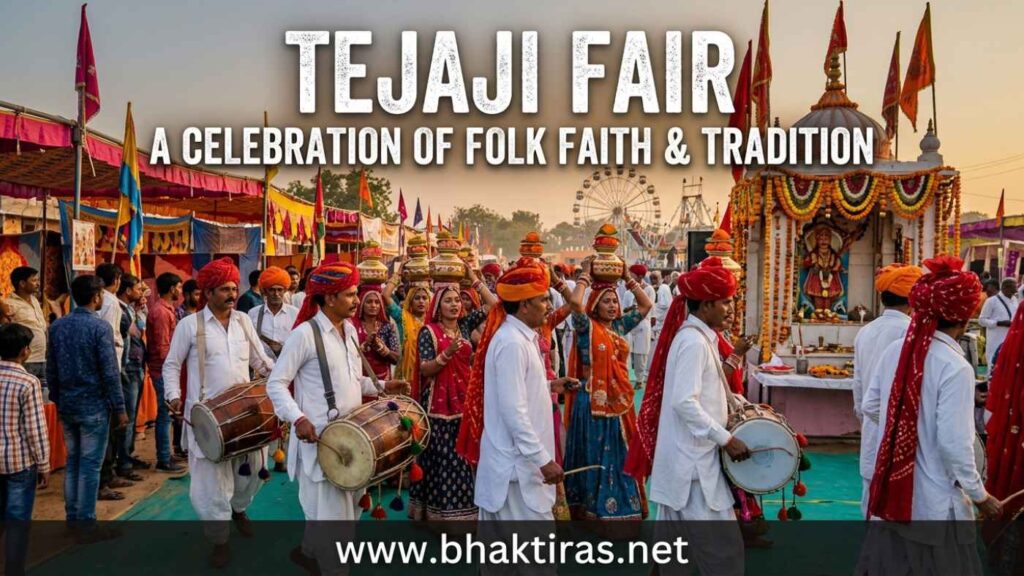
The Tejaji Fair honours Veer Tejaji, an 11th-century Rajasthani warrior remembered for keeping a promise to a snake even at the cost of his life. It is held on Teja Dashami, the tenth day of the bright fortnight of Bhadrapada, which falls on 21 September in 2026. The biggest observance is the huge cattle fair at Parbatsar in Nagaur district, where farmers worship at Tejaji temples, tie protective tanti threads believed to cure snakebite, sing his ballads, and buy and sell livestock.
Tejaji Fair 2026-2028: Dates & Calendar
Teja Dashami is set by the Hindu lunar calendar, so the Gregorian date moves each year. In 2026 it falls on 21 September; the Parbatsar fair runs on and around this day.
| Year | Teja Dashami | Day | Notes |
|---|---|---|---|
| 2025 | 2 September | Tuesday | Past occurrence |
| 2026 | 21 September | Monday | Next occurrence; Parbatsar mela peak |
| 2027 | 10 September | Friday | Bhadrapada Shukla Dashami |
| 2028 | 22 August | Tuesday | Bhadrapada Shukla Dashami |
At Parbatsar the livestock fair traditionally opens on Teja Dashami and continues through the following days up to the full moon (Purnima), drawing traders from across Rajasthan and neighbouring states.
Why the Tejaji Fair Is Celebrated
The fair marks the death anniversary of Veer Tejaji, a folk hero worshipped as a protector of cattle and a healer of snakebite. It celebrates loyalty, a promise kept, and the bond between farmers and their animals.
A promise kept
While recovering cattle stolen by raiders, Tejaji is said to have met a snake he had earlier disturbed. He gave his word to return and let it bite him. Badly wounded in the fight, he came back and offered his tongue, the only unbloodied part of his body, so the snake could take its bite. The tale is retold every year as the heart of the festival.
Guardian against snakebite
Because of that vow, devotees believe Tejaji can shield people and livestock from snake venom. Threads called tanti are blessed at his temples and tied on the wrist or arm, and his mantras are chanted over those bitten by snakes. This belief is strongest across rural Nagaur and Ajmer.
Protector of cattle
Tejaji died defending a herd of cows from cattle raiders, which is why farmers treat him as the guardian of their animals. The Parbatsar cattle fair grew around this devotion, mixing worship with the practical business of buying and selling bullocks, cows and camels.
Hero of the Jat community and beyond
Born into a Jat family at Kharnal near Nagaur, Tejaji is especially revered by the Jat community, though his following now cuts across castes and reaches into Madhya Pradesh. His life is preserved in oral gathas, sung ballads that keep his story alive.
Deities & Figures Worshipped
The fair centres on Veer Tejaji, the deified warrior, usually shown riding his mare with a snake near his hand.
Veer Tejaji
Tejaji (1074-1103) was a warrior and folk saint from Kharnal in Nagaur. Worshipped as a Lok Devta, he is honoured for his courage, his kept promise and his power over snakebite. Images and idols at the fair show him armed and mounted, often with a serpent coiled near his outstretched tongue or hand.
Leelan, the mare
Tejaji is almost always depicted on his loyal mare Leelan, who carried him through his battles to recover the stolen cattle. Leelan is remembered in the ballads as a devoted companion and appears in nearly every painting and idol of Tejaji.
Key Rituals, Step by Step
The day mixes temple worship with the bustle of a working cattle fair. Here is how devotees and farmers typically observe it.
- Early bath and offerings. Devotees rise early, bathe, and visit a Tejaji temple to offer jaggery, ghee, coconut and milk before the deity.
- Tanti thread blessing. Priests bless tanti threads at the shrine; people tie them on the wrist or arm as protection against snakebite for themselves and their cattle.
- Singing the gathas. Folk singers and villagers perform Tejaji’s gathas, long sung ballads that narrate his life, his vow to the snake and his death.
- Bringing the cattle. Farmers wash and decorate their bullocks, cows and camels and bring them to the Parbatsar fairground, where animals are inspected and registered.
- Livestock trading. Buyers and sellers gather over several days to trade cattle; the Parbatsar mela is one of Rajasthan’s largest livestock markets and continues up to Purnima.
- Fairs, folk performances and stalls. Around the trading ground, visitors enjoy folk music and dance, camel and horse displays, and stalls selling sweets, food and rural goods.
- Prayers for protection. Before leaving, families seek Tejaji’s blessing for the health of their animals and safety from snakes in the coming year.
Special Foods of the Tejaji Fair
Food at the fair is hearty Rajasthani fare, made to feed families, traders and pilgrims through a long day outdoors.
Dal-baati-churma
The signature meal of the region: baked wheat baati dunked in ghee, served with spiced lentil dal and sweet crushed churma. It is filling, keeps well in the heat, and is the dish most associated with Rajasthani fairs.
Churma
Coarsely ground wheat or baati mixed with ghee and jaggery or sugar, sometimes with cardamom and nuts. It is offered to Tejaji and shared as prasad and a festive sweet.
Ghewar and jalebi
Deep-fried honeycomb ghewar soaked in syrup and coils of jalebi are sold at stalls around the fairground, popular with families and children.
Rajasthani snacks
Kachoris, pakoras, gatte and other fried snacks, along with hot tea, keep traders and visitors going through the fair days.
Where the Tejaji Fair Is Celebrated
The festival is strongest in central Rajasthan but reaches well beyond it wherever Tejaji is revered.
Parbatsar, Nagaur
Parbatsar in Nagaur district hosts the best-known Tejaji cattle fair, a multi-day livestock market that draws huge crowds from Teja Dashami onward. It is the largest single gathering of the festival.
Kharnal and Sursura
Kharnal, Tejaji’s birthplace, and Sursura near Ajmer, linked to his final rites, both hold important observances with temple worship and gatha singing.
Wider Rajasthan and Ajmer
Villages across Nagaur, Ajmer and much of rural Rajasthan hold their own Tejaji fairs and processions, with local temples at the centre of the day.
Madhya Pradesh and beyond
Tejaji’s following extends into parts of Madhya Pradesh and to Rajasthani communities settled elsewhere, who mark Teja Dashami with worship and, where possible, cattle fairs.
Tejaji Fair Do's and Don'ts
A few simple courtesies help you take part respectfully and stay safe in a large fair crowd.
Do
- Visit a Tejaji temple early and offer jaggery, ghee, coconut or milk with a clean mind.
- Tie the blessed tanti thread if offered, and keep it on as a mark of the vow.
- Listen to the gathas to understand Tejaji’s story and the meaning of the day.
- Handle cattle gently and give animals space in the crowded fairground.
- Carry water, cover your head against the sun, and mind your belongings in the crowds.
Avoid
- Do not rely on temple rituals alone for a real snakebite; get urgent medical care and treat any bite as an emergency.
- Do not tease, crowd or startle the animals at the fair.
- Do not litter the fairground or temple precincts.
- Do not haggle rudely with traders; bargaining is normal but should stay courteous.
- Do not treat the folk beliefs or the deity dismissively; this is a living tradition for many families.
Frequently Asked Questions
When is the Tejaji Fair in 2026?
The Tejaji Fair is on Monday, 21 September 2026, which is Teja Dashami (Bhadrapada Shukla Dashami). The main gathering is the Parbatsar cattle fair in Nagaur, Rajasthan, which continues for several days around this date.
When is Teja Dashami in 2027 and 2028?
Teja Dashami falls on Friday, 10 September 2027 and on Tuesday, 22 August 2028. The date follows the Hindu lunar calendar, landing on the tenth day of the bright fortnight of Bhadrapada, so it moves each year between August and September.
Why is the Tejaji Fair celebrated?
The Tejaji Fair marks the death anniversary of Veer Tejaji, an 11th-century Rajasthani warrior who died defending cattle from raiders and kept his promise to let a snake bite him. He is worshipped as a protector of cattle and a healer against snakebite, and the fair honours his loyalty and sacrifice.
Who is Veer Tejaji?
Veer Tejaji (1074-1103) was a warrior and folk saint born into a Jat family at Kharnal near Nagaur in Rajasthan. He is revered as a Lok Devta, a folk deity, famous for keeping a vow to a snake and for dying while rescuing stolen cows. He is usually shown riding his mare Leelan.
What is the tanti thread at the Tejaji Fair?
The tanti is a thread blessed at Tejaji temples and tied on the wrist or arm of devotees. Followers believe it protects them and their cattle from snakebite, drawing on the legend of Tejaji’s promise to the snake. It is one of the most common rituals of the fair.
Where is the main Tejaji cattle fair held?
The best-known Tejaji cattle fair is held at Parbatsar in Nagaur district, Rajasthan. It is one of the state’s largest livestock fairs, running from Teja Dashami up to the full moon and drawing traders and pilgrims from across Rajasthan and neighbouring states.
Is Tejaji linked to snakebite cures?
Yes, Tejaji is worshipped as a guardian against snakebite because of the legend in which he offered his tongue to a snake to honour a promise. Devotees tie blessed tanti threads and chant his mantras for protection. This is a matter of faith; a real snakebite is a medical emergency and needs immediate hospital treatment.
What foods are eaten at the Tejaji Fair?
Typical Rajasthani food is served at the fair, above all dal-baati-churma, along with churma offered as prasad. Stalls also sell sweets such as ghewar and jalebi and fried snacks like kachori and pakora for the crowds of traders and visitors.
May Veer Tejaji watch over your family and your cattle this Teja Dashami – Jai Tejaji.