
Shad Suk Mynsiem 2027 – Dance of the Joyful Heart
When is Shad Suk Mynsiem in 2027?
Shad Suk Mynsiem falls in mid-April 2027, around 14-16 April, at the Weiking ground in Shillong, Meghalaya. It is the spring thanksgiving dance festival of the Khasi people, held over three days after the harvest to thank U Blei (God). The exact dates are fixed each year by the Seng Khasi, so confirm locally before you travel.
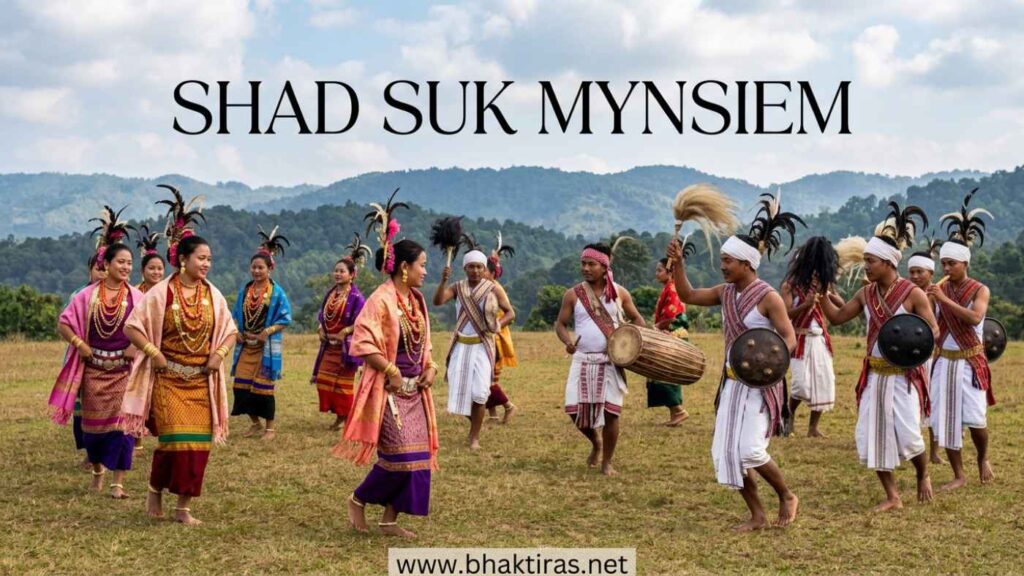
Shad Suk Mynsiem, the “Dance of the Joyful Heart”, is the great spring thanksgiving festival of the Khasi people of Meghalaya. Held each April at the Weiking ground in Shillong, it runs for three days and belongs to the indigenous Niam Khasi faith. Unmarried women in gold and silk dance slowly at the centre while men circle them with swords and whisks. The gathering thanks U Blei, the one God, for the harvest and honours the place of women in Khasi life.
Shad Suk Mynsiem 2026-2028: Dates & Calendar
The next Shad Suk Mynsiem is in April 2027. The festival is always held in April, at the close of the sowing and harvest cycle, but the precise three days are announced each year by the Seng Khasi.
| Year | Dates | Main day | Notes |
|---|---|---|---|
| 2026 | Mid-April | Approx. 13 April | Held earlier in 2026; already passed |
| 2027 | Approx. 14-16 April | Approx. 16 April | Next occurrence at Weiking, Shillong |
| 2028 | Mid-April | Approx. 14 April | To be fixed by the Seng Khasi |
For reference, the 2025 festival ran from 5 to 7 April, with 7 April declared a local holiday in the East Khasi Hills. Because the schedule shifts by a few days each year, the dates above are indicative rather than fixed.
Why Shad Suk Mynsiem Is Celebrated
Shad Suk Mynsiem is celebrated as a thanksgiving to U Blei for the harvest and as a public honouring of women in Khasi society. The dance retells the yearly cycle of sowing and reaping through movement.
A harvest thanksgiving
The festival marks the end of the agricultural year. After the fields have been sown and gathered, the community comes together to thank U Blei, the one God of the Niam Khasi faith, for a good season. The mood is grateful and unhurried rather than loud.
The sowing-harvest cycle
The choreography is a living metaphor for farming. The women at the centre are read as seed and mother earth, the men around them as those who till and guard the crop. The slow, circling movement mirrors the turning of the seasons on which Khasi life depends.
Honouring and protecting women
The Khasi are a matrilineal people, and the festival makes that visible. Women hold the sacred inner ground while men take the outer ring, sword in hand, as protectors. It is a public statement that the dignity and safety of women sit at the heart of the community.
The Niam Khasi identity
Organised by the Seng Khasi, the festival keeps the indigenous Khasi religion and its customs alive across generations. For many families it is the clearest annual expression of who the Khasi are, distinct from the region’s later religious influences.
Key Rituals, Step by Step
The three days at Weiking follow a familiar order, from opening prayers to the great circling dance and its closing.
- Opening prayers. Elders of the Seng Khasi open the gathering with invocations to U Blei, offering thanks for the harvest and asking blessings on the community and the dancers.
- The dancers assemble. Unmarried women in gold ornaments and silk take their places at the centre of the ground, forming the inner rings of the dance.
- The maidens’ dance begins. The women dance slowly and with restraint, eyes lowered, holding a white handkerchief that stands for purity and maidenhood. Their measured steps set the tone for the whole festival.
- The men form the protective circle. Young men move in an outer ring around the women, carrying a sword in one hand and a yak-tail whisk in the other, dancing with more vigour as guardians of the inner ground.
- Drums and the tangmuri lead. The rhythm of the ka nakra drum, the melody of the ka tangmuri pipe and the beat of cymbals guide the dancers; changes in the music signal changes in the pattern of the dance.
- The dance repeats over three days. The cycle of prayer and dance continues across the festival, drawing families and visitors to the edge of the ground to watch.
- Closing. The festival ends with final thanks to U Blei, sealing the community’s gratitude for the season that has passed and its hopes for the one to come.
Special Foods Around Shad Suk Mynsiem
Khasi festival food is simple, rice-based and centred on shared meals. These dishes are commonly eaten around the festival in Shillong and the Khasi hills.
Jadoh
A one-pot dish of rice cooked with meat, usually pork, and local spices. Jadoh is the signature comfort food of the Khasi table and a natural centre for a festival meal.
Dohneiiong
Pork cooked with black sesame, giving a dark, nutty gravy that is eaten with rice. It is one of the best-loved everyday and festive Khasi dishes.
Tungrymbai
A pungent paste of fermented soybean, cooked with pork and spices. It is an acquired taste for outsiders but a staple of Khasi home cooking.
Kyat (rice beer)
A traditional home-brewed rice beer that features at Khasi social and ritual occasions. It is part of the older indigenous custom rather than a commercial drink; treat it as a cultural offering and follow local cues.
Where Shad Suk Mynsiem Is Held
The festival is a Khasi tradition of Meghalaya. Its grandest form is at Shillong, but villages across the Khasi hills hold their own versions.
Weiking, Shillong
The central and best-known celebration takes place at the Weiking ground in Shillong, drawing dancers, families and visitors from across the state. This is the version most travellers come to see.
Khasi villages
Smaller Shad Suk Mynsiem gatherings are held in Khasi villages beyond the capital, keeping the tradition rooted in local communities rather than in one place alone.
Khasi diaspora
Khasi communities living outside Meghalaya mark the season and their Niam Khasi identity in a quieter way, often through community gatherings rather than the full three-day dance.
Shad Suk Mynsiem Do's and Don'ts
This is a living religious festival of an indigenous community, so attend as a respectful guest.
Do
- Watch from the edge of the ground and let the dancers have their space.
- Ask before photographing individual dancers, and respect anyone who declines.
- Dress modestly and neatly out of respect for the occasion.
- Learn a little about the Niam Khasi faith and the Seng Khasi before you go.
- Follow the guidance of organisers and local elders at the venue.
Avoid
- Do not step onto the dance ground or interrupt the dancers for a photo.
- Do not treat the festival as a mere spectacle or costume show; it is a faith observance.
- Do not use flash or drones near the dancers without clear permission.
- Do not touch dancers’ ornaments, swords or ritual items.
- Do not make loud noise, joke about the rituals or block others’ view.
Frequently Asked Questions
When is Shad Suk Mynsiem in 2027?
Shad Suk Mynsiem is expected in mid-April 2027, around 14-16 April, at the Weiking ground in Shillong. It always falls in April but the exact three days are set each year by the Seng Khasi, so confirm the schedule locally before you plan a visit.
What does Shad Suk Mynsiem mean?
Shad Suk Mynsiem means the “Dance of the Joyful (or Peaceful) Heart” in the Khasi language. It is a spring thanksgiving dance festival of the Khasi people of Meghalaya, held to thank U Blei, the one God of the indigenous Niam Khasi faith, for the harvest.
Where is Shad Suk Mynsiem celebrated?
Shad Suk Mynsiem is celebrated in Meghalaya, with its largest gathering at the Weiking ground in Shillong. Smaller versions are held in Khasi villages across the hills, making it a tradition of the whole Khasi community rather than one town.
Why do women dance in the centre and men around them?
At Shad Suk Mynsiem, unmarried women dance slowly in the centre while men circle them with swords and whisks. The women represent seed, purity and the mother, and the men represent those who till and protect the crop; the pattern reflects the sowing-harvest cycle and the honour and protection of women in Khasi matrilineal society.
Which faith does Shad Suk Mynsiem belong to?
Shad Suk Mynsiem belongs to the Niam Khasi, the indigenous religion of the Khasi people, and is organised by the Seng Khasi. It is a thanksgiving to U Blei, the one God, and is distinct from the region’s later religious traditions.
How long does Shad Suk Mynsiem last?
Shad Suk Mynsiem lasts three days. The days combine opening prayers, the slow dance of the women at the centre and the vigorous outer dance of the men, all set to the ka nakra drum and the ka tangmuri pipe.
What do the dancers wear?
Women wear silk garments and gold ornaments, including a crown or tiara, and carry a white handkerchief for purity, while men dance in traditional dress carrying a sword and a whisk. The finery is worn to honour the occasion and the dignity of the women at the heart of the dance.
Can visitors attend Shad Suk Mynsiem?
Yes, visitors are welcome to watch Shad Suk Mynsiem at Weiking in Shillong. Attend as a respectful guest: stay at the edge of the ground, ask before photographing dancers, dress modestly and follow the guidance of the Seng Khasi organisers.
May your season be blessed with a joyful heart. Khublei.