
Ker Puja 2026 – Tripura's Guardian-Deity Festival
কের পূজা
When is Ker Puja in 2026?
Ker Puja 2026 falls on Wednesday, 5 August, and runs for about two and a half days. It is a state festival of Tripura held roughly a fortnight after Kharchi Puja, worshipping Ker, the guardian deity who watches over a marked-out area. For its duration no one may enter or leave the boundary, and silence and fasting are observed inside it.
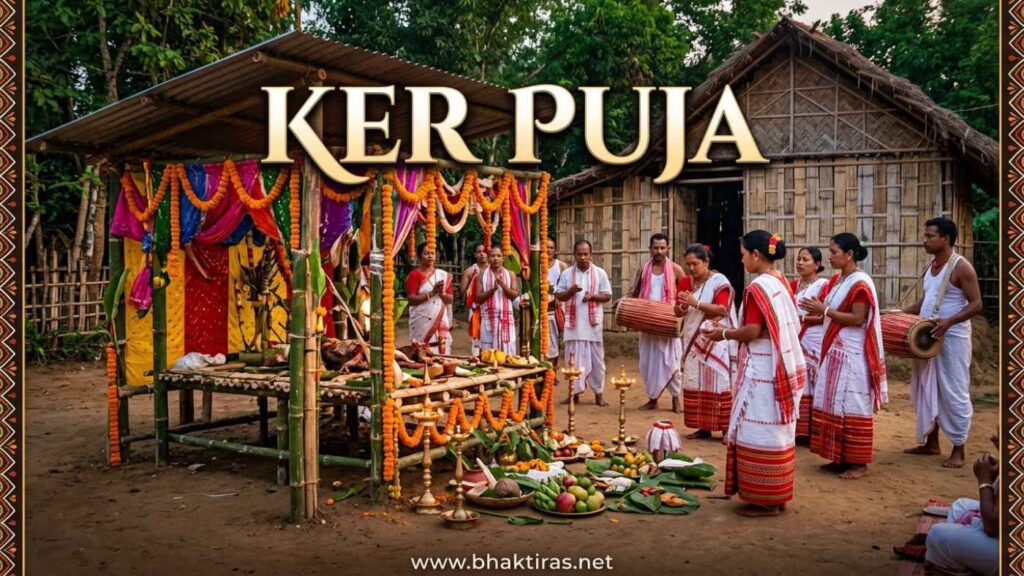
Ker Puja is one of Tripura’s oldest state festivals, held about a fortnight after Kharchi Puja, usually in late July or August. It honours Ker, a guardian deity who protects a fixed area rather than a temple idol. For roughly two and a half days a boundary around the old capital is sealed off: no one may cross it, no loud sound is allowed, mourning is set aside and residents fast. The whole observance is a collective plea for the region to be kept safe from calamity, disease and outside harm.
Ker Puja 2026-2028: Dates & Calendar
The next Ker Puja is on 5 August 2026. Because it is fixed by the lunar calendar and tied to Kharchi Puja, the Gregorian date shifts each year.
| Year | Date | Day | Notes |
|---|---|---|---|
| 2025 | 19 July | Saturday | Held about a fortnight after Kharchi Puja |
| 2026 | 5 August | Wednesday | Next occurrence; about 2.5 days |
| 2027 | Late July (approx.) | To be fixed | Confirmed nearer the date by the state calendar |
| 2028 | Mid-August (approx.) | To be fixed | Confirmed nearer the date by the state calendar |
The 2025 and 2026 dates are firm. The 2027 and 2028 windows are estimates only, since Ker Puja moves with the moon and follows Kharchi Puja; the Tripura government publishes the exact day each year.
Why Ker Puja Is Celebrated
Ker Puja is celebrated to seek the protection of Ker, the guardian deity of a demarcated area, so that the community is shielded from calamity, epidemic and external threat. It is a state festival of Tripura that dates back to the Manikya kings.
The word Ker comes from the Kokborok language and means a ‘fixed area’ or boundary. So Ker Puja is not worship of a personal god in a shrine, but the honouring of a protective spirit tied to a piece of land. The deity guards whatever lies inside the marked line, which is why the ritual is as much about the boundary itself as about any image.
A guardian of the land
Ker is regarded as the guardian deity of Vastu, the presiding power of a place. The puja asks Ker to keep the enclosed area free of evil influence, disease and misfortune for the year ahead. Protection of the whole community, not personal favour, is the point.
A royal, state ritual
The festival goes back to the Manikya dynasty, the old Hindu rulers of Tripura, and was performed by the kings for the welfare of their subjects. After the kingdom merged with India, the Tripura government took over its organisation in 1949 and continues to fund and conduct it.
The sequel to Kharchi Puja
Ker Puja is deliberately held about two weeks after Kharchi Puja, the worship of Tripura’s fourteen deities. Where Kharchi cleanses and honours the gods, Ker seals and guards the space, so the two form a linked cycle of purification and then protection.
The Deity Ker
The single focus of the festival is Ker, the guardian deity of a bounded area. There is no ornate idol; the deity is represented through bamboo and the marked-off space itself.
Ker (Ker Devata)
Ker is worshipped as the protector of Vastu, the spirit of the place. It is believed to shield the enclosed area from evil forces, black magic and disaster. Unlike most Hindu deities, Ker is honoured as a power of the land rather than as a figure with a mythological life story.
The bamboo symbol
A large green bamboo is bent into a curved shape to stand for Ker, and this bent bamboo is central to the rite. Long strands of green bamboo also mark out the sacred boundary. The living bamboo, rather than a carved image, is how the deity is made present.
Key Rituals, Step by Step
Ker Puja follows a set sequence over about two and a half days, from marking the boundary to lifting the restrictions.
- Timing after Kharchi. The observance is scheduled about a fortnight after Kharchi Puja, so preparations begin once that seven-day festival has ended.
- Demarcating the boundary. A specific area, historically around the old capital, is marked out and enclosed with long strands of green bamboo, which become the symbolic body of Ker.
- Shaping the bamboo deity. A large bamboo is bent into a curved form to represent Ker Devata and is set up as the focus of worship within the boundary.
- Sealing the area. All entry and exit points are closed. For the roughly two and a half days of the puja, no one may enter or leave the enclosed zone, and even those inside stay put.
- The main worship. Priests conduct the worship, usually in the morning hours, with offerings made to Ker so that the deity keeps the community safe from epidemic, calamity and outside aggression.
- Silence and fasting. While the restrictions hold, residents keep silence, avoid fire and noise, set mourning aside and observe a fast as an act of collective discipline.
- Lifting the restrictions. At the appointed close, the ban is formally lifted, the boundary is reopened, and normal life resumes. The sounding of guns or cannon traditionally marks the start and end of the observance.
Fasting and Food During Ker Puja
Ker Puja is centred on restraint, so its food customs are mostly about fasting; simple offerings and prasad follow once the puja is complete.
Fasting inside the boundary
Those within the sealed area observe a fast for the duration of the restrictions. Abstaining from ordinary meals is treated as part of the discipline that keeps the space pure and the deity favourable.
Offerings to Ker
Simple offerings are presented to the deity during the worship as prayers for the safety and welfare of the community. The emphasis is on the act of offering rather than on any elaborate festive spread.
Prasad after the close
Once the restrictions are lifted and the boundary reopens, the fast is broken and consecrated food is shared as prasad. This return to normal eating marks the community’s release from the sealed period.
Where Ker Puja Is Observed
Ker Puja is specific to Tripura and to its Tripuri community, with the main observance historically centred on the old capital.
Agartala and the old capital
The best-known observance covers the area around the state capital, where entry points are closed for the puja. The boundary tradition reflects the festival’s origin as a rite for the royal seat of the Tripura kingdom.
Tripuri community
Ker Puja is rooted in the indigenous Tripuri people and the Kokborok language, from which the word ‘Ker’ comes. It is one of the community’s defining festivals and a marker of Tripuri identity.
A state occasion
Because the government took over its organisation in 1949, Ker Puja is observed as an official occasion across Tripura, with senior state figures taking part in the rituals.
Ker Puja Do's and Don'ts
The whole festival is defined by a set of strict rules kept inside the sealed boundary.
Do
- Respect the sealed boundary and stay within or outside it as the rules require
- Keep silence and observe the fast if you are inside the enclosed area
- Follow the instructions of the priests and organisers throughout
- Treat the bamboo form and the marked space as sacred to Ker
- Approach the festival respectfully as a Tripuri and royal tradition
Avoid
- Do not enter or leave the boundary while the restrictions are in force
- Do not make loud noise, sing, dance or cry within the sealed area
- Do not carry out mourning rites during the observance
- Do not light fires or break the fast before the puja closes
- Do not cross the line for any reason except a genuine emergency, which traditionally carried a penalty
Frequently Asked Questions
When is Ker Puja in 2026?
Ker Puja 2026 falls on Wednesday, 5 August, and lasts for about two and a half days. It is held in Tripura roughly a fortnight after Kharchi Puja. The exact day is set by the lunar calendar and announced by the state government each year.
When was Ker Puja in 2025 and when will it be in 2027 and 2028?
Ker Puja 2025 was on 19 July. Because the festival moves with the moon and follows Kharchi Puja, 2027 is expected in late July and 2028 around mid-August, but these are approximate; the Tripura government confirms the precise date closer to the time.
Why is Ker Puja celebrated?
Ker Puja is celebrated to seek the protection of Ker, the guardian deity of a bounded area, so that the community is kept safe from calamity, disease and outside threat. It is an old state ritual of Tripura, once performed by the Manikya kings for the welfare of their people.
Which deity is worshipped in Ker Puja?
Ker Puja worships Ker, also called Ker Devata, the guardian deity of Vastu, meaning the protective power of a place. There is no carved idol; the deity is represented by a bent green bamboo and by the marked-off boundary itself, which Ker is believed to guard.
What does the word 'Ker' mean?
The word ‘Ker’ comes from the Kokborok language of Tripura and means a ‘fixed area’ or boundary. The festival is therefore the worship of a spirit tied to a demarcated space, which is why marking and sealing the boundary is central to the ritual.
Why are people not allowed to enter or leave during Ker Puja?
During Ker Puja all entry and exit points of the enclosed area are closed for about two and a half days so that the sacred space stays undisturbed and pure. No one may cross the boundary, and inside it people keep silence, avoid fire and noise, set mourning aside and fast. Crossing the line was traditionally allowed only in a genuine emergency.
How is Ker Puja connected to Kharchi Puja?
Ker Puja is deliberately held about two weeks after Kharchi Puja, the worship of Tripura’s fourteen deities. Kharchi honours and cleanses the gods, while Ker seals and guards the space afterwards, so the two festivals form a linked cycle of purification and protection in the Tripuri calendar.
Where is Ker Puja celebrated?
Ker Puja is celebrated in Tripura, chiefly in the area around the state capital that once formed the royal seat of the kingdom. It is rooted in the indigenous Tripuri community, and since 1949 the state government has organised and funded the festival.
May the guardian Ker keep your home and community safe this season. Ker Puja greetings from Tripura.