
Goddess Maheshwari
माहेश्वरी
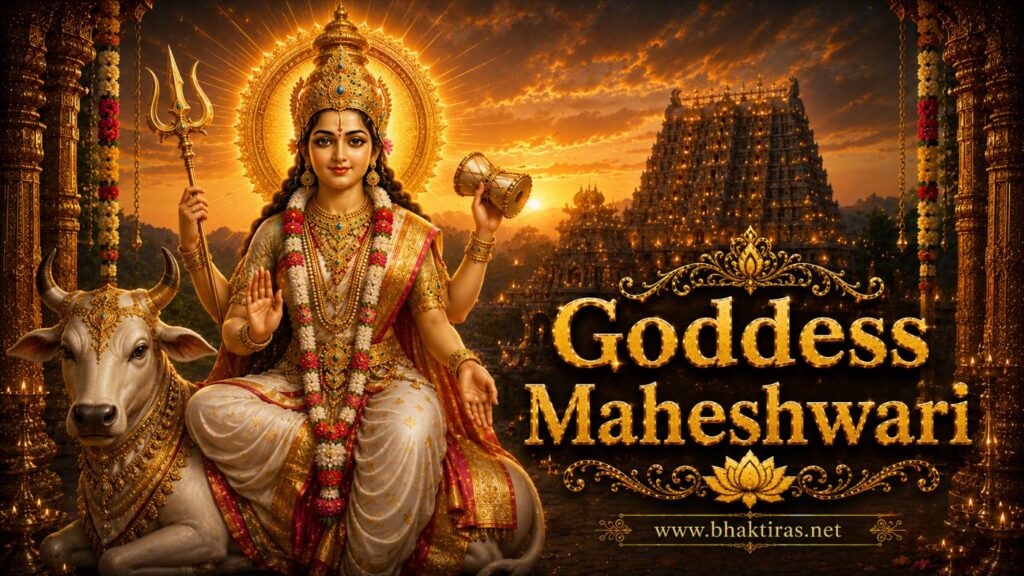
Maheshwari is the feminine power of Lord Shiva and one of the Saptamatrika, the seven mother goddesses. She carries Shiva's own emblems – the trident, the drum, the rosary and the skull-bowl – and rides his bull Nandi. Devotees revere her as a mother of inner strength, of transformation, and of release from the grip of the ego.
Who Is Goddess Maheshwari?
Goddess Maheshwari is the feminine face of Lord Shiva. Her name is the direct counterpart of Maheshvara, one of Shiva’s great titles meaning ‘the supreme Lord’, and so she is often understood as ‘the supreme Goddess’ – the power through which Shiva acts in the world. Where Shiva sits in silent stillness, Maheshwari is that stillness made active, the energy that carries his will into form.
She belongs to a group of seven mother goddesses known as the Saptamatrika. Each of these mothers is the Shakti, or living power, of a great god – and Maheshwari is the Shakti of Shiva. Because of this, she is not a separate figure standing apart from him but the same reality seen from another side: the god and his power are two names for one truth.
In her images she carries everything that marks Shiva. She wears the crescent moon in her matted hair, bears a third eye on her brow, drapes serpents at her throat, and holds his trident and skull-bowl. To look at her is to see Shiva reflected in a mirror – the same face, now maternal, now turned toward those who seek shelter.
Devotees come to Maheshwari for the qualities Shiva is known for: the strength to stand firm, the power to change what seems fixed, and the grace to let the ego fall away. She is worshipped as a mother of transformation, one who does not simply comfort but remakes those who turn to her.
The Shakti of Shiva
To call Maheshwari the Shakti of Shiva is to say something precise about how the divine is understood in these traditions. Shiva, in his deepest nature, is pure consciousness – vast, unmoving, present everywhere and doing nothing. Shakti is what allows that consciousness to become active: to create, to sustain, to dissolve. Without her, Shiva is described as still and silent; with her, worlds arise. Maheshwari is that active power wearing Shiva’s own form.
This is why she is honoured as a mother rather than only as a warrior. A mother is the source from which life comes, and Maheshwari is the source through which Shiva’s sovereignty reaches the world. The powers people associate with Shiva – his mastery over time, his freedom from fear, his authority over gods and demons alike – flow through her into those who worship her.
Her role also carries the weight of transformation. Shiva is the one who dissolves, who ends what has run its course so that something new can begin. Maheshwari takes up this same work in a nurturing key. She does not destroy to wound; she clears away what has grown heavy and false so that a person can begin again. In this she is fierce and gentle at once – the mother who will not let her child stay trapped.
The Mirror of Shiva
Everything Maheshwari carries is borrowed from Shiva, and each emblem tells part of his story. She rides Nandi, the white bull, who is Shiva’s own mount and his most devoted servant. The bull carries a meaning: it is steadiness and quiet strength, the disciplined power that waits patiently and moves only when called. To see Maheshwari seated on Nandi is to see Shiva’s own composure made visible.
The crescent moon rests in her hair. On Shiva it marks his rule over time and the cycles of waxing and waning; on Maheshwari it carries the same sign, the cool light that survives even in darkness. The serpents coiled about her show her ease with what others fear – the raw energy that would be poison to the untrained, held calmly in her hands.
Her third eye is perhaps the clearest mirror of all. In Shiva, the third eye is the eye of inner sight, the one that burns away illusion and, when opened, reduces desire itself to ash. Maheshwari bears this same eye – a promise that she sees past the surface of things, past the masks we wear, into the truth of who a person really is.
She holds the trident and the skull-bowl, the drum and the rosary. Nothing in her form is her own invention; all of it is Shiva’s. And yet, held in a mother’s hands, these severe emblems soften. The trident that pierces becomes protection; the skull that reminds us of death becomes a teaching about what is worth keeping.
Maheshwari Among the Saptamatrika
Maheshwari is never worshipped entirely alone. Her natural place is within the circle of the Saptamatrika, the seven divine mothers who are always shown and honoured together. Beside her stand Brahmani, the power of Brahma; Vaishnavi, the power of Vishnu; Kaumari, Varahi, Indrani, and Chamunda. Each is a great god’s energy taken form as a mother, and together they make a company of terrible tenderness.
The story that gathers them appears in the Devi Mahatmya, the ancient text that celebrates the Great Goddess and her victories. When the Goddess went to war against powerful demons who could not be beaten by ordinary means, the gods sent their own energies to fight at her side. From Shiva there came Maheshwari, riding a great bull, holding the trident and wearing the serpents and crescent that are his signs. She and her sister mothers poured their strength into the Goddess and struck at the demon hosts.
In that story the Matrikas show a truth about divine power: it is not scattered but shared. Each god releases his energy, and those energies act as one. Maheshwari’s part is Shiva’s part – the force that dissolves, that ends the demon’s grip so that order and life can return. Because of this she is remembered not only as a mother but as a protector who arrives when the situation seems past saving.
Goddess of Transformation and Liberation
The gift most closely tied to Maheshwari is transformation – and beyond it, liberation. Shiva is the great dissolver, the one who ends things, and this ending is not treated as loss but as freedom. When something binds us – a habit, a fear, a false idea of who we are – it takes a kind of destruction to be free of it. Maheshwari is the mother who performs that gentle destruction.
The mind, in these traditions, is described as restless – a stream of wants and worries that rarely grows quiet. The ego, the small self that insists on its own importance, keeps that stream churning. Maheshwari’s third eye is aimed exactly here. She is invoked to still the restless mind and to burn away the ego’s grip, not out of cruelty but so that a person can finally rest in something larger than themselves.
This is why she is called a mother of liberation. Strength she certainly gives, and transformation she works, but the aim of both is release – moksha, freedom from the endless round of grasping and fear. To worship Maheshwari is to ask not merely for help within the world but for help beyond it: for the clear, quiet freedom that Shiva embodies and that she, as his power, extends to those who seek her.
Iconography & Symbols
Nandi, the Bull
Maheshwari rides Nandi, the white bull who is Shiva’s own mount. The bull stands for patient strength and unwavering devotion – power that is disciplined and calm, ready to serve. Seeing her upon Nandi marks her as the feminine form of Shiva himself.
The Trishula (Trident)
The three-pronged trident is Shiva’s chief weapon, and Maheshwari carries it as her own. Its three points are read as the threefold rhythm of creation, preservation, and dissolution – the whole span of existence held in a single hand, and the power to cut through all that binds.
The Damaru (Drum)
The small hourglass drum sounds the pulse of creation. In Shiva’s hand it beats out the rhythm of the cosmic dance; in Maheshwari’s it carries the same meaning – the sound from which forms arise and into which they return.
The Kapala (Skull-Bowl)
The skull-bowl is a stark reminder that all forms pass away. Far from being grim, it is a teaching held in a mother’s hands: because life is brief, it must be lived with awareness. It also marks her fearless mastery over death itself.
Serpents, Moon & Third Eye
Serpents coil at her throat as a sign of energy tamed rather than feared. The crescent moon in her hair shows her rule over time, cool and enduring. And the third eye upon her brow is the eye of inner sight, which burns illusion away and sees each soul as it truly is.
How Goddess Maheshwari Is Worshipped
Maheshwari is most often worshipped as part of the Saptamatrika, and her devotion draws on the wider traditions of Shiva and the Divine Mother. The practices below are the common ways her presence is honoured.
- Worship within the Saptamatrika group, where the seven mothers are venerated together as a single company of divine power
- Recitation of the Devi Mahatmya, especially the passages that describe the Matrikas rising to aid the Great Goddess in battle
- Chanting of her mool mantra, Om Maheshwaryai Namah, as a steady practice for strength and inner calm
- Offerings tied to Shiva’s worship – bilva leaves, water, and lamps – since Maheshwari shares his form and his emblems
- Meditation on her third eye and her trident, used to quiet the restless mind and loosen the ego’s hold
- Tantric ritual, in which the Matrikas are invoked together as protectors and as powers of transformation
Temples & Sacred Sites
Maheshwari is rarely enshrined by herself. Her image appears alongside the other mothers wherever the Saptamatrika are carved and worshipped, and such places are found across the land.
- Saptamatrika shrines across India, where the seven mothers are enshrined in a row and Maheshwari holds her place among them
- Ancient rock-cut and stone temples of the Deccan and beyond, whose walls carry Matrika panels showing each goddess with her god’s emblems
- Shakta and Tantric temples, where the Matrikas are installed as guardians and as focal points of transformation
- Shiva temples that also honour the Divine Mother, where Maheshwari is recognised as Shiva’s own power in feminine form
- Regional Matrika shrines throughout North, South, East, and West India, reflecting how widely the seven mothers are venerated
Prayers & Mantras
The simplest and most cherished way to call upon Maheshwari is her seed mantra, offered with a still mind and a bowed head. It names her directly and places the devotee in her care.
Mantra:
ॐ माहेश्वर्यै नमः
Om Maheshwaryai Namah
Meaning: ‘Om, salutations to Maheshwari.’ In these few words the devotee turns toward the feminine power of Shiva, asking for her strength, her transforming grace, and the quiet freedom she carries. Repeated with attention, the mantra is meant less to petition than to settle the mind into her presence.
Frequently Asked Questions about Goddess Maheshwari
Who is Goddess Maheshwari?
Maheshwari is the feminine power, or Shakti, of Lord Shiva and one of the Saptamatrika, the seven mother goddesses. She carries Shiva's own emblems – the trident, drum, rosary and skull-bowl – rides his bull Nandi, and is worshipped as a mother of strength, transformation, and liberation.
Is Maheshwari the same as Parvati?
They are closely related but not identical in role. Parvati is Shiva's consort, his companion and wife. Maheshwari is specifically his Shakti in the Matrika group – his active power taken form as a mother goddess. Both express Shiva's feminine energy, but Maheshwari's identity is tied to the seven mothers and their work in the Devi Mahatmya.
What does Maheshwari represent?
She represents Shiva's own powers made active and maternal – sovereignty, transformation, and the dissolving of the ego. Because she mirrors Shiva, she stands for the stilling of the restless mind and the freedom that comes when false attachments fall away. Devotees revere her as a mother of inner strength and liberation.
Why does Maheshwari carry Shiva's symbols?
Because she is Shiva's power in feminine form, she naturally bears everything that marks him: the trident, the drum, the rosary, the skull-bowl, the crescent moon, the serpents, and the third eye. Her form is a mirror of Shiva, showing that the god and his Shakti are two aspects of one reality.
What is Maheshwari's role in the Devi Mahatmya?
In the Devi Mahatmya, when the Great Goddess fought powerful demons, the gods sent their energies to help her. From Shiva emerged Maheshwari, riding a great bull and holding his trident. She joined the other mother goddesses in striking down the demon hosts, lending Shiva's dissolving power to the Goddess's victory.
How is Goddess Maheshwari worshipped?
She is honoured chiefly within the Saptamatrika, the group of seven mothers worshipped together. Devotion includes reciting the Devi Mahatmya, chanting her mantra Om Maheshwaryai Namah, offering the bilva leaves and lamps used in Shiva worship, and meditating on her third eye and trident to quiet the mind.
What does the name Maheshwari mean?
Maheshwari is the feminine form of Maheshvara, a title of Shiva that means 'the great Lord'. So her name means 'the great Goddess'. It marks her as Shiva's counterpart – the supreme power through which the supreme Lord acts in the world.
May Goddess Maheshwari steady your mind, lighten the weight you carry, and lead you gently toward the freedom that is her gift.