
Mohini Avatar
मोहिनी
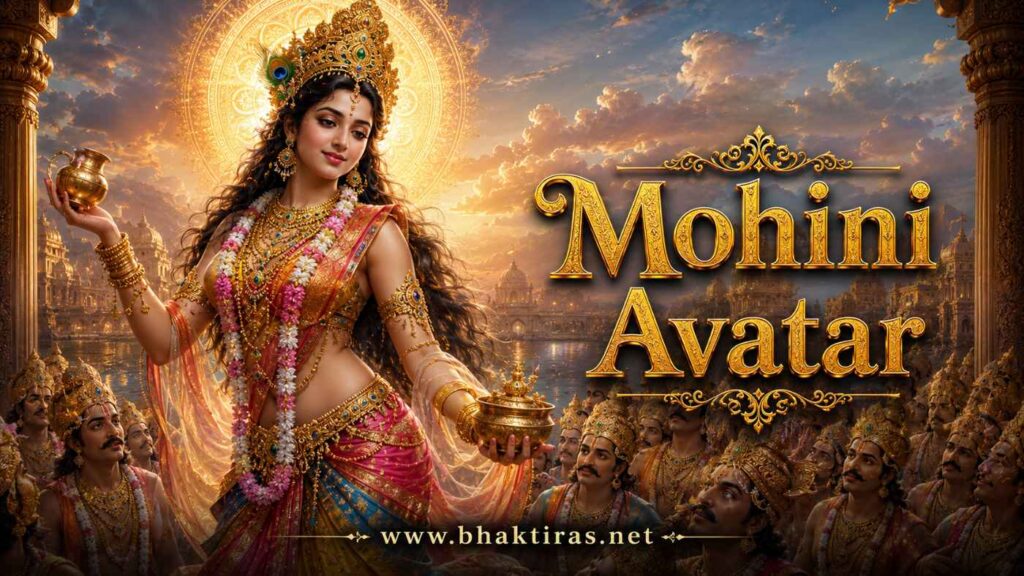
Mohini is the enchanting female form taken by Lord Vishnu, the only occasion the Lord appears as a woman. Her name means the enchantress. She is best known from the churning of the ocean, where she beguiled the demons and gave the nectar of immortality to the gods, guarding cosmic order.
Who Is the Mohini Avatar?
Among the many forms of Lord Vishnu, Mohini holds a place unlike any other. She is the single occasion in all the sacred stories when the great preserver of the universe sets aside his familiar male form and appears as a woman – and not simply a woman, but one of such beauty that gods, sages, and demons alike lose their composure before her. The name Mohini comes from the root moha, meaning to bewitch, to charm, to cloud the mind with longing. She is, quite literally, the enchantress.
Yet Mohini is far more than a beautiful face. In every account, her charm is not vanity but a weapon – a gentle, dazzling instrument turned always toward the protection of what is right. Where brute force would fail, her grace succeeds. The demons who could not be defeated in open war are undone by their own desire to be near her.
The Puranas and the Mahabharata preserve her chief appearances, and each one carries the same quiet lesson: that the divine can wear softness as easily as strength, and that beauty, in the hands of the Lord, becomes a shield for the good.
The Only Time Vishnu Became a Woman
Hindu tradition speaks of Vishnu descending again and again to restore balance – as fish, tortoise, boar, man-lion, dwarf, warrior, prince, and cowherd. In all of these he is unmistakably himself, masculine and sovereign. Mohini breaks that pattern. She is the one form in which the Lord chooses the feminine, and the tradition never treats this as a small thing.
The choice is deliberate and meaningful. When a situation cannot be solved by confrontation, when raw power would only make matters worse, Vishnu turns instead to maya – the power of enchantment and illusion. Mohini is that power given a face and a body. Her weapon is fascination itself.
This is why she matters far beyond the drama of any single tale. Mohini teaches that wisdom sometimes wears grace rather than a mace, that the mind can be won where the body cannot be forced, and that the feminine holds a strength of its own – subtle, patient, and complete. The Lord who is beyond gender shows, through her, that every quality of creation flows from the same divine source.
Mohini and the Nectar of Immortality
Mohini’s most celebrated appearance comes during the Samudra Manthan, the churning of the ocean of milk. The gods and the demons, using the great serpent as a rope and a mountain as a churning rod, laboured together to draw out the hidden treasures of the deep. From the churning ocean rose many wonders, and at last emerged Dhanvantari, the divine physician, holding the pot of amrita – the nectar that grants deathlessness.
The nectar is seized
The moment the pot appeared, the demons snatched it away, quarrelling among themselves over who would drink first. Had they succeeded, the balance of the worlds would have tipped toward chaos, for demons made immortal could never be checked. The gods, weary and outmatched in the scramble, turned to Vishnu.
The enchantress arrives
Vishnu took the form of Mohini – a woman of such loveliness that the demons forgot the very reason they had fought. Charmed and dazzled, they willingly handed her the pot, trusting this radiant stranger to divide the nectar fairly between the two sides.
The nectar goes to the devas
Mohini seated the gods and demons in separate rows and, with graceful gestures that held every eye, began to serve. Careful and unhurried, she passed the amrita to the gods alone, giving the demons only her smile and her sweet words. By the time the trick was understood, the devas had secured their immortality.
Rahu is detected
One demon, Rahu, disguised himself and slipped into the row of gods to steal a sip. The Sun and Moon recognised him and warned Mohini. Before the nectar could pass his throat, she struck off his head with the discus. His head lived on, immortal, becoming the shadow that ever chases the Sun and Moon – a reminder that no disguise escapes the Lord’s watchful eyes.
Through Mohini, the churning ended as it was meant to: the gods restored, cosmic order preserved, and the demons left with nothing but the memory of a face they could not resist.
The Fall of Bhasmasura
Another beloved story shows Mohini’s charm turned against a danger that threatened even the gods. The demon Bhasmasura had performed fierce austerities and won from Lord Shiva a terrible boon: whomever he touched upon the head would instantly be reduced to ashes.
A boon turned to menace
No sooner had Bhasmasura received the power than he decided to test it upon Shiva himself, so that he might seize the Lord’s place. Shiva fled, and the danger spread alarm through the heavens, for a boon once granted could not be taken back.
The dance
Vishnu appeared as Mohini and greeted the pursuing demon with a smile. So taken was Bhasmasura with her beauty that he begged her to be his. She agreed on one condition – that he match her, step for step, in dance. Blinded by longing, he consented.
His own hand
Mohini danced, and Bhasmasura followed her every movement. Gradually she brought her own hand to rest upon her head in a graceful pose. The demon, mirroring her without thought, placed his palm upon his own head – and in that instant was reduced to ash by the very boon he had sought to misuse.
The tale is a quiet warning: power sought for domination turns upon its owner, while grace guided by wisdom needs no violence to prevail.
Mohini and Shiva – the Birth of Ayyappa
One of the most profound episodes involving Mohini is her meeting with Lord Shiva. When Shiva heard of the form Vishnu had taken to save the nectar, he wished to behold this enchantress for himself. Vishnu again assumed the shape of Mohini, and even Shiva – the great ascetic, lord of renunciation – was moved by her beauty.
From the union of Shiva and Mohini was born Lord Ayyappa, also honoured as Hariharaputra, the son of Hari (Vishnu) and Hara (Shiva). The name itself carries a marvel: a child born of the two supreme deities of the tradition, uniting the preserver and the destroyer in a single divine form.
Ayyappa is deeply loved across South India, and his great pilgrimage at Sabarimala in Kerala draws countless devotees each year. In him, the meeting of Mohini and Shiva becomes something lasting and living – a bridge between two of the mightiest streams of Hindu devotion, and a reminder that the divine forms, however distinct they seem, spring from one shared source.
The Power of Enchantment in the Service of Dharma
What unites every story of Mohini is a single idea: that maya, the power of enchantment and illusion, can be a force for good. In many teachings maya is what veils the truth and binds the soul to the world of appearances. Mohini turns that same power to a higher end. Her illusion does not deceive the innocent; it disarms the dangerous.
The demons she charms are those who would swallow immortality and never be checked, or who would misuse a boon to rule by fear. Against them, force alone repeatedly fails. It is beauty, wit, and grace – the softer arts – that succeed where weapons cannot. In Mohini, the tradition honours a truth easily forgotten: that gentleness can be a strategy, and that the mind won over yields more surely than the body overpowered.
She also stands as a reminder that appearance is not the whole of reality. Those who see only Mohini’s loveliness are undone by it; those who understand what stands behind the form are protected by it. Her stories invite the devotee to look past the surface of things toward the divine will that moves within them – and to trust that the Lord’s play, however it appears, always bends toward the good.
Iconography & Symbols
The Pot of Amrita
Mohini is most often shown holding the kalasha, the vessel of nectar she distributed to the gods. It marks her as the guardian and giver of immortality – the one through whom the deathless gift reached its rightful keepers.
Matchless Beauty
Her form is that of a young woman of extraordinary loveliness, adorned with fine ornaments and flowing garments. This beauty is not decoration alone; it is her instrument, the very means by which she accomplishes the Lord’s work.
The Dancing Posture
Because dance figures in her tales – most vividly in the fall of Bhasmasura – Mohini is often depicted in a graceful, dance-like stance, one hand raised, her body poised in fluid motion. This links her closely to the Mohiniyattam tradition of Kerala.
The Discus
In some images she bears Vishnu’s discus, the weapon that struck off Rahu’s head. It quietly reminds the viewer that beneath the enchanting form stands the full power and vigilance of Lord Vishnu himself.
How Mohini Is Remembered
Though few temples are dedicated to Mohini alone, her presence runs through worship, art, and story across India, and especially through the culture of Kerala.
- Mohiniyattam – the graceful classical dance of Kerala takes its very name from Mohini. Its gentle, swaying movements and expressive gestures are said to echo the enchantress herself, and it remains one of the state’s most treasured art forms.
- Ayyappa devotion – through her son Ayyappa and the great Sabarimala pilgrimage, Mohini is honoured indirectly by millions who trace the god’s origin to her union with Shiva.
- Temple shrines – certain temples preserve images or shrines recalling the Mohini form of Vishnu, and her story is retold in sculpture and painting on temple walls across the south.
- Retelling in festivals – the churning of the ocean and the winning of the nectar are recounted and enacted during many religious observances, keeping Mohini’s role in the great cosmic drama alive for each generation.
- Sacred literature – her episodes in the Bhagavata, Vishnu, and Brahmanda Puranas, and in the Mahabharata, are recited and studied wherever the deeds of Vishnu are cherished.
Prayers & Mantras
Devotees who wish to honour the Mohini form of Vishnu turn to simple mantras that invoke her grace and her protective, illusion-piercing power. Chanted with a settled mind and a sincere heart, they are believed to draw the enchantress’s blessing and to help the seeker look past the surface of the world toward its inner truth.
The most direct invocation is the seed salutation to Mohini:
ॐ मोहिन्यै नमः
Om Mohinyai Namah
‘I bow to Mohini, the enchanting form of Lord Vishnu.’
Since Mohini is Vishnu himself, devotees also chant the names of Vishnu and Narayana, remembering that the same Lord who preserves the worlds is the one who, out of love for the good, once took the loveliest of forms to guard the nectar of immortality.
Frequently Asked Questions about the Mohini Avatar
Who is Mohini?
Mohini is the enchanting female form taken by Lord Vishnu, the only occasion in Hindu tradition when the Lord appears as a woman. Her name means the enchantress, and she is famous above all for beguiling the demons and giving the nectar of immortality to the gods during the churning of the ocean.
Why did Vishnu take a female form?
Vishnu became Mohini when a crisis could not be solved by force alone. By using enchantment and beauty – the power of maya – he could disarm the demons who had seized the nectar without open war. The female form let him win by fascination what could not be won by battle, always in the service of dharma.
How is Mohini connected to Ayyappa?
Lord Ayyappa, also called Hariharaputra, was born from the union of Mohini and Lord Shiva. He is honoured as the son of Hari (Vishnu) and Hara (Shiva), uniting the two great deities in one form. Ayyappa is deeply loved in South India, especially through the pilgrimage to Sabarimala in Kerala.
What is the meaning of the name Mohini?
The name Mohini comes from the Sanskrit root moha, meaning to bewitch, charm, or cloud the mind with longing. Mohini therefore means the enchantress – the one who fascinates and captivates. The name reflects her role of using irresistible charm to protect the good and uphold cosmic order.
What happened to Bhasmasura through Mohini?
Bhasmasura had won a boon that let him burn to ash anyone he touched on the head, and he turned it against Shiva. Vishnu appeared as Mohini and drew the demon into a dance. Mirroring her graceful movements, Bhasmasura placed his own hand on his head and was instantly destroyed by his own boon.
Which texts tell the story of Mohini?
Mohini's chief appearances are recorded in the Puranas, especially the Bhagavata, Vishnu, and Brahmanda Puranas, and in the Mahabharata. These texts describe the churning of the ocean, the winning of the nectar, the beheading of Rahu, the fall of Bhasmasura, and her meeting with Shiva.
Is Mohini a goddess or an avatar?
Mohini is best understood as an avatar – a form deliberately taken by Lord Vishnu – rather than an independent goddess. She is Vishnu himself in feminine shape. Because she embodies grace, beauty, and the wise use of enchantment, she is revered with the same devotion given to the Lord's other forms.
May Mohini, the graceful enchantress of Lord Vishnu, bless you with clear sight to look past illusion and a heart steady in the good.