
Lord Ayyappan
अय्यप्पन
Lord Ayyappan is a celibate warrior-ascetic god worshipped chiefly at Sabarimala in Kerala. Born of Lord Shiva and Mohini, the enchanting female form of Vishnu, he is called Hariharaputra, the son of Hari and Hara. Devotees reach him through a 41-day penance and welcome every caste and faith as equals.
Who Is Lord Ayyappan?
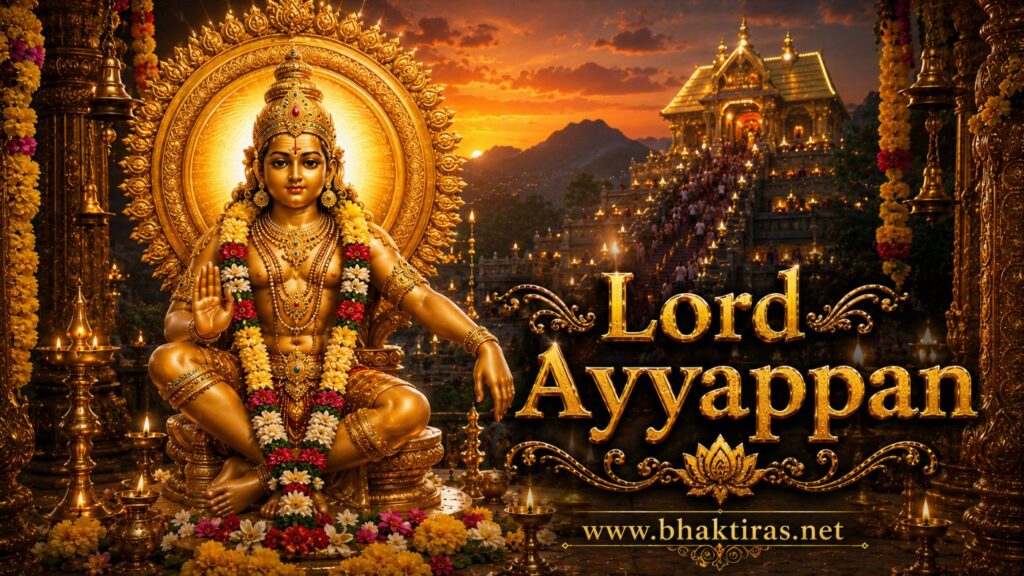
Lord Ayyappan is a deity of quiet strength, worshipped across Kerala and the southern states as a young ascetic who chose the discipline of the forest over the comforts of a throne. He sits with his knees drawn up and bound by a yoga strap, a bell resting at his throat, his gaze steady and inward. To his devotees he is Swami, the master of the hill, the one who receives every seeker who comes to him after weeks of self-denial.
His story joins two great streams of Hindu devotion. He is the child of Lord Shiva and of Mohini, the entrancing female form that Vishnu once took. Because of this he is called Hariharaputra, the son of Hari and Hara, and in him Shaivism and Vaishnavism meet without quarrel. He carries other names too. He is Sastha, or Dharma Sastha, the teacher and keeper of righteousness, and he is Manikandan, the one with the bell around his neck, from the infancy tale that his devotees never tire of telling.
What sets Ayyappan apart is the path he asks of his followers. He is not a god of easy blessings. To approach him at Sabarimala, a pilgrim takes on a demanding vow of simplicity and celibacy, wears dark clothing, walks barefoot, and carries an offering bundle on his head up a forest hill. In return the god asks nothing of a man’s birth, wealth or religion, only his sincerity. That openness has made Ayyappan beloved far beyond the boundaries of any single community.
To understand him fully, it helps to begin where his story begins, with the strange and beautiful union that gave him birth.
Born of Shiva and Mohini – Hariharaputra
The old texts of Kerala and the Sthala Purana of Sabarimala tell that Ayyappan was born to answer a threat the gods themselves could not easily meet. A demoness named Mahishi, sister of the buffalo-demon Mahishasura whom the goddess Durga had slain, had won a fierce boon. She could be killed only by a child born of both Shiva and Vishnu, a thing that seemed impossible, for the two are eternal male gods.
To make the impossible real, Vishnu took his most famous disguise. He became Mohini, a woman of such grace that even the gods lost their composure at the churning of the ocean. When Shiva beheld Mohini, the union of the two supreme lords brought forth a divine child. Because he was the son of Hari, that is Vishnu, and of Hara, that is Shiva, the boy was named Hariharaputra, and in his very being the followers of both traditions found a single shared devotion.
The child was no ordinary infant. He carried within him the calm of Vishnu and the ascetic fire of Shiva, and he was set upon the earth with a purpose already written into his birth. Yet before he would take up that purpose, he would first be found, unknowing of his own godhood, by a grieving human king.
The Infant Manikandan and the King of Pandalam
The child on the banks of the Pampa
The king of Pandalam, a kind and pious ruler, had no child of his own to inherit his small kingdom, and this weighed on his heart. One day, while hunting near the river Pampa in the wooded hills, he heard the cry of an infant. Following the sound to the riverbank, he found a radiant baby boy, alone yet unafraid, with a small golden bell tied on a cord around his neck. The king took the child in his arms and knew at once that his prayers had been answered.
Named for the bell
Because of the mani, the golden bell, at the child’s throat, the king named him Manikandan, the one with the bell around his neck. He carried the boy home to the palace and raised him as his own son. Manikandan grew swift in learning, gentle in temper and unmatched in every skill of arms and scripture, and the whole household came to love him. In time a younger prince was born to the queen by natural birth, and though the king still meant Manikandan to succeed him, others in the court began to fear the elder boy’s place.
The quest for tigress's milk
A scheme was laid. The queen, persuaded by a jealous minister, feigned a grave illness that, she claimed, could be cured only by the milk of a tigress. It was meant to send Manikandan to his death in the forest, for who could milk a wild tigress and return alive. But the boy accepted the task without fear, walked calmly into the deep woods, and there met his true purpose. In the forest he faced and slew the demoness Mahishi, whose end had been the very reason for his birth. Then, to the astonishment of all, he came back riding upon a tiger, surrounded by a band of tigers, the tigress’s milk within his reach.
The revealing of the god
Now the court understood who had lived among them. The king, filled with awe and sorrow at the plot against a divine child, fell at Manikandan’s feet. The boy forgave him with love, and told the king that his time as a mortal prince was ending. He asked the king to build a shrine for him where an arrow he shot would land, and there, upon the hill of Sabarimala deep in the Western Ghats, Ayyappan took his seat as a deity, to be worshipped for all time by those willing to walk the hard path to reach him.
The Warrior-Ascetic and the Slaying of Mahishi
The killing of Mahishi is the deed that gives Ayyappan his character as a warrior god, yet it is bound up with his identity as an ascetic. Mahishi had gained her boon through fierce penance and could not be defeated by any ordinary force. She had grown proud and cruel, troubling gods and sages alike, secure in the belief that no born being could match her.
Ayyappan met her not with rage but with the composure of one who knows his own strength. The battle is remembered as swift and decisive. He overcame the demoness and freed the worlds of her menace, and by that act he showed himself to be Dharma Sastha, the guardian who sets right what has gone wrong. The tradition also tells that from within the fallen Mahishi a repentant spirit emerged, and Ayyappan granted her a place near his own shrine, a mark of the mercy that tempers his power.
This blend of fierce capability and settled calm is what devotees carry in their minds when they climb to Sabarimala. Ayyappan is a protector, ready to guard those who seek him, but he is above all a master of himself, a god who conquered a demon and then chose the still life of an ascetic on a lonely hill.
Sabarimala and the Great Pilgrimage
The shrine of Ayyappan at Sabarimala sits high in the forested hills of the Western Ghats in Kerala, and the journey to it is one of the largest annual pilgrimages anywhere on earth. Each season millions of devotees make their way through the woods to stand before the god, and the whole undertaking is shaped by discipline rather than display.
Before a pilgrim may go, he keeps a vratam, a penance of forty-one days. During this time he lives simply, eats plainly, sleeps on the floor, keeps celibacy, and sets aside anger and indulgence. He wears black or dark blue, lets his beard grow, and wears a tulsi or rudraksha mala to mark himself as one under the vow. Through these weeks he turns his mind to the god, greeting fellow devotees as Swami, for each pilgrim under the vow is honoured as a form of Ayyappan himself.
When the day comes, the pilgrim carries the irumudi kettu, a sacred two-part cloth bundle balanced on his head. One part holds offerings for the deity, chiefly the ghee-filled coconut, and the other holds provisions for the journey. Only one who has kept the vow and carries the irumudi may climb the final approach. That approach is the Pathinettam Padi, the eighteen holy steps that lead up to the sanctum, each step held sacred and never trodden without the bundle on the head.
The great moment of the season is the Makara Jyoti, a sacred light seen on the horizon on Makara Sankranti in mid-January. As the light appears, the gathered crowds raise the cry of Swamiye Saranam Ayyappa, and the long weeks of penance find their answer in that shared glimpse of the divine.
For all its severity, the pilgrimage is remembered by those who make it as a season of deep fellowship, in which strangers become brothers on the road.
A Deity Who Welcomes All
Ayyappan holds a rare and precious place in Hindu devotion because he draws his followers together across every line that usually divides. His very birth unites the two great streams of Shaivism and Vaishnavism, for he is the son of Shiva and of Vishnu in the form of Mohini. A devotee of Shiva and a devotee of Vishnu can both look to Ayyappan as their own without contradiction.
That spirit of union runs through his worship. At Sabarimala the vow does not ask a pilgrim’s caste or community. Rich and poor, high-born and low-born, the learned and the simple all wear the same dark clothes, carry the same irumudi, address one another as Swami, and climb the same eighteen steps. In the season of the pilgrimage the ordinary rankings of society are set aside on the forest road.
The welcome reaches beyond the boundaries of Hinduism as well. A long-honoured tradition tells of a Muslim companion of Ayyappan, remembered as Vavar, whose shrine near the base of the hill is visited by pilgrims of every faith. Devotees of other religions who keep the vow with sincerity are received as equals. In an age that often keeps people apart, Ayyappan is honoured as a god who gathers them in.
Iconography and Symbols
The seated yoga pose
Ayyappan is most often shown as a young man seated with his knees raised and bound by a strap called the yogapatta, which holds the body still in deep meditation. This posture speaks of his nature as an ascetic who has mastered his senses. His face is serene and youthful, the face of one who has stepped away from worldly desire.
The bell at his neck
The small golden bell around his throat recalls his infancy as Manikandan, the child found on the banks of the Pampa with the bell already tied on his neck. It is his gentlest emblem, a reminder of the human family that raised him and of the mercy that runs beneath his ascetic sternness.
The bow and arrow
In many images Ayyappan holds a bow, the mark of the warrior who slew the demoness Mahishi and who chose the site of his shrine with an arrow shot into the hills. The bow balances the meditative pose, showing that his stillness is not weakness but the calm of one fully capable of decisive action.
How Lord Ayyappan Is Worshipped
Worship of Ayyappan is centred on discipline and devotion rather than on elaborate ritual, and much of it takes place in the heart and daily conduct of the devotee during the pilgrimage season. These are the practices most closely bound to his worship.
- Keeping the 41-day vratam, a penance of plain food, celibacy, simple living and steady prayer before the pilgrimage.
- Wearing black or dark blue clothing and a tulsi or rudraksha mala for the duration of the vow, marking oneself as a Swami under Ayyappan’s protection.
- Chanting Swamiye Saranam Ayyappa, the great refuge cry, again and again through the penance and the climb.
- Preparing and carrying the irumudi kettu, the sacred offering bundle, on the head during the final journey to the shrine.
- Ascending the Pathinettam Padi, the eighteen holy steps, only after the vow is kept and the irumudi is carried.
- Gathering for the darshan of the Makara Jyoti, the sacred light on Makara Sankranti, as the season’s highest moment.
- Treating every fellow pilgrim as a form of the god, addressing one another as Swami without regard to caste or standing.
Prayers and Mantras
The devotion of Ayyappan is carried above all in a single cry that a pilgrim repeats until it becomes the rhythm of his breath. It is a plea for refuge, offered to the god as one surrenders wholly to his care.
Devanagari: स्वामिये शरणम् अय्यप्पा
Transliteration: Swamiye Saranam Ayyappa
Meaning: O Swami Ayyappa, I take refuge in you. In these few words the devotee lays down his pride and his fear and places himself entirely at the feet of the lord of the hill. Repeated through the forty-one days and along the forest path, it turns the whole pilgrimage into one long act of surrender.
Frequently Asked Questions about Lord Ayyappan
Who is Lord Ayyappan?
Lord Ayyappan is a celibate warrior-ascetic Hindu deity worshipped mainly at Sabarimala in Kerala. He is the son of Lord Shiva and Mohini, the female form of Vishnu, and is honoured as Hariharaputra, Sastha and Manikandan. Devotees reach him through a demanding penance and a pilgrimage into the Western Ghats.
Why is Ayyappan called Hariharaputra?
He is called Hariharaputra because he was born of both Vishnu and Shiva. Vishnu took the enchanting female form of Mohini, and from his union with Shiva the divine child was born. Hari is a name of Vishnu and Hara a name of Shiva, so Hariharaputra means the son of Hari and Hara, uniting both traditions in one god.
What is the Sabarimala pilgrimage?
The Sabarimala pilgrimage is a journey to Ayyappan's hill shrine in Kerala, one of the largest annual pilgrimages in the world. Pilgrims keep a 41-day vow of simplicity and celibacy, wear dark clothes, carry the irumudi offering bundle on the head, and climb the eighteen holy steps to reach the deity.
Why is Ayyappan also called Manikandan?
Manikandan means the one with the bell around his neck. When the childless king of Pandalam found the divine infant on the banks of the river Pampa, the baby had a small golden bell tied on a cord at his throat. The king named him for that bell, and Manikandan remains one of Ayyappan's most loved names.
What are the eighteen steps at Sabarimala?
The eighteen steps, called the Pathinettam Padi, are the sacred final approach leading up to Ayyappan's sanctum. They are held so holy that a pilgrim may climb them only after keeping the full vow and carrying the irumudi bundle on his head. Each step is treated with reverence as part of drawing near to the god.
What is the Makara Jyoti?
The Makara Jyoti is a sacred light seen on the horizon near Sabarimala on Makara Sankranti in mid-January, the high point of the pilgrimage season. As it appears, the gathered devotees raise the cry of Swamiye Saranam Ayyappa, and the weeks of penance find their answer in that shared glimpse of the divine.
Can people of any caste or faith worship Ayyappan?
Yes. Ayyappan is honoured as a god who welcomes every devotee as an equal. At Sabarimala pilgrims of all castes and communities wear the same dark clothes and address one another as Swami. A cherished tradition of the Muslim companion Vavar, whose shrine pilgrims also visit, reflects his openness to devotees of other faiths.
May Lord Ayyappan grant you the strength to walk the harder path with a steady heart, and may his refuge cry, Swamiye Saranam Ayyappa, carry you safely to his hill.