
Lord Dattatreya
दत्तात्रेय
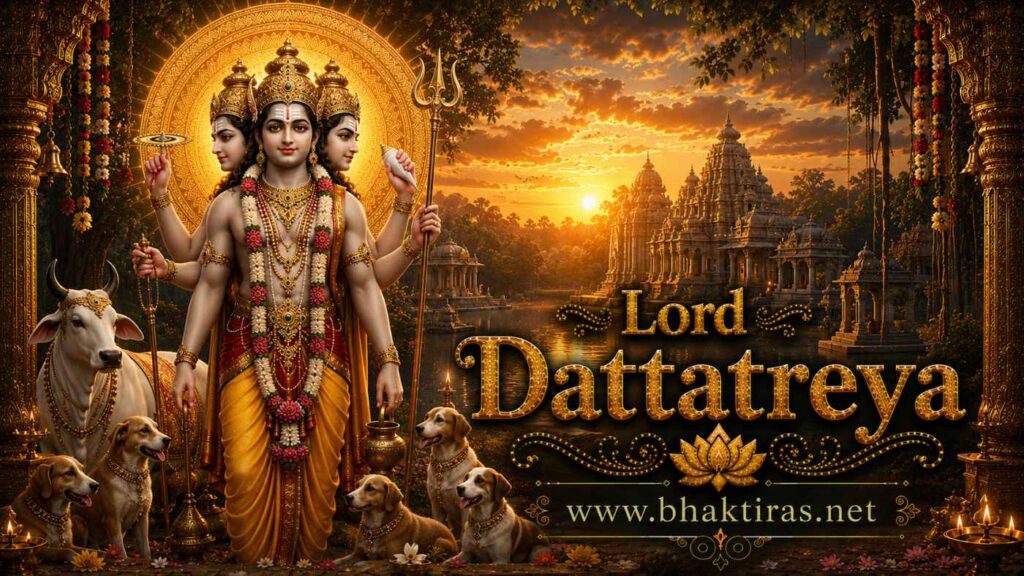
Lord Dattatreya is the one deity who holds Brahma, Vishnu and Shiva together in a single form, born as the son of the sage Atri and his devoted wife Anasuya. Revered as the Adi Guru, the first and universal teacher, he is shown with three heads and six arms, four dogs and a cow at his side, and is worshipped across the Datta Sampradaya of Maharashtra and Karnataka.
Who Is Lord Dattatreya?
Lord Dattatreya is unlike any other figure in the Hindu pantheon, because he is not one god borrowing the aura of the others – he is Brahma, Vishnu and Shiva held together in a single living form. Where most deities carry one clear function, Datta carries all three: the making of the world, its keeping, and its dissolution, gathered into one sage who walks the earth without home or possession.
He was born as the son of the sage Atri and his wife Anasuya, whose devotion was so complete that the three great gods themselves came to test it. What they meant as a trial became instead the occasion of his birth, and so from the very start his story is bound up with the power of a faithful heart rather than with conquest or thunder.
Yet the title that devotees love most is not ‘god’ but ‘guru’. Dattatreya is the Adi Guru, the first teacher, the one who shows that wisdom is not locked in temples or texts alone but scattered through the whole of creation for anyone humble enough to learn. He wears ash, keeps no clothes, answers to no rule of society, and moves as freely as the wind – the very picture of a soul that has let go of everything except truth.
Across Maharashtra and Karnataka especially, whole lineages of saints trace their light back to him, and his image – three-faced, six-armed, ringed by four dogs and a gentle cow – is kept in countless homes as the guru who never leaves a sincere seeker without answer.
The Trimurti United in One
The Test of Anasuya
Anasuya, wife of the sage Atri, was famed in the three worlds for her chastity and her unwavering devotion to her husband. So great was the power of her purity that the heavens themselves grew uneasy, and the wives of Brahma, Vishnu and Shiva began to feel that their own virtue was overshadowed. They pressed their husbands to put Anasuya to the test.
The three great gods came to her hermitage disguised as wandering ascetics and begged for alms. When Anasuya rose to serve them, they made a strange condition: they would accept food from her only if she served them without any clothing on. It was a demand meant to trap her – to keep her vow of hospitality she would have to break her modesty, and to keep her modesty she would have to turn away guests.
The Three Gods Become Her Son
Anasuya did not falter. Trusting completely in the strength of her devotion to Atri, she sprinkled water upon the three visitors and, by the force of that same purity, turned them into infants. Now they were children, and she was free to care for them as a mother without any breach of her vow. She took them to her breast and nursed them with a mother’s love.
When Brahma, Vishnu and Shiva did not return, their consorts came searching, and at last understood what had happened. Humbled, they begged Anasuya to restore their husbands. She did – but the three gods, moved by her greatness, granted her a boon: their combined essence would be born to her as a single son. That child was Dattatreya, the Trimurti gathered into one body, given (datta) to Atri and Anasuya. His three heads and six arms are the memory of that day, when the makers of the universe agreed to become the son of a faithful woman.
The Adi Guru – the First Teacher
Of all his names, the one that shapes his worship most is Adi Guru, the first guru. In the Datta tradition, teaching is not a role he takes up now and then – it is his whole nature. He is the source from which the idea of the guru itself flows, the one who shows that a true teacher does not merely hand over information but awakens the student to what was always present within.
Dattatreya embodies the ideal of the Avadhuta – the ascetic who has cast off (the literal sense of the word) every attachment, every rule of caste and custom, every concern for how the world sees him. He is Digambara, ‘sky-clad’, clothed only in the directions of space. He owns nothing, lives nowhere in particular, and answers to no convention. This freedom is not carelessness; it is the outward sign of a mind that has nothing left to protect and nothing left to want.
Because of this, seekers approach him not for wealth or victory but for the deepest gift a guru can give – the removal of ignorance. He is said to appear to sincere devotees when they least expect it, often in the plain guise of a beggar or a passing ascetic, testing whether the heart is humble enough to recognise the teacher when he comes without ornament.
The Twenty-Four Gurus from Nature
Perhaps the most beloved of all Dattatreya’s teachings is the story he tells of his own learning. Asked how he grew so wise, he answers that he took not one guru but twenty-four, and every single one was drawn from the world of nature – proof that the humble mind can find a teacher in anything it meets. A few of them show his method clearly:
- The Earth – which is dug into, trampled and burdened yet never complains, taught him patience and the strength to bear all things while still giving freely.
- The Wind – which moves through fragrant gardens and foul places alike yet takes on the quality of neither, taught him to pass through the world untouched by its pleasures and its filth.
- The Bee – which gathers a little nectar from many flowers without harming any, taught him to take only what is needed from many sources and to grasp at none.
- The Python – which lies still and eats only what comes to it, taught him contentment and the freedom of a life without restless striving.
- The Ocean – which stays calm and full whether rivers pour into it or not, taught him to keep an even mind whether fortune comes or goes.
- The Moth – which flies into the flame and perishes, warned him how desire for the senses can destroy a soul that loses its caution.
The lesson beneath them all is that creation is one vast, open school. To the proud, the world is only scenery; to the humble, every creature and element becomes a teacher. Dattatreya’s twenty-four gurus are his invitation to live with eyes open, learning from the least of things.
The Four Dogs and the Cow
No image of Dattatreya is complete without the animals that stand quietly around him, and each carries a meaning that turns the picture into a teaching. Behind him or at his feet are four dogs, and beside him stands a single cow – a scene that at first looks homely and rustic, but that devotees read as a map of the whole of sacred knowledge and the world it serves.
The four dogs represent the four Vedas – Rig, Yajur, Sama and Atharva – the foundational scriptures of the tradition. They are shown as dogs, faithful and ever-watchful, following the guru wherever he walks, to say that all the wisdom of the Vedas attends upon the true teacher and is at the service of the seeker who follows him. Some also see in them the four aims of human life, kept always within the guru’s sight.
The cow standing beside him is the Earth herself, and also Kamadhenu, the wish-granting cow who is mother of all beings and nourisher of the world. Her presence declares that Dattatreya is the guardian and sustainer of creation, the one from whom all needs can be met. Together the four dogs and the cow show the guru as both keeper of sacred knowledge and protector of the living world – scripture behind him, the nurturing Earth at his side.
The Datta Sampradaya
From Dattatreya flows one of the most living guru-traditions of the Indian subcontinent, the Datta Sampradaya, strongest in Maharashtra and Karnataka. In this lineage Datta is understood to return again and again in the form of realised gurus, so that the same teaching light passes from age to age through a chain of saints who are honoured as his very incarnations.
The lineage is traced through three great figures above all. Sripada Srivallabha, held to be the first full human descent of Datta in this tradition, brought the guru’s presence into the flow of everyday devotion in the southern lands. After him came Narasimha Saraswati, whose life and miracles at places like Ganagapur and Narsobawadi drew crowds of seekers and firmly rooted the tradition in the Deccan. Later still shone Swami Samarth of Akkalkot, an avadhuta of few words and immense power whose simple sayings still guide households across Maharashtra.
The scripture that holds this tradition together is the Gurucharitra, a revered account of the lives and teachings of Sripada Srivallabha and Narasimha Saraswati. Read aloud over sacred weeks with great care and devotion, it is treated less as a book than as the living voice of the guru, and its recitation is itself considered a form of worship. Through these saints and this scripture, Dattatreya remains not a distant memory but a guru still met and still followed.
Iconography & Symbols
Three Heads
The three faces are Brahma, Vishnu and Shiva together in one being – creation, preservation and dissolution held in a single gaze. They remind the devotee that the three powers are not rivals but one truth seen from three sides.
Six Arms and Their Emblems
His six hands carry the marks of all three gods: the trident and damaru drum of Shiva, the conch and discus of Vishnu, and the rosary and water-pot of Brahma. To hold them all is to say that no divine function lies outside him.
The Four Dogs
Faithful and alert, the four dogs stand for the four Vedas, following the guru wherever he goes. They show that all sacred knowledge waits upon the true teacher and serves the one who follows him.
The Cow
The cow beside him is the Earth and Kamadhenu, mother and nourisher of all. Her presence marks Dattatreya as the sustainer and protector of the living world, the source from which every need can be met.
Ash and Matted Locks
Smeared with sacred ash and crowned with matted hair, he wears the signs of the avadhuta who has renounced all things. His sky-clad, unadorned form is the very image of a soul with nothing left to hide or hold.
How Lord Dattatreya Is Worshipped
Devotion to Dattatreya is above all guru-devotion – it is offered in the spirit of a student before a beloved teacher rather than a subject before a distant king. Worship tends to be simple, inward and steady, centred on remembrance of his name and on the reading of his sacred stories. A few practices stand out in the tradition:
- Datta Jayanti – his birth, celebrated on the full moon of the month of Margashirsha with special worship, lamps and the singing of his praises, the great festival of the Datta devotees.
- Thursday observance – Thursday is the day most sacred to Datta and to gurus in general, kept by many with fasting, visits to Datta shrines and extra prayer.
- Reading the Gurucharitra – the sacred text is recited over a fixed span of days with vows and discipline, an act held to be a complete worship in itself.
- Pilgrimage to the Datta kshetras – devotees travel to Ganagapur, Narsobawadi, Audumbar and other seats of the tradition where his presence is felt most strongly.
- Chanting the mool mantra and the Digambara refrain – the repetition of his name is the heart of daily practice, keeping the guru present in ordinary life.
Prayers & Mantras
Because Dattatreya is approached as the living guru, his mantras are chanted less to obtain worldly things than to draw near to the teacher within and to ask for the clearing of ignorance. Two are especially dear to his devotees.
The seed-mantra that opens most Datta worship is:
ॐ द्रां दत्तात्रेयाय नमः
Om Draam Dattatreyaya Namah
‘Om, with the seed-sound Draam, I bow to Dattatreya.’ The syllable draam is his bija, the sound-form of his presence, and to repeat this mantra is to call the guru gently into the heart.
The other, chanted in a swaying rhythm at aartis and gatherings across Maharashtra, is the beloved refrain:
दिगंबरा दिगंबरा श्रीपाद वल्लभ दिगंबरा
Digambara Digambara Sripada Vallabha Digambara
It hails him as the sky-clad avadhuta and names Sripada Srivallabha, the first descent of Datta in the tradition. Sung again and again, it carries the mind past thought into simple remembrance of the guru.
Frequently Asked Questions about Lord Dattatreya
Who is Lord Dattatreya?
Lord Dattatreya is the one deity who unites Brahma, Vishnu and Shiva in a single form. Born as the son of the sage Atri and his wife Anasuya, he is revered as the Adi Guru, the first and universal teacher, and is the fountainhead of the Datta Sampradaya of Maharashtra and Karnataka.
Why does Dattatreya have three heads?
His three heads represent the Trimurti – Brahma, Vishnu and Shiva – held together in one being. Because he embodies all three great gods at once, he is shown with their three faces to mark that creation, preservation and dissolution are gathered in his single form.
What do the four dogs and the cow represent?
The four dogs stand for the four Vedas, following the guru faithfully to show that all sacred knowledge serves the true teacher. The cow beside him is the Earth and Kamadhenu, mother and nourisher of all, marking Dattatreya as the sustainer and protector of the living world.
Who were the parents of Dattatreya?
He was born to the sage Atri and his devoted wife Anasuya. When Brahma, Vishnu and Shiva came to test Anasuya's chastity, she turned them into infants by the power of her purity, and they blessed her with a son who was their combined essence – Dattatreya.
What are the twenty-four gurus of Dattatreya?
When asked how he became wise, Dattatreya said he had learned from twenty-four teachers drawn from nature – among them the earth, the wind, the bee, the python and the ocean. Each taught a single lesson, showing that the whole world becomes a teacher to the humble seeker.
What is the Datta Sampradaya?
The Datta Sampradaya is the guru-tradition flowing from Dattatreya, strongest in Maharashtra and Karnataka. Its great gurus – Sripada Srivallabha, Narasimha Saraswati and Swami Samarth of Akkalkot – are honoured as his incarnations, and its beloved scripture is the Gurucharitra.
When is Datta Jayanti celebrated?
Datta Jayanti marks the birth of Dattatreya and falls on the full moon of the month of Margashirsha. Devotees observe it with special worship, lamps, fasting and the singing of his praises, and it is the foremost festival of the Datta tradition.
What does the name Dattatreya mean?
The name joins 'Datta', meaning the given one, with 'Atreya', the son of Atri. It recalls how the essence of the three gods was given as a son to the sage Atri and his wife Anasuya, so the name itself carries the story of his miraculous birth.
May the Adi Guru Dattatreya, who carries the three great gods in one form, walk beside you as your inner teacher and gently lift the veil of ignorance from your heart.