
Veerabhadra
वीरभद्र
Veerabhadra is the fierce warrior form of Lord Shiva, born from a lock of Shiva's matted hair flung to the ground in his grief and rage after Sati's death. Commanded by Shiva, he destroyed the sacrifice of Daksha and beheaded him. His consort is the terrible goddess Bhadrakali.
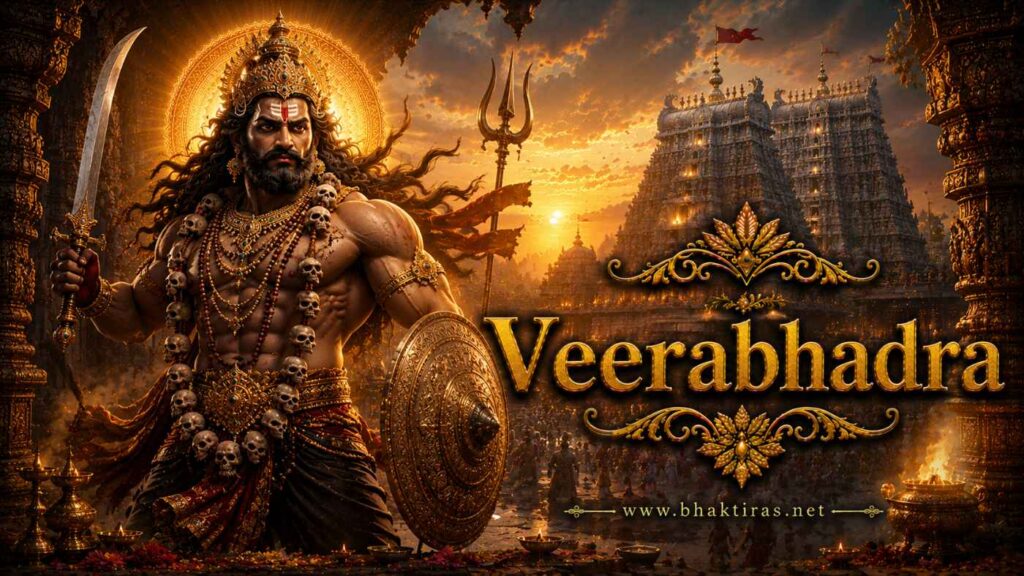
Who Is Veerabhadra?
Veerabhadra is the wrath of Shiva given a body. When grief and fury overwhelmed the great god, they did not simply pass through him – they took shape, walked out of him, and became a warrior tall enough to touch the sky. That warrior is Veerabhadra, and to understand him is to understand what happens when the calm ascetic of Kailasa is finally pushed past his limit.
He is not a separate god so much as a face of Shiva, an ugra rupa or fierce form summoned for a single terrible purpose. Where Shiva sits in meditation, Veerabhadra strides forward with sword and bow. Where Shiva forgives, Veerabhadra corrects. He carries in his body the memory of an insult and a loss, and he answers both with force.
Across the Deccan – in Karnataka, Andhra Pradesh, Telangana and Maharashtra – he is worshipped as a fierce guardian, a protector who keeps arrogance and injustice in check. In the Veerashaiva and Lingayat tradition he is deeply loved, celebrated in temple festivals and in the pounding, whirling Veeragase dance performed by his devotees.
To his worshippers he is fearsome but not cruel. His anger is aimed, not scattered. He destroys what deserves to be destroyed and then, when Shiva’s own heart softens, he stands aside so that mercy can follow.
Born of Shiva's Grief and Rage
The wound behind the warrior
Sati, daughter of the patriarch Daksha, had married Shiva against her father’s wishes. Daksha never accepted the wild, ash-smeared ascetic as a son-in-law, and his resentment festered. When he arranged a grand yajna, a great fire sacrifice, he invited every god and sage of note – and pointedly left Shiva out.
Sati went anyway, longing to see her family. What she found instead was public contempt. Before the assembled gods, Daksha mocked her husband, calling Shiva a haunter of cremation grounds, a keeper of ghosts, unworthy of the offerings being poured into the fire. Sati could not bear it. Unwilling to live as the daughter of a man who so degraded the one she loved, she gave up her body – by some accounts casting herself into the sacrificial flames, by others withdrawing her life through the fire of her own yoga.
The lock of hair
When word of Sati’s death reached Kailasa, Shiva’s grief broke into something the worlds had never seen. He tore a lock from his matted hair and hurled it to the ground. Where it struck, the earth split, and out of that fury rose Veerabhadra – colossal, blazing like a thousand suns, with a thousand arms, fierce eyes, and fangs bared. Beside him arose the dark goddess Bhadrakali, terrible and magnificent.
They bowed before Shiva and asked what he willed. And Shiva, still shaking with sorrow and rage, gave them a single command: go, and destroy the sacrifice of Daksha.
The Destruction of Daksha's Yajna
The storming of the sacrifice
Veerabhadra descended on the sacrificial ground with an army of Shiva’s ganas at his back. The very sight of him scattered the gathered gods. Where offerings had been burning peacefully, there was now uproar – the sacrificial fires overturned, the pavilions torn down, the priests fleeing. Indra was thrown from his mount, Agni’s flames were quenched, and the sages who had sat in judgment of Shiva ran for their lives.
The gods who tried to stand and fight were struck down or driven off. This was not a battle of equals; it was a reckoning, and Veerabhadra was its instrument.
The beheading and the goat's head
At the centre of the ruin stood Daksha. Veerabhadra seized him and severed his head, ending the sacrifice and the arrogance that had begun it. The yajna, which the proud patriarch had meant as his moment of glory, lay in ashes.
Yet the story does not end in blood. When Shiva’s anger at last cooled and his grief turned quiet, mercy returned. Daksha’s own head could not be found – by some accounts it had been consumed in the sacrificial fire – so Shiva restored him to life with the head of a goat set upon his shoulders. Humbled and made whole, Daksha rose and, at last, honoured Shiva. The lesson of the tale is written into its ending: pride is broken, but the broken are not left to die.
Veerabhadra and Bhadrakali
Veerabhadra does not act alone. Born in the same instant of Shiva’s wrath, the fierce goddess Bhadrakali stands beside him as his consort and counterpart. If he is the sword-arm of that fury, she is its dark flame – a form of the Great Goddess who carries the concentrated rage that Sati’s death poured into the world.
In the assault on Daksha’s sacrifice, the two move together: the warrior scattering the gods, the goddess turning the sacrificial ground into a place of terror for those who had insulted Shiva. In temple worship across the Deccan they are often honoured as a pair, the god and goddess of righteous wrath, guardians who share a single origin and a single purpose.
Their bond is not the tender companionship of Shiva and Parvati at peace. It is the fierce unity of two powers forged for war – and yet, like all of Shiva’s manifestations, they carry within them the promise of return to calm once the wrong has been set right.
The Fierce Guardian of Dharma
It would be easy to read Veerabhadra only as destruction, but his devotees see something deeper. He is the force that stands against arrogance. Daksha’s fault was not weakness but pride – the pride that lets a man insult the divine and imagine himself untouchable. Veerabhadra is what answers that pride.
For those who honour him, he is a guardian in the truest sense: a power invoked against injustice, against the tyranny of the strong over the weak, against the ego that forgets its place. His anger is disciplined, aimed only at what has broken dharma. He does not rage without cause, and he does not punish without reason.
This is why the fierce forms of Shiva are not feared the way ordinary violence is feared. Veerabhadra’s sword falls on adharma. To the honest worshipper he is protection; only to the arrogant and the unjust is he terror. In him, devotees find courage – the reminder that even overwhelming grief can be turned into the strength to set the world right.
Iconography and Symbols
Veerabhadra’s images, especially the towering carvings of the Deccan, are built to overwhelm. Every detail declares his power and his purpose.
Many arms and weapons
He is shown with four, eight or more arms, each gripping a weapon – the sword, the bow, the trident and the axe among them. The crowd of arms says that no enemy of dharma can escape his reach.
The trident (trishula)
The three-pronged trishula marks him unmistakably as a form of Shiva. It is the emblem of the god of destruction, carried now into open battle rather than held in meditation.
Fierce face and fangs
Wide, blazing eyes, a fierce brow and protruding tusks give his face the terror of a guardian. This is the countenance of wrath, meant to frighten wrongdoers and reassure the faithful.
Garland of skulls
Around his neck he often wears a garland of skulls, the mundamala. It links him to the cremation-ground aspect of Shiva and to the reality that he is a lord of endings as well as protection.
Warrior's sandals and stance
In sculptures such as the great Lepakshi image he is carved wearing sandals and standing in a firm, forward stance – the posture of a soldier ready to march, not a sage at rest.
Colossal scale
He is depicted as gigantic, often dwarfing the figures around him. His size is itself a symbol: the wrath of Shiva is larger than any pride that provokes it.
Veerabhadra in the Deccan
Nowhere is Veerabhadra loved more than in the Deccan. Across Karnataka, Andhra Pradesh, Telangana and Maharashtra his temples anchor towns and villages, and his worship is woven into local life and identity.
He holds a central place in the Veerashaiva, or Lingayat, tradition – the devotional movement that reveres Shiva above all and looks to fierce, faithful figures like Veerabhadra as guardians of its community. Many Lingayat families keep him as a household or clan deity, invoking his protection at weddings, harvests and journeys.
His festivals bring out the Veeragase, a fierce and athletic dance performed by costumed devotees who carry sword and idol, whirling and leaping to drums in his honour. The dance re-enacts his power and his martial spirit, and dancers often enter states of intense devotion as they perform.
His temples are landmarks in their own right. The Veerabhadra Temple at Lepakshi in Andhra Pradesh, with its Vijayanagara-era carvings and painted ceilings, is among the most celebrated, drawing pilgrims and admirers of temple art alike. Other shrines across the plateau keep his worship alive from generation to generation.
How Veerabhadra Is Worshipped
Worship of Veerabhadra blends the intensity of a warrior god with the steady rhythm of Shaiva devotion. Devotees approach him for courage, protection and the removal of obstacles raised by pride and enmity.
- Offering bilva (bel) leaves, sacred to Shiva, along with red flowers and vermilion at his shrine.
- Chanting his name and the mantra Om Veerabhadraya Namah for protection and inner strength.
- Lighting oil lamps and offering camphor arati before his fierce image, especially at dawn and dusk.
- Observing his temple festivals in the Deccan, where the Veeragase dance is performed in his honour.
- Invoking him as a family or clan deity at weddings, housewarmings and important beginnings.
- Keeping vows and fasts on days sacred to Shiva, since Veerabhadra is worshipped as Shiva’s own form.
- Making pilgrimage to major shrines such as Lepakshi to seek his blessing and behold his great image.
Prayers and Mantras
The simplest and most beloved invocation of the fierce warrior is his root mantra, repeated for courage and protection:
ॐ वीरभद्राय नमः
Om Veerabhadraya Namah
“I bow to Veerabhadra, the mighty warrior of Shiva.”
Devotees hold that steady repetition of this mantra with a sincere heart draws his guardianship over the household and turns his aimed wrath against the obstacles and ill-will that trouble the worshipper. It is often chanted before dangerous undertakings, journeys and important beginnings, and during his temple festivals across the Deccan.
Frequently Asked Questions about Veerabhadra
Who is Veerabhadra?
Veerabhadra is a fierce warrior form of Lord Shiva, born from Shiva's wrath after the death of his wife Sati. He is a guardian and destroyer of adharma, especially revered across the Deccan and in the Veerashaiva or Lingayat tradition. His consort is the goddess Bhadrakali.
How was Veerabhadra born?
When Shiva learned that Sati had given up her life at Daksha's sacrifice, his grief and rage overwhelmed him. He tore a lock from his matted hair and flung it to the ground, and from it arose Veerabhadra, colossal and blazing, together with the fierce goddess Bhadrakali.
What happened at Daksha's yajna?
Daksha held a great sacrifice and insulted Shiva while excluding him. On Shiva's command, Veerabhadra stormed the yajna, scattered the assembled gods, destroyed the offerings and beheaded Daksha. Later, when Shiva's anger cooled, Daksha was restored to life with the head of a goat.
Is Veerabhadra the same as Shiva?
Veerabhadra is not a separate god but a fierce emanation of Shiva, an ugra rupa created for a specific purpose. He carries Shiva's power and wrath in a warrior's body, so worshipping Veerabhadra is understood as worshipping a particular form of Shiva himself.
Who is the consort of Veerabhadra?
Veerabhadra's consort is Bhadrakali, a fierce form of the Great Goddess who arose in the same moment of Shiva's wrath. The two act together, and in Deccan temples they are often honoured as a pair, the god and goddess of righteous wrath.
Where is Veerabhadra worshipped?
He is worshipped chiefly across the Deccan – in Karnataka, Andhra Pradesh, Telangana and Maharashtra – and is central to the Veerashaiva or Lingayat tradition. Famous shrines include the Veerabhadra Temple at Lepakshi, and his worship features the vigorous Veeragase dance.
What does Veerabhadra hold in his hands?
In sculptures and paintings Veerabhadra is shown many-armed, carrying weapons such as the sword, bow, trident and axe. He often wears a garland of skulls and has a fierce, fanged face, marking him as a colossal guardian and warrior of Shiva.
What is the Veeragase dance?
The Veeragase is a fierce, athletic folk dance performed in honour of Veerabhadra, mainly in Karnataka. Costumed devotees carry sword and idol and whirl and leap to drums, re-enacting his martial spirit. It is a living part of his worship during temple festivals in the Deccan.
May the fierce warrior of Shiva guard you from harm, break the pride that troubles your path, and turn every grief into strength.