
Lord Parashurama
परशुराम
Lord Parashurama is the sixth avatar of Vishnu, an axe-wielding sage-warrior born to the rishi Jamadagni and Renuka in the Bhargava line. A Brahmin by birth yet a fierce fighter, he received his axe from Shiva. Grieving his father's murder, he vowed to clear the earth of tyrant kings. He is one of the Chiranjivi, the immortals who still live.
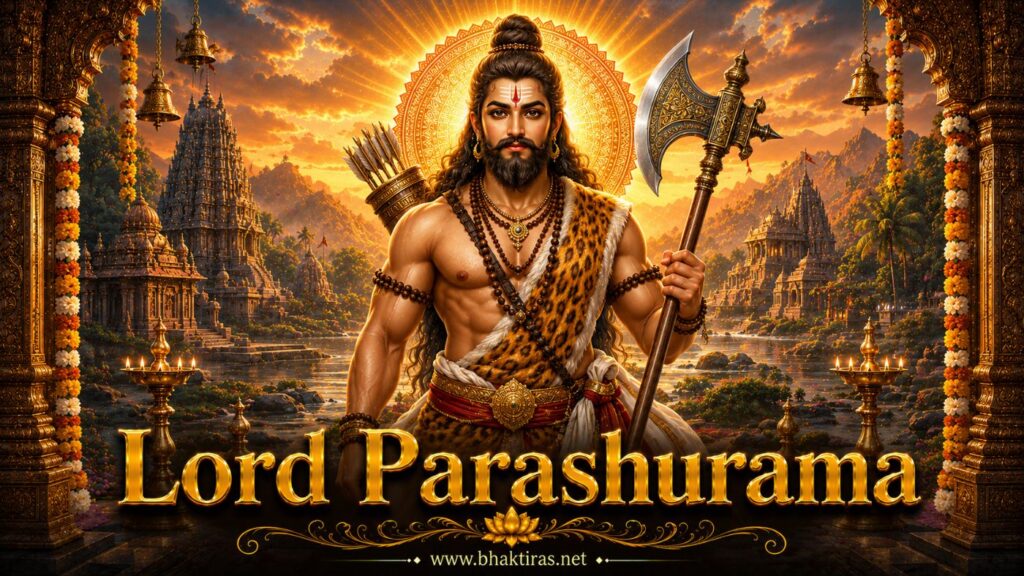
Who Is Lord Parashurama
Lord Parashurama is the sixth of the ten principal avatars of Vishnu, and one of the most striking. His name joins two words – parashu, the battle-axe, and Rama, meaning delight or the pleasing one – so he is remembered simply as Rama with the axe. He arrived not to charm the world but to correct it, at a time when kings had forgotten that power is a duty and not a possession.
He was born to the sage Jamadagni and his wife Renuka, in the ancient Bhargava line that traces back to the rishi Bhrigu. That parentage matters. Parashurama was a Brahmin by birth, raised in a forest hermitage on prayer, ritual and restraint. Yet within him burned the courage and skill of the greatest warriors. This blend of priest and fighter is unusual in the tradition, and it shaped everything he did.
Unlike the gentler avatars, Parashurama is a figure of controlled fury. His story is full of blood and grief, but also of penance, obedience and the search for peace after violence. He is not an easy god to sum up. He punishes, but he also weeps; he destroys, but he also builds and teaches. To understand him is to sit with the hard question of when anger becomes just.
He is also one of the Chiranjivi, the immortals of Hindu belief who never truly die. Tradition holds that he still lives in deep meditation in the mountains, waiting quietly through the ages, which is why he appears across different epochs and even meets the later avatars.
The Brahmin Who Was Also a Warrior
In the old ordering of society, the sage and the soldier belonged to separate paths. The Brahmin kept the fire, chanted the mantras and preserved knowledge; the Kshatriya carried the sword, ruled the land and shed blood when duty demanded it. Parashurama refused to stay on one side of that line.
Born into a family of ascetics, he learned scripture, meditation and self-denial from childhood. But he also mastered archery, swordsmanship and the handling of celestial weapons, training so thoroughly that no warrior of his age could match him. He became, in effect, a Brahmin in birth and learning and a Kshatriya in spirit and force – a Brahma-Kshatriya, as the texts sometimes call such a rare being.
This dual nature is the key to his whole life. His violence was never for conquest or a throne; he wanted no kingdom and took none. He fought as a sage fights, from a sense of wounded dharma, and when the fighting was done he returned to the forest and to austerity. Later tradition treats him with caution because of this – a holy man whose hands had known so much killing – and that tension is exactly what makes him human and memorable rather than a simple hero.
The Axe of Shiva
Parashurama’s devotion to Lord Shiva runs beneath his entire story. Before he became the terror of unjust kings, he was a disciple who sat in long, unbroken penance to please the great ascetic god of Kailasa. Shiva, moved by his discipline, became his teacher in the arts of war.
From Shiva he received the parashu, the divine axe that would give him his name and never leave his hand. It was no ordinary weapon. In the telling of the sages it could not be blunted or broken, and it answered only to its bearer. Alongside it, Shiva taught him the use of powerful celestial weapons, the astras whose mantras could summon fire, storm and light on the battlefield.
There is a well-loved episode in which Parashurama, testing the young Ganesha who barred his way to Shiva, hurled the axe at him. Ganesha, recognising it as his own father’s gift, let it strike and break one of his tusks rather than dishonour Shiva’s weapon – which is one traditional account of how the elephant-faced lord came to be called Ekadanta, the single-tusked one. The story ties Parashurama’s axe forever to the household of Shiva.
That the fiercest of Vishnu’s avatars was a devoted follower of Shiva carries a quiet lesson often repeated on the coast where he is worshipped – that the great gods are not rivals, and that strength and devotion belong together.
The Tragedy That Set His Vow
The theft of Kamadhenu
The sage Jamadagni kept in his hermitage the wish-granting cow Kamadhenu, or her calf, a divine creature able to provide whatever a guest could need. One day the mighty king Kartavirya Arjuna, called Sahasrarjuna for his thousand arms, came to the ashram with his army. Jamadagni, with the cow’s help, fed the entire host with ease. Instead of gratitude the king felt envy. Believing such a treasure belonged in a palace and not a forest hut, he seized the cow by force and drove her away, ignoring the old sage’s protests.
The killing of Jamadagni
When Parashurama returned and learned what had happened, he pursued the king, defeated his army and recovered the cow, killing Sahasrarjuna in the fight. But the matter did not end there. The sons of the slain king, nursing revenge, later came upon the hermitage while Parashurama was away and murdered the unarmed Jamadagni in cold blood. Renuka, finding her husband’s body, is said to have struck her chest twenty-one times in unbearable grief.
The vow taken in grief
Parashurama came home to find his father dead and his mother broken. His sorrow turned to a terrible resolve. Reading those twenty-one blows on his mother’s breast as a sign, he swore to clear the earth of the arrogant, oppressive warrior-kings who had let power curdle into cruelty – and to do so twenty-one times over. The vow was not blind hatred of a class of people; in the epics it is aimed at tyranny itself, at rulers who had abandoned the dharma that alone justifies a crown. Yet it remains the darkest and most debated act of his life, and the tradition does not pretend it was simple.
The restoring of Renuka
An earlier, equally haunting episode reveals the same theme of terrible obedience. When Jamadagni, in a fit of anger, ordered his sons to behead their mother Renuka for a momentary lapse, only Parashurama obeyed without hesitation, trusting his father completely. Pleased by such devotion, Jamadagni offered him a boon – and Parashurama at once asked that his mother be brought back to life, and his brothers restored. She lived again, unharmed. The story is disturbing to modern ears, and rightly discussed with care, but in its own frame it speaks of a faith so total that it could undo even death.
After the years of retribution, tradition says Parashurama’s anger finally spent itself. He performed great penance to atone, gave away the lands he had won to worthy Brahmins, and withdrew again into the life of a sage. The warrior had done what he believed dharma required; now the sage had to make peace with it.
Guru of Bhishma, Drona and Karna
Because he lives across the ages, Parashurama appears in the Mahabharata not as a fighter but as the great teacher of weapons, the master to whom the finest warriors came to learn. Three of the epic’s central figures passed through his hermitage, and his mark is on all of them.
He trained Bhishma, the vow-bound grandsire of the Kuru house, and the two even crossed weapons in a long, undecided duel over the matter of Amba – master against pupil, neither able to defeat the other. He taught Dronacharya, who would in turn become the guru of the Pandava and Kaurava princes, passing Parashurama’s science of arms down another generation.
His most fateful student was Karna. Because Parashurama, still bitter toward Kshatriyas, taught only Brahmins, Karna came to him disguised as one and learned the highest secrets of warfare, including the terrible Brahmastra. The truth surfaced when Karna, letting an insect bore into his thigh rather than disturb his sleeping teacher, bled without flinching – a stillness no Brahmin could have borne. Realising he had been deceived, Parashurama cursed him: the divine weapons would fail him at the very moment he needed them most. That curse, born of a broken trust, would help seal Karna’s death on the battlefield of Kurukshetra. It is one more instance where Parashurama’s wrath, once roused, carried consequences far beyond the moment.
Reclaiming the Western Coast
A gentler and more creative legend surrounds Parashurama on India’s western shore. After his years of penance, the story goes, he wished for a quiet land where he could settle sages and live out his austerities in peace, far from the kingdoms he had emptied. He asked the sea-god Varuna for space, and Varuna answered that he might have whatever ground he could reclaim.
Standing on the mountains, Parashurama flung his mighty axe far out into the ocean. Where it fell, the waters drew back, and a long strip of green coastal land rose from the sea. This is why the Konkan coast and Kerala are together called the Parashurama Kshetra, the field of Parashurama, and the reclaimed land is sometimes named Parashurama Srishti, his creation.
On this coast he is honoured as a founding figure – the sage who gave the land itself, settled Brahmin communities there, and established temples and sacred sites still visited today. The legend turns the axe that had shed so much blood into an instrument of creation, drawing new earth out of the waves. In the memory of the coastal south and west, the destroyer of tyrants is also, fittingly, a giver of homes.
Iconography and Symbols
The Parashu (Axe)
His defining emblem is the divine axe from Shiva, almost always shown resting on his shoulder or gripped in one hand. It stands for the cutting away of injustice – the sharp, deliberate force used to sever what is corrupt so that dharma can grow back.
The Bow and Arrows
He is frequently depicted with a bow, marking him as a master archer as much as an axeman. The bow recalls his role as guru of the great warriors and links him, by name and skill, to the archer-avatar Rama who follows.
The Ascetic's Form
Parashurama is shown as a muscular, weathered sage with matted locks (jata), a simple loincloth or deerskin, and a rudraksha strand – the body of a forest ascetic rather than a king. His frame is powerful but his dress is spare, holding together his two natures.
Fierce, Focused Bearing
His expression is stern and unsmiling, his stance ready. He is rarely painted at ease. This intensity is deliberate: it reminds the devotee that his power is meant for the defence of righteousness, not for display.
How Lord Parashurama Is Worshipped
Parashurama is revered across India but holds special place along the western coast he is said to have made. His worship blends the reverence given to a great avatar with the affection felt for a founding sage of the region. His main festival falls on Akshaya Tritiya, celebrated as his birthday.
- Parashurama Jayanti – his birth anniversary, observed on Akshaya Tritiya in the bright half of the month of Vaishakha (April to May), considered an especially auspicious day for new beginnings, charity and prayer.
- Temple worship – shrines dedicated to him are found chiefly in Kerala, coastal Karnataka, Goa and Maharashtra, in the land of the Parashurama Kshetra, where he is honoured as protector and founder.
- Chanting his mantra – devotees recite ॐ परशुरामाय नमः and offer prayers for courage, discipline and the strength to stand against wrong.
- Fasting and charity – many keep a fast on Parashurama Jayanti and give food, cloth or gifts to Brahmins and the needy, echoing his own act of giving away all he had won.
- Reverence as guru – because he was the teacher of Bhishma, Drona and Karna, warriors and students traditionally look to him as a patron of martial skill and disciplined learning.
Prayers and Mantras
Prayers to Parashurama are prayers for inner strength, unshakable devotion and the resolve to do what is right even when it is hard. Devotees turn to him to steady their courage and to burn away weakness of will. His simple root mantra is offered with a bowed head and a focused mind:
ॐ परशुरामाय नमः
Om Parashuramaya Namah
Salutations to Lord Parashurama, the axe-bearing sage. Reciting this name is a way of asking for his firmness of purpose – the discipline of the ascetic joined to the fearlessness of the warrior – so that the devotee may face difficulty without flinching and hold to dharma without wavering.
Frequently Asked Questions about Lord Parashurama
Who is Lord Parashurama?
Lord Parashurama is the sixth avatar of Vishnu, a sage-warrior born to the rishi Jamadagni and Renuka in the Bhargava line. Known as Rama with the axe, he was a Brahmin by birth yet a mighty fighter, a devotee of Shiva, and one of the Chiranjivi, the immortals of Hindu tradition.
Why did Parashurama vow to destroy the Kshatriyas?
His vow grew out of grief. The tyrant king Kartavirya Arjuna stole his father's wish-cow, and the king's sons later murdered the unarmed Jamadagni. Reading his mother Renuka's twenty-one blows of mourning as a sign, Parashurama swore to clear the earth of oppressive, dharma-forgetting kings twenty-one times over – a war against tyranny rather than against people.
Is Parashurama still alive?
Yes, in tradition he is one of the Chiranjivi, the deathless immortals who live on through the ages. It is said he withdrew into deep penance in the mountains and remains there in meditation, which is why he appears in different epochs and even meets the later avatars Rama and Krishna.
Why is Parashurama called Rama with the axe?
His name combines parashu, the battle-axe granted to him by Lord Shiva, with Rama. To distinguish him from the later Rama of Ayodhya, he is called Parashurama, Rama of the axe, since the divine axe is his constant weapon and defining symbol.
How is Parashurama connected to the Mahabharata?
Living across the ages, he appears in the Mahabharata as the great teacher of arms. He trained Bhishma, Dronacharya and Karna. His curse on Karna, that his divine weapons would fail when most needed, played a decisive part in Karna's fall at Kurukshetra.
What land is said to have been created by Parashurama?
Legend holds that Parashurama hurled his axe into the sea and the waters withdrew, raising the coastal land of Konkan and Kerala. This region is called the Parashurama Kshetra, and the reclaimed strip is known as Parashurama Srishti, his creation, where he settled sages and founded sacred sites.
When is Parashurama Jayanti celebrated?
Parashurama Jayanti, his birth anniversary, falls on Akshaya Tritiya in the bright fortnight of the month of Vaishakha, usually in April or May. The day is regarded as highly auspicious for charity, prayer and new beginnings, and is marked with fasting and worship, especially along the western coast.
May Lord Parashurama grant you the courage of the warrior and the calm of the sage, so that you may walk the path of dharma with a steady heart.