
Rishi Jamadagni
जमदग्नि
Jamadagni is a revered Vedic sage counted among the Saptarishi in the Puranic tradition. Born in the line of Bhrigu, he was a master of severe penance and celestial weapons. He was the husband of the devoted Renuka and the father of Parashurama, the sixth avatar of Vishnu. His death at the hands of a tyrant king set that avatar's mission in motion.
Who Is Rishi Jamadagni
Among the great sages whose names anchor the memory of Hindu tradition, Jamadagni holds a place both luminous and sorrowful. He belongs to the Saptarishi, the seven seers who appear in the Puranic reckoning as guardians of dharma and lawgivers of a cosmic age. Yet his story is remembered less for cosmic authority than for the intensity of a single household – a sage of overwhelming penance, a wife of rare devotion, and a son whose grief would change the course of kings.Jamadagni was a Bhargava, born into the line of the sage Bhrigu, one of the mind-born progenitors of creation. His father was Richika and his mother Satyavati, and through them ran a current of spiritual power that would flow into the next generation with startling force. The sages of the Bhrigu line were known for penance so concentrated that it bent the ordinary rules of the world. Jamadagni inherited that heat of tapas, and to it he added something rarer among ascetics – the discipline of a warrior who had mastered the bow. His life unfolded in a forest ashram, a place of fire offerings, recitation, and the quiet order of a sage’s household. Here he raised five sons with Renuka, taught them, and received guests according to the ancient law of hospitality. Nothing in that peaceful setting suggested the violence that would one day break upon it. The tradition preserves Jamadagni precisely because his story shows how the smallest injustice against a righteous man can unleash consequences that ripple across generations.A Bhargava Sage of Penance and Weapons
What set Jamadagni apart from many contemplative rishis was the union of two disciplines that rarely meet in one person. He was a man of extreme penance, his austerities so severe that they earned him standing among the Saptarishi. At the same time he was an accomplished archer who commanded knowledge of the divine astras, the celestial weapons that answered to sacred formulas rather than to muscle alone. This combination came partly from the peculiar circumstances of his birth. The Puranas tell of a mix-up around the sacrificial offering prepared for his mother Satyavati and her mother, in which the qualities meant for a Brahmin and a Kshatriya were exchanged. The result was that Jamadagni carried within him the tranquil learning of a Brahmin married to the fierce temper of a warrior. His son Parashurama would inherit that same volatile blend and carry it to its furthest edge. Because of this inheritance, Jamadagni could sit for years in meditation and yet, when tested, could speak with the authority of one who held terrible power in reserve. He was not a soft or indulgent teacher. He demanded obedience, expected discipline, and lived by a code that admitted no compromise. Those who came to his ashram found a sage whose calm rested on a foundation of iron.Jamadagni, Renuka and Parashurama
At the centre of Jamadagni’s life stood his marriage to Renuka, a princess of great virtue who left the comforts of a royal household to share the austerity of a forest hermitage. She is remembered as a wife of extraordinary devotion and purity, one whose chastity was said to be so complete that she could carry water in an unfired clay pot shaped fresh each morning from the riverbank. Her fidelity was not merely personal virtue; in the logic of the tradition it was a source of power that upheld the ashram itself. Together Jamadagni and Renuka had five sons. The youngest was Rama of the axe – Parashurama – who would become the sixth avatar of Vishnu. From childhood Parashurama absorbed his father’s twin gifts, the depth of penance and the science of arms, and he added to them a devotion to Lord Shiva from whom he received the great axe that gave him his name. The bond between father and son was intense and demanding. Jamadagni saw in Parashurama not simply a child but an instrument of a purpose larger than either of them understood at the time. The obedience the sage required of his son, and the trials he set for him, would later prove to be preparation for a mission that no ordinary upbringing could have produced. In raising Parashurama, Jamadagni was, without fully knowing it, shaping the hand that would answer his own death.Kamadhenu and the Wish-Fulfilling Cow
The prosperity of Jamadagni’s ashram rested in large part upon a wonder in his keeping – the divine cow Kamadhenu, called also Surabhi or Nandini, the celestial mother of cattle who could grant any wish asked of her. She was no ordinary animal but a being of heaven, and her presence meant that the sage’s simple forest home could receive guests with a lavishness that no palace could match. The tradition tells that when kings or travellers arrived at the hermitage, Jamadagni had only to turn to Kamadhenu, and she would produce whatever was needed – food, wealth, comforts, even armies at need – so that no visitor left unhonoured. This was hospitality in its highest form, the sacred duty of the householder-sage fulfilled through a gift from the gods themselves. But such a treasure could not remain hidden, and it was Kamadhenu who drew disaster to the ashram. The cow that fed the sage’s guests so freely became an object of desire for a proud king who saw in her not a sacred trust but a prize to be taken. In this way the very source of Jamadagni’s generosity became the cause of his ruin, a turn that the tradition holds up as a lesson in the greed that undoes the powerful.The Tragedy of Kartavirya Arjuna
The King Who Coveted the Cow
Kartavirya Arjuna, known as Sahasrarjuna for the thousand arms granted to him by his own austerities, was the mighty ruler of the Haihaya people. Powerful, victorious in war, and swollen with pride, he came one day to Jamadagni’s ashram while hunting in the forest. The sage received him with full honour, and Kamadhenu, at Jamadagni’s word, produced a feast fit for a king and his entire retinue. Where Kartavirya expected a poor hermit’s fare, he found abundance beyond anything his treasury could supply.
The Theft and the Sage's Death
The king’s wonder curdled into greed. He demanded that the sage surrender the divine cow, and when Jamadagni refused, explaining that Kamadhenu was a sacred charge not to be given away, Kartavirya seized her by force and drove her off to his capital along with her calf. Some accounts tell that Parashurama, returning to find the ashram violated, pursued the king and defeated him in battle to recover the cow. But the story did not end there. In vengeance, the sons of Kartavirya came to the hermitage while Parashurama was away, and there they killed the unresisting Jamadagni as he sat in meditation. Renuka, finding her husband slain, is said to have struck her breast many times in grief – a number that foretold the reckoning to come.
Parashurama's Terrible Vow
Parashurama returned to a scene of horror. Overcome with grief and rage at the murder of his father, he made a vow that would shape an age – to cleanse the earth of the arrogant and lawless Kshatriya rulers who had abandoned dharma. The tradition records that he fulfilled this oath by clearing the earth of such tyrants twenty-one times over. Whatever one makes of that fierce reckoning, its root lay in a single crime against a peaceful sage. Jamadagni’s death was not merely a family tragedy; it became the hinge on which an avatar’s mission turned.
The Test of Obedience
An earlier episode in Jamadagni’s household shows the severe discipline for which the sage was known, and the depth of the bond between him and Parashurama. The Puranas tell that one day Renuka went to the river to fetch water. There she saw a Gandharva king sporting with his consorts, and for a single moment her mind wavered from its perfect concentration. So subtle was the lapse that she was unable, that morning, to shape the unfired clay pot that her chastity had always allowed her to make. She returned to the ashram without the water. Jamadagni, perceiving the momentary falling of her thought through his penance, was seized with anger and commanded his sons one after another to behead their mother. The four elder sons, unable to raise a hand against Renuka, refused, and the sage in his wrath cursed them. Then he turned to Parashurama and gave the same terrible order. Parashurama, holding his father’s word above all else, obeyed without hesitation and struck. Pleased by this absolute obedience, Jamadagni offered his son any boon he wished. Parashurama, whose devotion to his father had never dimmed his love for his mother, asked that Renuka be restored to life with no memory of what had passed, and that his cursed brothers be released. The sage granted it all, and Renuka rose whole and unharmed. The episode is a hard one, and the tradition preserves it not to praise the killing but to illustrate the extremity of a rishi’s authority and the perfect obedience that made Parashurama worthy of the mission ahead. It also reveals the mercy hidden within severity, for the very obedience that struck the blow was the obedience that asked for its undoing.Iconography & Symbols
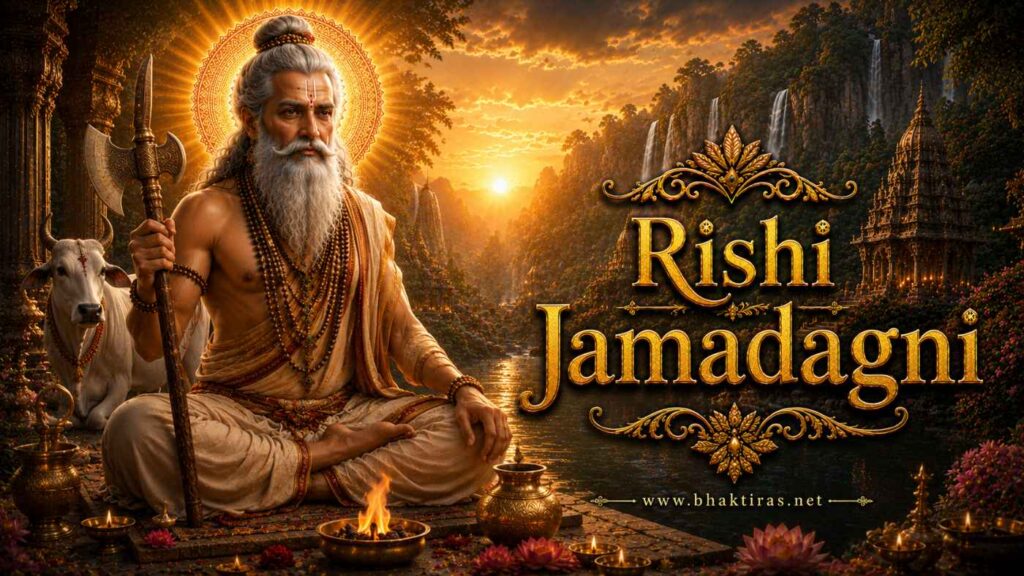
Jamadagni is rarely worshipped through elaborate images in the way that the great deities are, but where he appears in sacred art and in the imagination of devotees, a consistent set of features marks him out.The Ascetic's Form
He is shown as a mature sage with matted hair coiled upon his head, a flowing beard, and the simple garments of a forest hermit. His face carries the composure of long penance, and his posture is often that of one seated in meditation before the sacred fire.
The Bow
Unusually for a Brahmin sage, Jamadagni is remembered with a bow at hand, marking his mastery of archery and the celestial weapons. This detail sets him apart and quietly foretells the martial destiny of his son Parashurama.
The Divine Cow
Beside him in memory stands Kamadhenu, the wish-fulfilling cow whose presence made his hospitality boundless. She is his emblem of abundance freely given and, in the end, of the treasure whose theft brought about his death.
The Sacred Fire
The homa fire of the ashram accompanies him, symbol of the tapas and the daily offerings through which he sustained his spiritual power and honoured the gods.
How Rishi Jamadagni Is Remembered
Across the sacred literature and living memory of the tradition, Jamadagni is honoured in several distinct ways, each drawing out a different thread of his story.- As one of the Saptarishi in the Puranic list of the seven great seers, his name is recalled among the guardians of dharma for a cosmic age.
- As a Bhargava, a shining member of the Bhrigu line, whose penance placed him among the most powerful ascetics of the sacred past.
- As the father of Parashurama, the sixth avatar of Vishnu, so that reverence for the avatar naturally reaches back to the sage who raised him.
- As the husband of Renuka, who is worshipped in her own right as a goddess in many parts of India, keeping the memory of their household alive.
- As the keeper of Kamadhenu, whose story teaches the sanctity of hospitality and the ruin brought by greed.
- As a figure in the Mahabharata and the Puranas, cited in the retelling of Parashurama’s deeds and in the wider lore of the sages.
- In the recitation of the Saptarishi names during rituals and prayers, where his name is invoked along with the other seers for blessing and protection.
Prayers & Mantras
Devotees who wish to honour Rishi Jamadagni, or to invoke the Saptarishi as a group, often turn to a simple salutation to the sage. Such a mantra is chanted with a calm and reverent mind, ideally before the morning offerings or during the remembrance of the seven seers.The core salutation is spoken as follows: ॐ जमदग्नये नमः Om Jamadagnaye Namah This means: Salutations to the sage Jamadagni. In uttering it, the devotee bows to the sage’s penance, his mastery, and his place among the Saptarishi, and asks that a measure of his steadiness and devotion settle upon their own life. When the seven seers are invoked together in ritual, his name takes its place among theirs, binding the worshipper to the ancient lineage of the sages who upheld dharma.Frequently Asked Questions about Rishi Jamadagni
Who is Rishi Jamadagni?
Jamadagni is a revered Vedic sage counted among the Saptarishi in the Puranic tradition. Born in the line of the sage Bhrigu, he was known for fierce penance and for his mastery of archery and celestial weapons. He was the husband of Renuka and the father of Parashurama, the sixth avatar of Vishnu.
Who was Jamadagni's son?
Jamadagni had five sons with Renuka. The youngest and most famous was Parashurama, the sixth avatar of Vishnu, who inherited his father's penance and skill in arms. Parashurama's grief at his father's murder led him to vow the destruction of the tyrant Kshatriya rulers of his time.
How did Jamadagni die?
Jamadagni was killed by the sons of the thousand-armed king Kartavirya Arjuna. The king had earlier seized the divine cow Kamadhenu from the sage by force. In revenge for a later defeat, his sons came to the ashram while Parashurama was away and slew the unresisting Jamadagni as he sat in meditation.
What is the divine cow of Jamadagni?
The divine cow in Jamadagni's keeping was Kamadhenu, also called Surabhi or Nandini, the wish-fulfilling cow of heaven. She could produce whatever was asked of her, allowing the sage to receive his guests with unlimited hospitality. Her theft by Kartavirya Arjuna set in motion the tragedy that led to Jamadagni's death.
Why did Parashurama behead his mother Renuka?
Jamadagni, perceiving that Renuka's mind had wavered for a moment, ordered his sons to behead her as a test of obedience. Only Parashurama obeyed. Pleased, the sage granted him a boon, and Parashurama at once asked that his mother be restored to life unharmed and his cursed brothers released. The sage granted all of it.
Is Jamadagni one of the Saptarishi?
Yes. In the Puranic list of the Saptarishi, the seven great seers who guard dharma for a cosmic age, Jamadagni is counted among them. Lists of the seven vary across texts and ages, but his inclusion reflects the exceptional power of his penance and his standing in the Bhrigu lineage.
Where is Jamadagni mentioned in the scriptures?
Jamadagni appears in the Puranas and the Mahabharata, chiefly within the accounts of Parashurama and the wider lore of the Bhargava sages. These texts preserve the stories of Kamadhenu, the conflict with Kartavirya Arjuna, and the test of obedience involving Renuka.
May the steady flame of Rishi Jamadagni’s penance and the memory of his devoted household inspire faith, discipline, and an unshaken love of dharma in all who recall his name.