
Goddess Renuka
रेणुका
Renuka is a mother goddess of Hindu tradition, wife of the sage Jamadagni and mother of Parashurama, the sixth avatar of Vishnu. Famed for her devotion and her son's restoring her to life, she is widely worshipped as Yellamma and Ekavira at Mahur and Saundatti, honoured as a giver of fertility, protection and grace.
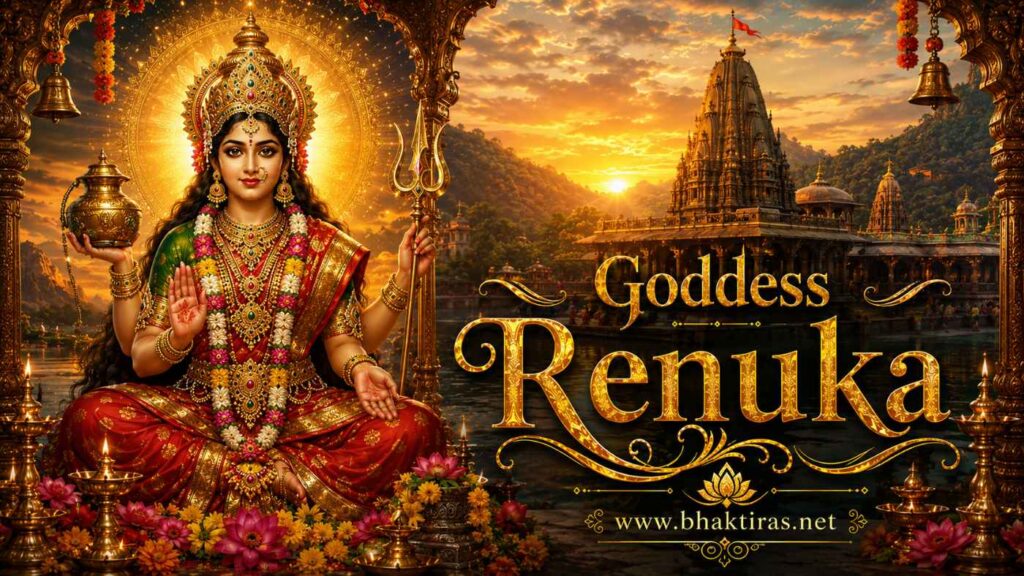
Who Is Goddess Renuka?
Goddess Renuka is loved across the Deccan as a mother in the fullest sense – one who nourishes, forgives and returns to her children even after death has touched her. In the Puranic story she is the wife of the sage Jamadagni and the mother of Parashurama, the axe-bearing avatar of Vishnu. In the folk devotion of Karnataka, Maharashtra and Telangana she is Yellamma, the goddess whose face is smeared with turmeric and whose jatras draw crowds of the faithful.
Two streams of worship meet in her. One is the scriptural memory carried in the Puranas, where Renuka is the chaste wife whose spiritual power let her draw water from the river in a pot of raw, unbaked clay. The other is the living folk cult, sung in the villages, carried by hereditary devotees, and centred on the great hill shrines. Both agree on her tenderness and her strength.
Because her story holds sorrow as well as blessing, devotees approach her with a particular closeness. She is not a distant deity of the heavens but a mother who suffered, who was wronged, and who was restored – and so she is trusted with the sorrows people carry quietly.
To understand Renuka is to hold together the sage’s wife of the Puranas and the turmeric-bright Yellamma of the hill jatras, and to see them as one continuous devotion.
Wife of Jamadagni, Mother of Parashurama
Renuka was the wife of Jamadagni, a sage of fierce discipline who belonged to the ancient rishi lineage and kept a forest ashram of great austerity. Their home was a place of fire-offerings, study and hard vows, and Renuka’s part in it was the quiet, daily labour of devotion – keeping the sacred fire, drawing water, and holding the household to its rhythms.
The couple had several sons, and the youngest was Parashurama, who would grow into one of the most striking figures of Hindu tradition – the sixth avatar of Vishnu, born to set the world’s balance right. For a mother, Renuka’s legacy is bound up with this son: it was his obedience that would one day cost her, and his love that would give her back her life.
Her marriage is remembered less for grand events than for the strength hidden in ordinary faithfulness. It was the purity of her daily conduct, the tradition says, that gave her a small, luminous power – the ability to carry water home in a pot she shaped fresh each morning from wet clay, without ever baking it hard.
The Legend of the Clay Pot
The pot she carried by her purity
Each dawn Renuka walked to the river to fetch water for the ashram’s rites. By the strength of her chastity and the steadiness of her mind, she could gather the water into a vessel of raw, unbaked clay and even, in some tellings, shape a coil of sand to carry it upon her head. The unbaked pot should have crumbled the moment it met the river – that it held was the outward sign of an inward discipline.
A moment of distraction
One morning, as she stood at the water, a celestial couple – a gandharva and his consort – passed by in the sky, and for a single breath Renuka’s gaze followed the beauty of their reflection on the river. The lapse was slight and human, no more than a heartbeat of wonder. But the power she carried rested on perfect steadiness of attention, and in that instant it withdrew. The clay softened, the pot dissolved, and she returned to the ashram empty-handed and afraid.
The father's command
Jamadagni, reading through his ascetic sight what had passed, was seized by anger, and in the harsh logic of the tale he ordered his sons to strike down their mother. One by one the elder sons refused, unable to raise a hand against her, and the sage’s wrath turned upon them too. Only Parashurama, bound by his vow of obedience to his father, did as he was told. This is the hard heart of the story, and tradition tells it not to praise the act but to weigh the terrible cost of obedience against a mother’s life.
The boon and the restoration
Pleased that his command had been honoured, Jamadagni offered Parashurama any boon he wished. Without hesitation the son asked for his mother’s life – and, in the fullest tellings, for his brothers’ too – and that the deed and its memory be wiped clean. The sage granted it. Renuka rose again, whole and living, and the family was made new. It is this ending that devotees hold to: not the blow, but the boon; not the loss, but the return of the mother through the love of her child.
The legend is remembered with sorrow and with reverence. Its meaning, for the devout, lies in the restoration – a mother’s grace proven stronger than death, and a son’s first act of love shown to be the saving of her.
Renuka and Yellamma
In the folk retelling of the Deccan, the moment of restoration takes a further turn. As Renuka was brought back, tradition says, her head was joined to the body of another woman – or, in other villages, another woman’s head to Renuka’s body. From this joining grew the belief that the goddess embraces every caste and condition, for she carries within her form the union of high and humble.
This is where the sage’s chaste wife of the Puranas becomes Yellamma, ‘mother of all’, the great folk goddess of Karnataka and the borderlands. Yellamma is worshipped with turmeric and vermilion, her devotees carrying her image in procession, singing her deeds through the night. The name Ekavira, ‘the singular heroine’, belongs to the same goddess at Mahur, where she is honoured in her Puranic dignity.
The Yellamma tradition has its own hereditary devotees and its own long history, and parts of that history carry real sorrow that the community itself has worked hard to reform. This site honours the goddess as her devotees hold her – as a protecting mother – and treats the living faith of the Yellamma and Matangi communities with the respect it deserves.
The Temples of Mahur and Saundatti
Two great hill shrines anchor the worship of Renuka. At Mahur in Maharashtra, the goddess is enshrined as Renuka Mata, and the site is counted among the Shakti Peethas, the places where the Devi is present in her fullness. Set on a wooded hilltop, the Mahur temple draws pilgrims through the year and fills at Navaratri, when the whole hill takes on the sound of drums and devotional song.
At Saundatti in Karnataka, on a hill above the Malaprabha country, the goddess is Yellamma. Her temple here is one of the busiest folk shrines of the Deccan, and its great jatras on the full moons of Magha and other months bring lakhs of devotees who climb the hill, offer turmeric, and bathe in the sacred tank below. The two shrines, Puranic Mahur and folk Saundatti, show the two faces of one goddess.
Beyond these, smaller Renuka and Yellamma temples dot the villages of Maharashtra, Karnataka and Telangana, each keeping its own local vow and festival – proof of how deeply this mother is woven into the devotional life of the south.
Iconography & Symbols
The turmeric-smeared face
Renuka, especially as Yellamma, is most often worshipped as a face or bust bright with turmeric and vermilion. The golden turmeric is her signature offering, spoken of as bhandara, and devotees smear it on themselves and each other as her blessing of health and fertility.
The kalasha and water
The water pot she carried by her purity remains her defining emblem. In shrine and story alike the kalasha stands for the discipline that gave her power and for the nourishment a mother pours out for her household.
The head risen from earth
Because of the clay and the beheading legend, she is sometimes shown as a head rising from the ground, garlanded and serene. Far from a symbol of horror, devotees read it as the sign of a goddess who cannot be destroyed – who returns, whole, from the earth itself.
Serene, maternal bearing
Where she is shown in full form, Renuka is calm and open-handed, a mother at rest rather than a warrior in motion. Her ornaments are simple, her expression gentle, her posture that of one who receives her children and gives without stint.
How Goddess Renuka Is Worshipped
Worship of Renuka blends quiet home devotion with large, joyful public festivals. Some common practices:
- Turmeric offerings (bhandara): devotees offer and share turmeric powder, smearing it as a blessing of fertility, health and the goddess’s protection.
- Navaratri devotion: during the nine nights of the Devi, her shrines fill with lamps, song and fasting, and many families keep a special vow to her.
- Jatras and full-moon fairs: at Saundatti and other hill shrines, great fairs on the full moon bring pilgrims who climb the hill, bathe in the sacred tank and process with her image.
- Vows for children and family: as a mother goddess, Renuka is invoked by those praying for children, for a safe home, and for the well-being of the family line.
- Simple daily puja: a lamp, kumkum, turmeric and the recitation of her name are enough to bring her near in a household shrine.
Whatever the scale, the spirit of her worship is the same – approaching a mother who is close, forgiving and quick to bless.
Temples & Sacred Sites
Renuka and Yellamma are honoured at many shrines across the Deccan. Among the most visited:
- Mahur, Maharashtra: the Renuka Mata temple, counted among the Shakti Peethas, set on a forested hilltop and thronged at Navaratri.
- Saundatti, Karnataka: the great Yellamma hill temple above the Malaprabha, one of the busiest folk shrines of the south, famed for its full-moon jatras.
- Chandragutti, Karnataka: an old hill shrine of Renukamba, drawing pilgrims for its own annual fair.
- Village Yellamma shrines: countless small temples across Karnataka, Maharashtra and Telangana keep her worship in local, everyday form.
Each of these carries its own festival calendar and local vow, so that Renuka’s presence runs from the great pilgrimage hills down to the smallest village lamp.
Prayers & Mantras
A simple, much-loved way to call on the goddess is to repeat her name-mantra with a lamp and a little turmeric before her image:
ॐ रेणुकायै नमः
Om Renukayai Namah
‘Om, salutations to Goddess Renuka.’
Spoken morning and evening, this short line is held to steady the mind and draw the mother’s protection over the home. Devotees often add her folk name in praise – Yellamma – calling on her as the mother of all, and offer their turmeric with a prayer for the health and unity of the family.
Frequently Asked Questions about Goddess Renuka
Who is Goddess Renuka?
Renuka is a Hindu mother goddess, the wife of the sage Jamadagni and the mother of Parashurama, the sixth avatar of Vishnu. Remembered for her devotion and for her restoration to life by her son, she is worshipped across the Deccan as a giver of fertility, protection and grace, and is widely known in folk tradition as Yellamma.
Is Renuka the same as Yellamma?
Yes, in most Deccan traditions Renuka and Yellamma are one goddess. Renuka is her Puranic name as the wife of Jamadagni, while Yellamma, 'mother of all', is her name in the folk worship of Karnataka, Maharashtra and Telangana. The two streams of devotion honour the same mother in different voices.
Who was Renuka's son?
Renuka's most famous son was Parashurama, the axe-bearing sixth avatar of Vishnu. When Jamadagni, in anger, ordered his sons to behead their mother, only Parashurama obeyed. Pleased, the sage granted him a boon, and Parashurama at once asked for his mother's life – restoring Renuka whole and living.
What is the legend of the clay pot?
By the power of her chastity and steady mind, Renuka could carry water home in a pot of raw, unbaked clay. One day a moment's distraction at the river broke her focus, the pot dissolved, and this lapse set in motion the story of her beheading and her restoration by Parashurama. The pot became her lasting emblem.
Where are the main temples of Goddess Renuka?
The two greatest shrines are Mahur in Maharashtra, where she is Renuka Mata and the site is a Shakti Peetha, and Saundatti in Karnataka, where she is worshipped as Yellamma. Both stand on hills and hold large festivals, especially at Navaratri and on the full-moon jatras.
What is Renuka the goddess of?
Renuka is honoured above all as a mother goddess – a giver of fertility, protection and household well-being. Devotees pray to her for children, for the safety of the family, and for grace in times of sorrow, trusting her as a mother who herself knew suffering and was restored.
Why is turmeric offered to Renuka?
Turmeric, offered as bhandara, is the signature gift to Renuka and Yellamma. Golden and auspicious, it stands for health, fertility and the goddess's blessing. Devotees offer it at her shrines and smear it on themselves as a mark of her protection during festivals and jatras.
May Goddess Renuka, the mother of all, keep your family whole and bless your home with her turmeric-bright grace.