
Gita Jayanti 2026 – Birthday of the Bhagavad Gita
गीता जयंती
When is Gita Jayanti in 2026?
Gita Jayanti falls on Sunday, 20 December 2026. It marks the day Lord Krishna is believed to have spoken the Bhagavad Gita to Arjuna on the Kurukshetra battlefield. The date is fixed by Margashirsha Shukla Ekadashi, the same tithi observed as Mokshada Ekadashi.
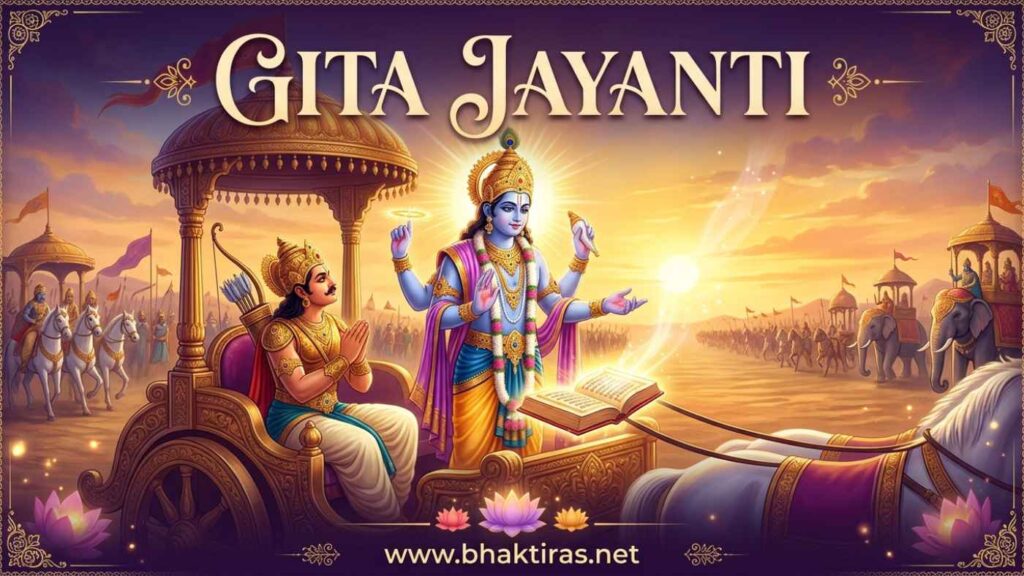
Gita Jayanti is the birthday of the Bhagavad Gita – the day Hindus remember Lord Krishna speaking the seven hundred verses of the Gita to a doubting Arjuna, just as the Mahabharata war was about to begin at Kurukshetra. It falls on Margashirsha Shukla Ekadashi, the bright-fortnight eleventh day that is also kept as Mokshada Ekadashi, usually in December. Rather than a birth of a person, it honours the birth of a teaching: how to act with courage, do one’s duty, and walk the path towards liberation.
Gita Jayanti 2026-2028: Dates & Calendar
The next Gita Jayanti is on Sunday, 20 December 2026. Because it follows the lunar Margashirsha Shukla Ekadashi, the English calendar date shifts by a couple of weeks each year, landing anywhere from late November to late December.
| Year | Date | Day | Notes |
|---|---|---|---|
| 2025 | 1 December | Monday | Observed on Margashirsha Shukla Ekadashi |
| 2026 | 20 December | Sunday | Next occurrence, with Mokshada Ekadashi |
| 2027 | 9 December | Thursday | Mokshada Ekadashi vrat the same day |
| 2028 | 27 November | Monday | Falls earlier as the lunar month shifts |
The same tithi is observed as Mokshada Ekadashi, one of the most important Ekadashi fasts of the year, so many people keep the vrat and mark Gita Jayanti together on one day.
Why Gita Jayanti Is Celebrated
Gita Jayanti celebrates the day the Bhagavad Gita was spoken – the moment Krishna answered Arjuna’s despair on the battlefield with a teaching on duty, devotion and liberation.
The setting is the opening of the Mahabharata war. Arjuna, seeing his own teachers and kinsmen arrayed against him, lays down his bow and refuses to fight. What follows is a conversation of seven hundred verses in which Krishna guides him out of paralysis and into clear, right action. Hindus hold that this exchange took place on Margashirsha Shukla Ekadashi, and so keep that day each year as the Gita’s birthday.
The birth of a scripture
Most festivals mark a deity’s birth or a mythic event. Gita Jayanti is unusual in celebrating the arrival of a text – one that later travellers, reformers and thinkers across the world have read as a guide to living well.
Karma and dharma
The Gita’s central counsel, to do your duty without clinging to the fruit of the action, is remembered on this day. It reframed the war before Arjuna as a question of righteous action rather than personal gain.
The path to moksha
Because the day shares its tithi with Mokshada Ekadashi, whose name points to release, it is also seen as auspicious for prayers seeking freedom from the cycle of rebirth for oneself and one’s ancestors.
Deities & Figures Worshipped
Gita Jayanti centres on Lord Krishna as the speaker of the Gita, with Arjuna remembered as the listener who asked the questions on everyone’s behalf.
Krishna
Krishna is worshipped in his role as the charioteer and teacher who reveals the Gita. On this day he is honoured less as the playful cowherd of Vrindavan and more as the guide who steadies a friend in crisis.
Arjuna
The Pandava prince whose honest doubt draws out the teaching. Devotees see in Arjuna an image of the ordinary seeker – troubled, questioning, and finally willing to listen and act.
The Bhagavad Gita itself
The book is placed on the altar, garlanded and read aloud. On Gita Jayanti the scripture is treated almost as a living presence, the day’s true honoured guest.
Key Rituals, Step by Step
Observance blends a simple Krishna puja, the Mokshada Ekadashi fast and, above all, the reading and reciting of the Gita.
- Rise early and bathe. Devotees begin before dawn with a bath, clean clothes and a quiet, settled mind for the day’s reading.
- Set up the Gita and Krishna. A copy of the Bhagavad Gita is placed on a clean cloth or small altar beside an image of Krishna, with a lamp, incense, flowers and tulsi leaves.
- Keep the Mokshada Ekadashi vrat. Many fast for the day, avoiding grains, beans and rice, taking only fruit, milk or water, and breaking the fast the next morning at the correct paran time.
- Read the Gita. The heart of the day is reading the scripture – a favourite chapter, the whole text over the day, or a group recitation of all eighteen chapters.
- Attend a discourse. Temples and homes host talks explaining verses in everyday language, so the teaching is understood and not only recited.
- Offer aarti and bhog. Krishna is offered an aarti and simple satvik food such as fruit, milk sweets or panchamrit, which is later shared as prasad.
- Give in charity. Donating copies of the Gita, food or clothing is considered especially fitting on a day devoted to knowledge and duty.
Special Foods of Gita Jayanti
Because most observers keep the Mokshada Ekadashi fast, the day’s food is satvik and grain-free, with sweets offered to Krishna and shared as prasad.
Vrat fruit and milk
Those keeping the Ekadashi vrat take fresh fruit, milk and water through the day, avoiding grains, rice, beans and onion or garlic.
Sabudana khichdi
Tapioca pearls cooked with peanuts, potato and cumin are a common permitted dish for Ekadashi fasts, filling without breaking the grain restriction.
Panchamrit
A mix of milk, curd, honey, ghee and sugar offered to Krishna and taken in small spoonfuls as blessed prasad.
Milk sweets
Kheer, pedha and other dairy sweets are prepared as bhog, in keeping with Krishna’s well-known fondness for milk and butter.
Regional Names & Variations
Gita Jayanti is observed across India and by Hindus abroad, but the grandest gathering is at Kurukshetra, the battlefield where the Gita is said to have been spoken.
Kurukshetra, Haryana
The International Gita Mahotsav is held here over several days by the sacred Brahma Sarovar, with evening aartis on the water, seminars on the Gita, craft stalls, cultural programmes and pilgrims and scholars from many countries.
Temples across India
ISKCON centres and Krishna temples everywhere hold mass Gita recitations, chapter-by-chapter readings and discourses, often with children reciting verses they have learned by heart.
The global diaspora
Hindu communities in Nepal, the Caribbean, East Africa, the UK and North America mark the day with group readings and talks, keeping the Gita’s teaching alive far from Kurukshetra.
Gita Jayanti Do's and Don'ts
A short guide to observing the day with the right spirit.
Do
- Read at least a few verses of the Gita, even if you cannot manage the whole text
- Handle the scripture with clean hands and place it respectfully on a raised, clean spot
- Keep the Mokshada Ekadashi fast if your health allows, and break it at the proper paran time
- Attend or listen to a discourse to understand the meaning, not only the sound, of the verses
- Share prasad and consider donating a copy of the Gita or giving food in charity
Avoid
- Avoid grains, rice and beans if you are keeping the Ekadashi vrat
- Do not treat the Gita casually – avoid setting it on the floor or reading with unwashed hands
- Skip onion, garlic and tamasic food for the day if you are observing the fast
- Do not turn a group recitation into a competition; the aim is reflection, not speed
- Avoid quarrels, harsh speech and idleness on a day meant for calm study and duty
Frequently Asked Questions
When is Gita Jayanti in 2026?
Gita Jayanti in 2026 falls on Sunday, 20 December. It is fixed by Margashirsha Shukla Ekadashi and is observed on the same day as Mokshada Ekadashi.
When is Gita Jayanti in 2027 and 2028?
Gita Jayanti is on Thursday, 9 December 2027 and on Monday, 27 November 2028. The date moves each year because it follows the lunar Margashirsha Shukla Ekadashi rather than a fixed English calendar date.
Why is Gita Jayanti celebrated?
Gita Jayanti is celebrated as the birthday of the Bhagavad Gita, marking the day Lord Krishna spoke its teaching to Arjuna at Kurukshetra before the Mahabharata war. It honours the birth of a scripture on duty, devotion and liberation rather than the birth of a deity.
Which god is worshipped on Gita Jayanti?
Lord Krishna is worshipped on Gita Jayanti, in his role as the charioteer and teacher who revealed the Gita to Arjuna. The Bhagavad Gita itself is also honoured, placed on the altar, garlanded and read aloud.
Is Gita Jayanti the same as Mokshada Ekadashi?
Gita Jayanti and Mokshada Ekadashi fall on the same day, Margashirsha Shukla Ekadashi, so they are observed together. Mokshada Ekadashi is the fasting vrat kept on that tithi, while Gita Jayanti marks the speaking of the Bhagavad Gita on that same day.
How is Gita Jayanti celebrated?
Gita Jayanti is celebrated by reading and reciting the Bhagavad Gita, attending discourses, keeping the Mokshada Ekadashi fast and worshipping Krishna. The largest gathering is the International Gita Mahotsav at Kurukshetra, held over several days by the Brahma Sarovar.
Where was the Bhagavad Gita spoken?
The Bhagavad Gita is said to have been spoken at Kurukshetra, in present-day Haryana, on the field where the Mahabharata war was about to begin. Krishna delivered it to Arjuna from the chariot as the two armies faced each other.
How many verses and chapters does the Bhagavad Gita have?
The Bhagavad Gita has eighteen chapters and around seven hundred verses. On Gita Jayanti many devotees try to read all eighteen chapters in a single day, alone or in a group recitation.
May the words Krishna spoke at Kurukshetra bring clarity and courage to your own path. Gita Jayanti ki shubhkamnaayein.