
Nagamandala 2026-2027 – The Overnight Serpent Ritual of Tulu Nadu
नागमण्डल
When is Nagamandala held in 2026-2027?
Nagamandala is a seasonal overnight ritual, not a fixed-date festival. In coastal Karnataka’s Tulu Nadu region it is usually performed in the cool months between December and April, on a night chosen by the temple or sponsoring family. The next season runs roughly December 2026 to April 2027, with each event scheduled locally.
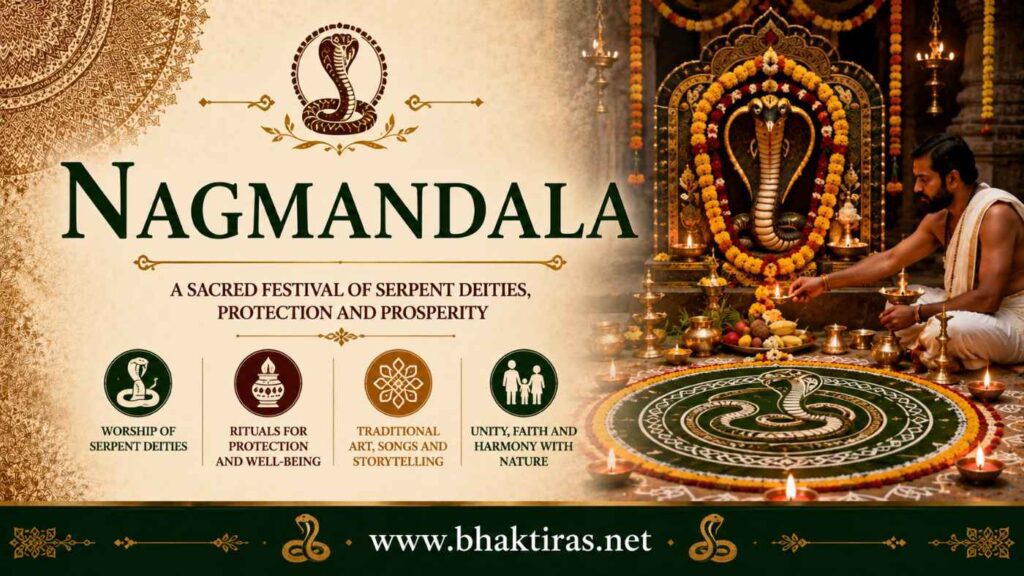
Nagamandala is one of the most striking night rituals of coastal Karnataka. Across the Tulu-speaking districts of Dakshina Kannada and Udupi, and into the Kerala border country, families and temples hold this all-night rite to honour the Naga, the serpent god worshipped here as Nagabrahma. A huge serpent design is drawn on the floor in coloured powder, and through the dark hours two ritual performers sing, circle and slip into trance until dawn. It is done to seek children, prosperity and release from serpent-related curses.
Nagamandala 2026-2027: When It Is Held
Nagamandala has no single calendar day. It is a cool-season ritual, arranged whenever a family or temple sponsors one, generally between December and April.
| Season | Typical window | How the date is set | Notes |
|---|---|---|---|
| 2025-2026 | December 2025 – April 2026 | Temple / family choice | Past season |
| 2026-2027 | December 2026 – April 2027 | Temple / family choice | Next season |
| 2027-2028 | December 2027 – April 2028 | Temple / family choice | Following season |
The ritual is deliberately held in the cooler, drier months when night-long ceremonies outdoors are comfortable and the harvest is in. A specific night is fixed after consulting the temple priest or an astrologer, so the exact date varies from one Naga shrine to another.
Why Nagamandala Is Performed
Nagamandala is performed to please the Naga deities, remove serpent-related curses (naga dosha) and ask for fertility, healthy children and family prosperity.
In Tulu culture the serpent is a guardian of the soil, water and the family line. Many households keep a naga bana, a small sacred grove or stone with serpent carvings, and a Nagamandala is the grand form of honouring it. People often vow to hold one after a wish is granted, or on the advice of an astrologer who traces a family misfortune to a neglected serpent shrine.
Removing naga dosha
A common reason for sponsoring the ritual is to clear naga dosha, a fault linked in local belief to harming a snake or neglecting the family’s serpent shrine. Couples hoping for children and families facing repeated troubles are often the ones who arrange it.
Fertility and the family line
The serpent is tied to fertility and continuity. Offerings and the night-long worship are meant to bless the household with children and to protect the lineage, which is why the rite carries deep emotional weight for the sponsoring family.
Honouring the guardian of the land
Nagas are seen as protectors of the soil, groves and water sources. Holding a Nagamandala renews the bond between a family and the serpent spirit that watches over its land, keeping fields, home and cattle safe.
Deities & Figures Worshipped
The ritual centres on the Naga, the serpent god, worshipped in Tulu Nadu as Nagabrahma and identified with the great serpent Vasuki.
Naga (Nagabrahma)
The Naga is the serpent divinity at the heart of the rite, revered as Nagabrahma, a guardian who blesses fertility and punishes neglect. The whole night of song, dance and offering is directed at pleasing this spirit.
Vasuki
The serpent design and invocations draw on Vasuki, king of the nagas in Hindu tradition. Local belief merges the family’s guardian serpent with this cosmic serpent, giving the household rite a wider sacred meaning.
How the Night Unfolds, Step by Step
Nagamandala runs from dusk to dawn in a set sequence, built around the drawn serpent design and two special performers.
- Drawing the mandala. On the temple or pavilion floor, artisans draw a large, intricate serpent design, the mandala, using natural coloured powders in red, white, yellow and black, often showing intertwined snakes coiled around a central form.
- Purification and offerings. The space and the family are purified, and offerings of flowers, tender coconut, areca, milk and betel are readied for the serpent spirit.
- The Vaidya appears. A Brahmin performer, the Vaidya, dresses in female attire and takes on the role of the female serpent, opening the invocations with song.
- The Pathri is invoked. The Pathri, or Nagapatri, the serpent-medium, is prepared to receive the serpent spirit and gradually enters an altered, trance-like state as the night deepens.
- Song and circling dance. Through the long hours the two performers sing serpent hymns and dance around the mandala, the rhythm and drumming building steadily.
- The trance and possession. At the height of the rite the Pathri is believed to be possessed by the serpent spirit, moving with sinuous, snake-like motions and, in some traditions, disturbing part of the powder design.
- Blessings and vows. Devotees and the sponsoring family approach for blessings, place their petitions and receive assurance of the serpent’s grace.
- Closing at dawn. As morning comes the spirit is respectfully sent off, final offerings are made, and the gathering shares food to end the all-night observance.
Food and Offerings at Nagamandala
Offerings and the meal that follows draw on the coastal Tulu kitchen, with milk, coconut and rice-based dishes given to the serpent and shared with those present.
Milk and tender coconut
Milk poured over the serpent stones and the water of tender coconut are core offerings, seen as cooling and pleasing to the naga. Turmeric and sandal paste are applied to serpent carvings.
Rice and payasa
Sweet payasa (kheer) made with rice, jaggery and coconut milk is prepared as prasada, along with plain rice offerings, and shared with the gathering after the night’s rites.
Areca, betel and flowers
Areca nut, betel leaves, flowers and coloured powders are laid before the mandala. These everyday coastal-Karnataka items carry the household’s respect to the serpent guardian.
Where Nagamandala Is Held
Nagamandala belongs to the Tulu-speaking coast, and closely related serpent rites appear along the wider Karnataka-Kerala shore.
Dakshina Kannada
This district, around Mangalore and its many Naga shrines, is a heartland of the ritual. Old temple families and rural households alike sponsor Nagamandala at their naga banas.
Udupi
In and around Udupi the rite is performed at serpent groves and temples, keeping alive a serpent-worship tradition that runs deep through Tulu Nadu.
Kerala border
In the Tulu and neighbouring areas near the Kerala border, related serpent worship such as sarpam thullal shares the same core idea of honouring the naga through night-long song, design and trance.
Nagamandala Do's and Don'ts
A few pointers for those attending or sponsoring a Nagamandala at a Naga shrine.
Do
- Attend with a calm, respectful attitude toward the serpent worship.
- Follow the instructions of the temple priest and organisers.
- Dress modestly, as expected at a traditional temple ritual.
- Stay quiet and attentive during the invocations and trance.
- Ask the family or priest before taking photographs of the rite.
Avoid
- Do not step on or disturb the drawn serpent mandala.
- Do not treat the Pathri’s trance as a spectacle or mock it.
- Do not harm snakes or serpent shrines, the very act the ritual seeks to atone for.
- Do not push forward for blessings out of turn.
- Do not bring meat or alcohol into the ritual space.
Frequently Asked Questions
When is Nagamandala held in 2026-2027?
Nagamandala is a seasonal ritual rather than a fixed-date festival. It is usually held between December and April, so the 2026-2027 season runs roughly from December 2026 to April 2027. The exact night is chosen by the sponsoring temple or family, not by a set calendar date.
What is Nagamandala?
Nagamandala is an elaborate overnight serpent-worship ritual of coastal Karnataka’s Tulu Nadu region. A large serpent design is drawn on the floor in coloured powders, and two performers sing and dance around it through the night until one enters a trance believed to be possession by the serpent spirit. It is done to please the Naga deities.
Why is Nagamandala performed?
Nagamandala is performed to appease the Naga deities and to seek fertility, healthy children and family prosperity. It is also held to remove naga dosha, a fault linked to harming snakes or neglecting a family’s serpent shrine. Many families sponsor it after a vow or on an astrologer’s advice.
Which deity is worshipped in Nagamandala?
The Naga, the serpent god, is worshipped in Nagamandala. In Tulu Nadu the deity is revered as Nagabrahma and identified with Vasuki, the king of serpents. The whole night of song, dance and offering is directed at pleasing this serpent spirit.
Who are the Vaidya and the Pathri?
The Vaidya and the Pathri are the two ritual performers in Nagamandala. The Vaidya is a Brahmin who dresses in female attire to represent the female serpent, while the Pathri, or Nagapatri, is the serpent-medium who becomes possessed by the serpent spirit and enters a trance during the night.
Where is Nagamandala celebrated?
Nagamandala is celebrated in the Tulu Nadu region of coastal Karnataka, mainly in the Dakshina Kannada and Udupi districts, and in areas near the Kerala border. It is held at Naga temples and at family serpent groves known as naga banas, where related serpent rituals also appear along the Karnataka-Kerala coast.
How long does Nagamandala last?
Nagamandala is an overnight ritual that runs from dusk to dawn. The serpent design is drawn in the evening, the song, dance and trance unfold through the night, and the rite closes the next morning with final offerings and a shared meal.
Is Nagamandala the same as Nag Panchami?
No, Nagamandala and Nag Panchami are different. Nag Panchami is a pan-Indian festival day for worshipping snakes, held on a fixed lunar date in the monsoon month of Shravana. Nagamandala is a specific overnight serpent ritual of coastal Karnataka, arranged by temples or families in the cool months and not tied to a single calendar day.
May the serpent guardian of the coast bless every home that keeps its old vows. Naga devarige namaskara.