
Kambala 2026-27 – Tulu Nadu's Buffalo Race in the Paddy Mud
ಕಂಬಳ
When is Kambala in 2026-27?
Kambala runs as a season, not a single day. The 2026-27 races are expected roughly from November 2026 to March 2027, held across dozens of villages in coastal Karnataka after the paddy harvest. Exact dates and venues are announced by local Kambala committees closer to each event, so the November-to-March window here is approximate.
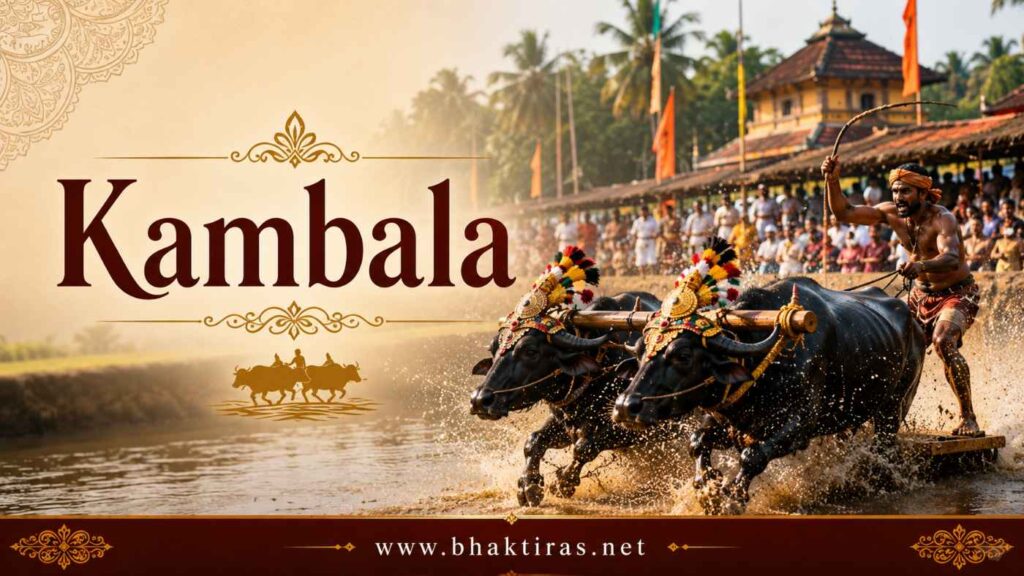
Kambala is the traditional buffalo race of Tulu Nadu, the coastal belt of Karnataka covering Dakshina Kannada and Udupi. After the paddy harvest, pairs of yoked buffaloes are driven at full sprint down parallel, water-filled tracks carved into the fields, kicking up sheets of mud and spray. It began as a harvest thanksgiving to local deities and Bhuta spirits, and to soften the ground for ploughing. Today it survives as an organised folk sport, run village by village through the cool months from about November to March.
Kambala 2026-2028: Season & Calendar
Kambala has no single fixed date. It is a season of races spread across the coast, tied to the post-harvest months rather than one tithi, so the timings below are approximate windows.
| Season | Approx. window | Where | Notes |
|---|---|---|---|
| 2025-26 | Nov 2025 – Mar 2026 | Dakshina Kannada, Udupi | Recently concluded season |
| 2026-27 | Nov 2026 – Mar 2027 | Tulu Nadu villages | Next season (dates approximate) |
| 2027-28 | Nov 2027 – Mar 2028 | Coastal Karnataka | Expected window |
Dozens of races are held each season across the coast. Well-known meets include those at Katapadi, Moodabidri, Bajagoli, Aikala-Bava and Mangaluru. Check the organising committee or local news for a specific venue’s date, as these are confirmed only weeks ahead.
Why Kambala Is Celebrated
Kambala began as a farmer’s thanksgiving. After the harvest, running buffaloes through the flooded fields was both an offering to the local deities and a practical way to churn the mud before the next sowing.
A harvest thanksgiving
The race grew out of gratitude for a good paddy crop. Villagers offered the spectacle to their gods and to the Bhuta spirits who, in Tulu belief, guard the fields and the harvest. Winning was a way of honouring that protection.
Preparing the land
There is a farming logic underneath the sport. Buffaloes pounding down water-filled tracks loosen and level the mud, leaving the ground softer for the next round of ploughing and transplanting.
Village pride
Owning and running a strong pair of buffaloes carries real standing in the community. Families breed, feed and train their animals through the year, and a win is a matter of local honour as much as sport.
A living folk tradition
What was once a purely village affair is now an organised sport with a season, committees and thousands of spectators. It has become one of the most recognisable symbols of Tulu Nadu’s coastal culture.
Devotional Roots
Kambala is a folk sport rather than a temple festival, but its roots run into the local sacred world of Tulu Nadu, where the land and its spirits are worshipped.
Local deities & Bhuta spirits
The race was traditionally offered to village deities and the Bhuta (spirit) guardians of the fields. In Tulu Nadu these spirits are honoured through rituals like Bhuta Kola, and a good harvest is credited to their favour.
Kadri and coastal shrines
Some Kambala traditions are linked to nearby shrines such as Kadri in Mangaluru. The connection ties the sporting spectacle back to older acts of thanks and devotion rather than pure competition.
How a Kambala Race Runs, Step by Step
A Kambala meet is a full day’s affair, from preparing the buffaloes to the final splash of water down the track.
- Preparing the field. Two parallel tracks are dug into a paddy field and flooded with water and slush, usually a few hundred feet long.
- Grooming the buffaloes. Owners bathe, oil and decorate their pairs; prized animals are cared for through the year and paraded before the crowd.
- Yoking the pair. Two buffaloes are yoked together and matched to a runner, who stands behind or between them holding a plough-shaped board or a rope.
- The start. On the signal, the pair charges down its track while the runner grips the board and is dragged along at speed through the mud.
- The splash. In some categories a whip-board throws up a spray of water; the higher the splash reaches against measuring poles, the better the score.
- Judging. Winners are decided by speed down the track and, in the splash events, by how high the water is thrown, timed and measured by officials.
- Honours. Winning pairs and runners take prizes and, more importantly, the pride of the village that owns them.
What People Eat at Kambala
Kambala draws big coastal crowds, and the day comes with the food of Tulu Nadu served at stalls around the fields.
Neer dosa & coconut chutney
Soft, lacy rice crepes are a coastal staple, eaten with fresh coconut chutney or a light curry. They are quick, filling stall food for a long day by the track.
Kori rotti
A signature Mangalurean dish of crisp rice wafers soaked in a fiery chicken curry. It is festive, hearty food that suits the crowd-and-carnival mood of a big meet.
Coastal seafood
Fish and prawn fries seasoned with the region’s red-chilli and coconut masalas are common at coastal gatherings, sold hot from roadside pans near the fields.
Patrode & snacks
Steamed colocasia-leaf rolls and other regional snacks turn up at stalls, alongside sweet payasa, giving spectators plenty to graze on between races.
Where Kambala Is Held
Kambala is specific to the Tulu-speaking coast. Its races are concentrated in a handful of districts rather than spread across India.
Dakshina Kannada
The heartland of Kambala, with many of the best-known meets held in and around villages near Mangaluru, Moodabidri and Bantwal through the season.
Udupi
The Udupi belt hosts several major races, including popular meets at places like Katapadi, drawing large crowds and top buffalo pairs.
Kasaragod (Kerala border)
The Tulu cultural zone spills across the state line, and Kambala-style buffalo races are also found in the neighbouring Kasaragod area of northern Kerala.
Kambala Do's and Don'ts
A few practical and ethical pointers if you plan to watch a race.
Do
- Check the exact date and venue with the local committee, as they are set close to the day.
- Reach early; the good vantage points near the tracks fill up fast.
- Respect the animals and their owners; keep out of the running lanes.
- Support meets that follow the official animal-welfare rules and veterinary checks.
- Try the coastal food stalls and take in the wider village atmosphere.
Avoid
- Do not step onto or cross the flooded tracks while a race is on.
- Do not encourage or applaud any mistreatment or over-driving of the buffaloes.
- Do not attend or promote unofficial races that skip veterinary checks and welfare rules.
- Do not crowd or startle the buffaloes before their run.
- Do not litter the paddy fields; these are working farms lent for the event.
Frequently Asked Questions
When is Kambala in 2026-27?
Kambala in 2026-27 is expected to run roughly from November 2026 to March 2027. It is a season of many races across coastal Karnataka rather than one fixed date, and individual venues confirm their dates only a few weeks ahead.
What is Kambala?
Kambala is the traditional buffalo race of Tulu Nadu, the coastal region of Karnataka. Pairs of yoked buffaloes are driven at speed down water-filled paddy tracks, and winners are judged on how fast they run and how high they throw up the water.
Where is Kambala held?
Kambala is held in coastal Karnataka, chiefly the Dakshina Kannada and Udupi districts, with related races in the Kasaragod area of northern Kerala. Dozens of village meets take place across this Tulu-speaking belt each season.
Why is Kambala celebrated?
Kambala began as a harvest thanksgiving to local deities and the Bhuta spirits believed to protect the fields, and as a way to churn the mud before ploughing. Today it continues as an organised folk sport and a strong marker of village pride in Tulu Nadu.
Which deities are linked to Kambala?
Kambala is a folk sport rather than a temple festival, but its roots lie in worship of local village deities and Bhuta spirits, who in Tulu belief guard the land and the harvest. Some traditions connect it to nearby coastal shrines such as Kadri in Mangaluru.
How does a Kambala race work?
In a Kambala race, two buffaloes are yoked together and driven by a runner down a flooded, slushy paddy track. Winners are decided by speed, and in the splash categories by how high the water is thrown against measuring poles, judged by officials.
Is Kambala safe for the buffaloes?
Kambala has drawn an animal-welfare debate, and it now operates under rules meant to protect the buffaloes, including veterinary checks and limits on how the animals are driven. Watching only official, rule-following meets is the responsible way to enjoy the sport.
How can I watch Kambala?
To watch Kambala, follow local Kambala committees or coastal Karnataka news for the season’s schedule, then travel to a specific village meet in Dakshina Kannada or Udupi. Arrive early for a good spot near the tracks and try the local food stalls.
If the coast calls you this winter, come for the mud, the thundering pairs and the pride of Tulu Nadu. Kambala shubhashayagalu.