
Bhuta Kola 2026-2027 – The Spirit-Worship Night of Tulu Nadu
ಭೂತ ಕೋಲ
When is Bhuta Kola performed in 2026-2027?
Bhuta Kola is a seasonal night ritual, not a fixed-date festival. In coastal Karnataka (Tulu Nadu) and Kasargod in northern Kerala it is held mostly in the cool months, roughly December to May, on dates set by each temple, family or village shrine. A performer becomes the living vessel of a local guardian spirit, or Bhuta, and dances through the night to drums and firelight.
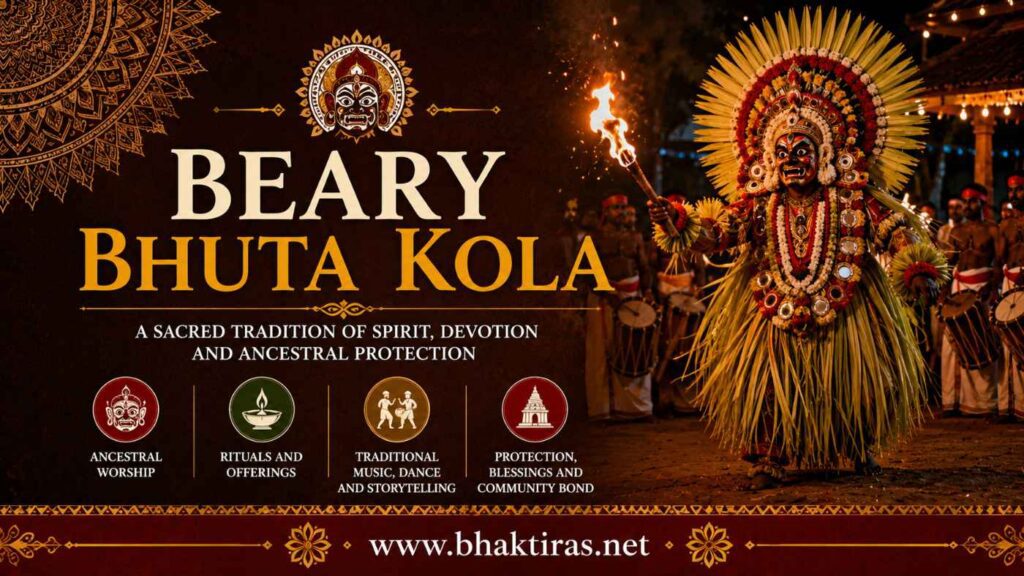
Bhuta Kola is the overnight spirit-worship ritual of Tulu Nadu, the coastal belt of Dakshina Kannada and Udupi in Karnataka, reaching into Kasargod in northern Kerala. Through the night a trained performer paints his body, dons towering headgear and heavy anklets, and by firelight and drumbeat surrenders his own self to become the living vessel of a Bhuta or Daiva – a guardian spirit the community reveres as protector and judge. Once the spirit has descended, it speaks, blesses, and settles the village’s disputes. It runs on the temple and family calendar, mostly through the cool months from about December to May.
Bhuta Kola 2026-2027: When It Happens
Bhuta Kola has no single national date. Each shrine, family or village fixes its own night, and most fall in the cooler, drier stretch from roughly December to May.
| Season | Typical window | Basis | Notes |
|---|---|---|---|
| 2025-2026 | Dec 2025 – May 2026 | Temple / family schedule | Season now largely past |
| 2026-2027 | Dec 2026 – May 2027 | Temple / family schedule | Next main season |
| 2027-2028 | Dec 2027 – May 2028 | Temple / family schedule | Following season |
The heaviest concentration of kolas falls after the monsoon and harvest, when nights are dry and cool. A related grander form, the multi-day Nema, is held at some shrines on a longer cycle of a few years.
Why Bhuta Kola Is Held
Bhuta Kola is held to honour and consult the guardian spirits, or daivas, who the Tuluva people believe watch over their land, families and cattle. It is worship, justice and community memory in a single night.
In the Tuluva worldview the daivas are not distant gods but near, powerful presences tied to specific fields, houses and lineages. Some began as ordinary people or beings who died wronged and were later deified; others are older nature and forest spirits. The kola is how the living keep faith with them.
It is also a form of village justice. When the spirit speaks through the performer, people bring their quarrels, land disputes and grievances before it, and its word, called nudi, is accepted as binding. Wider audiences met this tradition through the 2022 film Kantara, though the ritual itself is centuries old.
Protection and blessing
Families and villages invite the daiva to guard their homes, harvests and cattle for the year ahead. In return they offer the kola, food and respect, renewing a bond that can pass down a lineage for generations.
Justice and truth
Once the spirit has descended, its verdict on a dispute is treated as final. People long relied on the kola as a court of last appeal, trusting the daiva to see what humans could not and to speak the truth plainly.
Living memory
Each daiva carries its own story, or paddana, sung through the night. These oral epics preserve local history, heroes and injustices, keeping the community’s past alive in a form no book records.
The Daivas Worshipped
Bhuta Kola centres on local guardian spirits called Bhutas or Daivas, each with its own character, story and territory. A few are honoured across much of Tulu Nadu.
Panjurli
One of the most widely worshipped daivas, associated with the wild boar and cast as a protector of fields, crops and households. Panjurli is seen as a fair and benevolent guardian, invoked at countless family shrines.
Guliga
A powerful, fiery spirit often paired with Panjurli as a balancing force, feared and respected for swift, uncompromising justice. Guliga demands careful, exact ritual and is not treated lightly.
Kalkuda
A daiva remembered as a gifted sculptor who was wronged and maimed by a king, then deified after death. His story, sung in the paddanas, is one of the tradition’s most moving accounts of injustice remembered.
Koragajja
A beloved guardian believed to recover what is lost and answer the prayers of the humble. Devotees across Tulu Nadu make vows to Koragajja and offer tender coconut, beedi and simple gifts in thanks.
How a Kola Unfolds, Step by Step
A kola is performed by artists from designated communities such as the Nalike, Pambada and Parava, who carry the tradition as a hereditary duty. The night moves through a set sequence.
- Preparation and purity. The performer fasts and purifies himself. The shrine or courtyard is cleaned and readied, and offerings, oil lamps and the paraphernalia of the daiva are arranged.
- The drums begin. Musicians strike up on drums such as the dolu and other percussion. The rhythm is the spine of the whole night, steadily building the intensity that will call the spirit down.
- Body painting and costume. The performer’s face and body are painted in bold reds, yellows and black in patterns fixed for each daiva. He is dressed in the elaborate costume, chest ornaments and heavy metal anklets.
- The headgear and fire. A towering headdress, or ani, sometimes wide as a fan, is fixed on. Torches and burning coir raise walls of firelight, and the performer may leap through or handle fire without harm.
- The trance. As the drumming peaks the performer loses his ordinary self and is possessed by the daiva. His movements, voice and bearing change; the community now addresses him as the spirit itself.
- The nudi, the spirit’s word. Speaking as the daiva, he blesses devotees, accepts offerings, and hears the disputes and pleas placed before him, delivering verdicts and reassurances that are taken as binding.
- The paddana. Alongside the dance the daiva’s own epic is sung, recounting how it lived, suffered and became divine, tying the night’s ritual to a remembered story.
- Blessing and close. Toward dawn the spirit gives its final blessings and withdraws. The performer returns to himself, and the community shares food, closing the bond for another cycle.
Food and Offerings at a Kola
Food is both offering and shared feast. Dishes reflect the coastal Tuluva kitchen, with rice, coconut and, at many shrines, non-vegetarian fare presented to the daivas.
Rice and coconut offerings
Cooked rice, tender coconut and jaggery are laid before the daiva as core offerings. Coconut in particular runs through nearly every Tuluva ritual as a mark of respect and auspiciousness.
Non-vegetarian prasada
For fierce daivas such as Guliga, offerings of chicken, and at some shrines other meat, are traditional. The food is later shared among those gathered as blessed prasada.
Kori Rotti and coastal dishes
The wider Tulu Nadu table, including the famous Kori Rotti of chicken curry with crisp rice wafers, often features when families and neighbours eat together after the night’s rites.
Beedi, betel and simple gifts
For helper spirits like Koragajja, humble offerings such as beedi, betel leaf and tender coconut are customary, given in fulfilment of personal vows rather than as a feast.
Where Bhuta Kola Is Performed
The ritual belongs to the Tulu-speaking coast and its close neighbours, with local names and forms shifting across the region.
Dakshina Kannada & Udupi
The heartland of the tradition, where the Tuluva people hold kolas at family shrines, village gudis and larger temples through the cool season. This is where the practice is densest and most varied.
Kasargod, Kerala
Just across the state line, northern Kerala’s Kasargod district shares the Tulu cultural belt and its spirit worship. The local Beary community also takes part in the shared coastal ritual life here.
Daiva Kola and Nema
The ritual is also known as Daiva Kola. A grander, longer form called Nema is held at some shrines over several days on a multi-year cycle, drawing very large gatherings.
Kindred traditions
Theyyam in northern Kerala is a related form of divine possession worship, and Tulu Nadu’s own Nagamandala serpent ritual sits in the same living folk-faith world of the coast.
Attending a Bhuta Kola: Do's and Don'ts
This is living faith, not a show, so approach it with the respect the community gives it.
Do
- Treat the event as sacred worship and follow the lead of local devotees.
- Ask before photographing or filming, as many families consider it intrusive.
- Dress modestly and keep a respectful distance from the performer and fire.
- Stay quiet and attentive during the trance and the delivery of the nudi.
- Accept prasada and hospitality graciously if it is offered to you.
Avoid
- Do not treat it as a tourist spectacle or a photo opportunity.
- Do not mock, imitate or question the possession or the daiva.
- Do not touch the performer, the costume or the ritual objects.
- Do not crowd the sacred space or block the ritual movements.
- Do not bring or consume alcohol or behave carelessly at the shrine.
Frequently Asked Questions
When is Bhuta Kola performed in 2026-2027?
Bhuta Kola has no single fixed date. It is a seasonal ritual held mainly in the cool months, roughly December 2026 to May 2027, with each temple, family or village shrine setting its own night. Confirm the exact date locally, as it follows tradition rather than a printed calendar.
What is Bhuta Kola?
Bhuta Kola is an overnight spirit-worship ritual of Tulu Nadu in coastal Karnataka and Kasargod in Kerala. A trained performer, in body paint, costume and towering headgear, dances by firelight to drums, enters a trance and becomes the living vessel of a guardian spirit called a Bhuta or Daiva, who then blesses the community and settles disputes.
Why is Bhuta Kola celebrated?
Bhuta Kola is held to honour and consult the daivas, the local guardian spirits the Tuluva people believe protect their land, families and cattle. It works as worship, as a form of village justice where the spirit’s word settles quarrels, and as living memory, since each daiva’s story is sung through the night.
Which spirits are worshipped in Bhuta Kola?
Bhuta Kola centres on local guardian spirits called Bhutas or Daivas, each with its own story and territory. Widely honoured ones include Panjurli the boar-protector, the fierce Guliga, the deified artisan Kalkuda, and the helper spirit Koragajja who is believed to recover what is lost.
Who performs Bhuta Kola?
Bhuta Kola is performed by artists from designated communities such as the Nalike, Pambada and Parava, who carry the tradition as a hereditary duty. Through fasting, painting, costume and drumming they prepare to become the vessel of the daiva, a role passed down within their families.
Is Bhuta Kola the same as Kola in the film Kantara?
Yes. The 2022 film Kantara brought wide attention to Bhuta Kola, depicting the spirit-worship and trance dance of coastal Karnataka. The ritual it portrays is a genuine, centuries-old tradition of Tulu Nadu, not something invented for the screen, and should be treated as living faith.
What is the difference between Bhuta Kola and Nema?
Bhuta Kola is the core overnight ritual honouring a daiva, often at a family or village shrine. Nema is a grander, longer form of the same worship, held at some shrines over several days on a multi-year cycle and drawing much larger gatherings.
Where is Bhuta Kola performed?
Bhuta Kola is performed in Tulu Nadu, the coastal Karnataka districts of Dakshina Kannada and Udupi, and across the state line in Kasargod district of northern Kerala. It belongs to the Tulu-speaking coast and its shared culture, where the Beary community of Kasargod also takes part in the region’s ritual life.
May the daivas of the coast keep watch over your home and harvest. Bhuta Kola is living faith, so wherever you meet it, meet it with respect.