
Ashokastami 2027 – Lingaraj's Rukuna Rath Yatra in Bhubaneswar
अशोकाष्टमी
When is Ashokastami in 2027?
Ashokastami falls on Wednesday, 14 April 2027. It is observed on Chaitra Shukla Ashtami, the eighth day of the bright fortnight of the Chaitra month. The day is best known for the Rukuna Rath Yatra of the Lingaraj Temple in Bhubaneswar, when Lord Lingaraj (Shiva) is taken out on a towering wooden chariot.
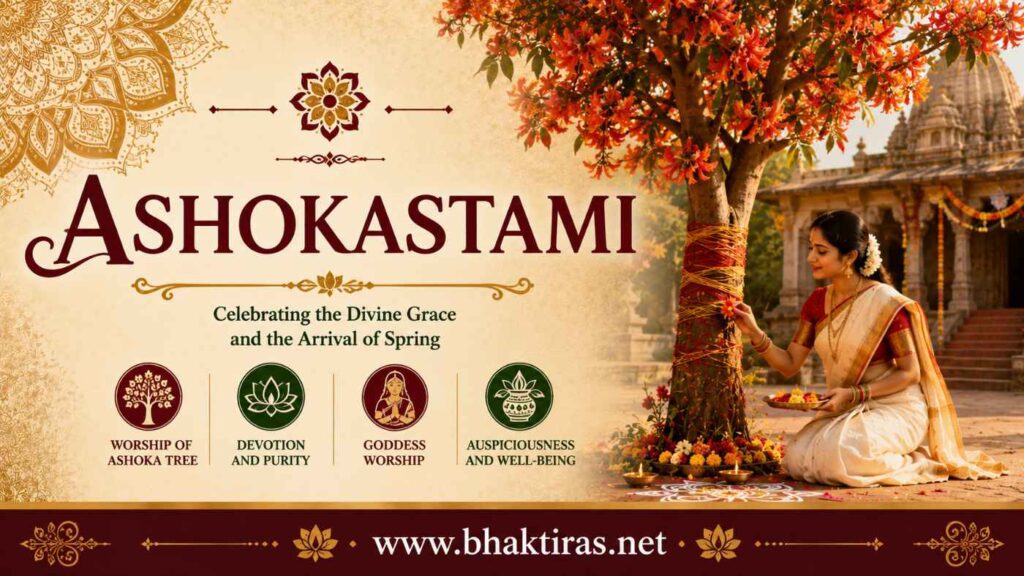
Ashokastami is a Chaitra-month festival dedicated to Lord Shiva, falling on the bright eighth day (Shukla Ashtami) in March or April. Its grandest expression is in Bhubaneswar, Odisha, where the Lingaraj Temple holds its Rukuna Rath Yatra – one of the oldest and largest car festivals in the state. The name itself carries meaning: a-shoka means without grief, and the day is tied both to the flowering ashoka tree and to the hope of release from sorrow. Beyond Odisha, families in Bengal and parts of north India mark it with quiet ashoka-tree customs.
Ashokastami 2026-2028: Dates & Calendar
The next Ashokastami is on 14 April 2027. Because it is fixed to a lunar tithi rather than a solar date, it shifts each year within the March-April window.
| Year | Date | Day | Notes |
|---|---|---|---|
| 2026 | 26 March | Thursday | Already observed |
| 2027 | 14 April | Wednesday | Next occurrence |
| 2028 | 2 April (approx.) | Sunday | Falls just before Ram Navami; confirm nearer the date |
In Bhubaneswar the Lingaraj chariot festival itself unfolds over several days: the deity travels to the Rameswar (Mausima) temple, stays a few days, and then returns. The exact procession timings are set each year by the temple’s servitors and local panchang.
Why Ashokastami Is Celebrated
Ashokastami honours Lord Shiva and is linked to freedom from grief, drawing its name from a-shoka, meaning without sorrow.
The meaning of a-shoka
The word shoka means grief, and a-shoka means its absence. The day is understood as a time to shed sorrow and seek a lighter, more settled heart, which is why worship on Ashokastami is often done with a wish for peace within the family.
Lingaraj's outing
In Bhubaneswar the festival centres on Lord Lingaraj, the presiding deity of the great Lingaraj Temple, who is worshipped as both Shiva and Vishnu (Harihara). Ashokastami is the one day he leaves the sanctum and is pulled through the streets on a chariot, letting devotees who never enter the inner temple have his darshan in the open.
The ashoka tree
The flowering ashoka tree gives the festival part of its name and its old ritual. In some households, tender ashoka buds are eaten on this day, and the tree is honoured as a plant associated with the easing of grief in Indian tradition.
Deities & Figures Worshipped
Ashokastami is primarily a festival of Lord Shiva, worshipped in Odisha as Lingaraj, together with the divine family around him.
Lingaraj (Shiva)
Lingaraj is the form of Shiva enshrined at the Lingaraj Temple in Bhubaneswar, one of Odisha’s oldest and most important shrines. On Ashokastami he is the deity carried out on the Rukuna chariot to the Rameswar temple.
Rukmini / the accompanying form
Lingaraj does not travel alone. A representative deity accompanies him on the journey to the Mausima (aunt’s) temple, keeping the festival’s story of a family visit at its centre.
Parvati
As Shiva’s consort, Parvati is remembered on this Chaitra Ashtami, which also overlaps with the wider spring worship of the Goddess during the Chaitra fortnight in eastern India.
Key Rituals, Step by Step
In Bhubaneswar the day follows the rhythm of the chariot festival, while at home the observance is simpler.
- Early rituals at the temple. Priests perform the morning worship of Lingaraj, and the deity is prepared and decorated for his journey.
- Bringing the deity to the chariot. Lingaraj is carried out of the sanctum in a ceremonial procession and placed on the tall wooden Rukuna Rath built for the occasion.
- Pulling the chariot. Thousands of devotees take hold of the ropes and pull the chariot through the streets towards the Rameswar (Mausima) temple, treating the act of pulling as an offering.
- The stay at the Mausima temple. The deity remains at the Mausima temple for a few days, where special worship and offerings continue.
- The return journey. After the stay, the chariot is drawn back and Lingaraj is returned to the main temple, completing the yatra.
- Home worship of Shiva. Away from the procession, devotees bathe, visit a Shiva temple, offer water and bilva leaves on the linga, and keep a simple fast.
- Ashoka-flower custom. Where the old tradition survives, tender ashoka buds are gathered and taken as part of the day’s observance.
Special Foods of Ashokastami
Food on Ashokastami leans towards simple, sattvic dishes suited to a Shiva fast, with a few regional touches.
Ashoka flower buds
The most distinctive custom is the taking of tender ashoka-tree buds on this day, an old practice tied directly to the festival’s name and to the wish for freedom from grief.
Fasting fare
Those who fast keep to fruit, milk and light sattvic food, breaking the fast after evening worship rather than sitting down to a heavy meal.
Odia bhoga
In and around the Lingaraj Temple, devotees share temple bhoga – rice, dal and vegetable preparations offered to the deity and then distributed as prasad.
Regional Names & Variations
Ashokastami is felt most strongly in Odisha, but it is also kept quietly elsewhere in the east and north.
Odisha
Bhubaneswar is the heart of the festival. The Lingaraj Temple’s Rukuna Rath Yatra draws huge crowds, making Ashokastami one of the city’s major religious days rather than a household observance alone.
Bengal
In Bengal the day is observed more privately, with worship of Shiva and Parvati and the older ashoka-tree customs kept by some families during the Chaitra fortnight.
North India
In parts of the north Ashokastami is marked as a Shiva vrat, with a fast, a temple visit and offerings on the Shiva linga, without the large public procession seen in Odisha.
Ashokastami Do's and Don'ts
A few simple points help keep the day respectful and calm.
Do
- Bathe early and visit a Shiva temple if you can
- Offer water and bilva leaves on the Shiva linga
- Keep the day’s food simple and sattvic
- Join or support the chariot pulling respectfully if you are in Bhubaneswar
- Use the day to let go of a grievance, in keeping with a-shoka
Avoid
- Do not force your way to the front of the chariot crowd
- Do not treat the ashoka-flower custom carelessly if you follow it
- Do not break the fast before completing the evening worship
- Do not carry quarrels or anger into a day named for the end of grief
- Do not litter or damage the ashoka tree while gathering buds
Frequently Asked Questions
When is Ashokastami in 2027?
Ashokastami is on Wednesday, 14 April 2027. It falls on Chaitra Shukla Ashtami, the eighth day of the bright half of the Chaitra month, and is best known for the Lingaraj Rukuna Rath Yatra in Bhubaneswar.
When is Ashokastami in 2026 and 2028?
Ashokastami was on 26 March 2026 (Thursday). In 2028 it is expected around 2 April (Sunday), just before Ram Navami; the exact date should be confirmed against the panchang nearer the time, as it depends on the lunar tithi.
Why is Ashokastami celebrated?
Ashokastami is celebrated as a day dedicated to Lord Shiva and to freedom from grief, since a-shoka means without sorrow. In Odisha it is the day the Lingaraj deity leaves his temple on a great chariot, and elsewhere it is kept with Shiva worship and old ashoka-tree customs.
Which god is worshipped on Ashokastami?
The main deity of Ashokastami is Lord Shiva, worshipped in Bhubaneswar as Lingaraj. Parvati and the accompanying form of the deity who travels with Lingaraj are honoured alongside him.
What is the Lingaraj Rukuna Rath Yatra?
The Rukuna Rath Yatra is the chariot festival of the Lingaraj Temple in Bhubaneswar held on Ashokastami. Lord Lingaraj is placed on a tall wooden chariot and pulled by devotees to the Rameswar (Mausima) temple, where he stays a few days before the return journey.
Where is Ashokastami celebrated most?
Ashokastami is celebrated most grandly in Bhubaneswar, Odisha, at the Lingaraj Temple, where it is one of the oldest and largest car festivals in the state. It is also observed more quietly in Bengal and parts of north India as a Shiva vrat.
What does the ashoka tree have to do with the festival?
The ashoka tree gives the festival its name and one of its customs. On Ashokastami some families take tender ashoka buds and honour the tree, which Indian tradition links with easing grief – fitting for a day whose name means without sorrow.
Is Ashokastami a fasting day?
Yes, many devotees keep a fast on Ashokastami. They eat only fruit, milk and light sattvic food and break the fast after the evening worship of Shiva, though the observance is optional and varies by family.
May this Ashokastami lift a little sorrow from your home. Har Har Mahadev.