
Hayagriva Jayanti 2026 – The Horse-Headed Lord of Knowledge
हयग्रीव जयन्ती
When is Hayagriva Jayanti in 2026?
Hayagriva Jayanti falls on Friday, 28 August 2026. It is the appearance day of Hayagriva, the horse-headed form of Vishnu worshipped as the lord of knowledge and the restorer of the Vedas. The festival is observed on Shravana Purnima, the same full moon as Raksha Bandhan.
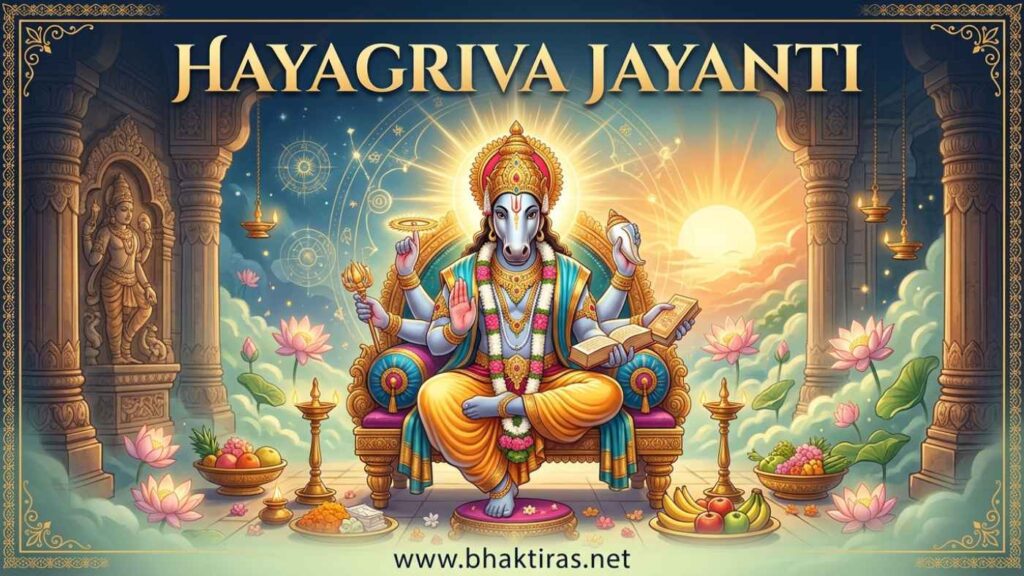
Hayagriva Jayanti honours one of the most unusual and beloved forms of Vishnu – a deity with the body of a man and the head of a white horse, worshipped as the source of all learning and wisdom. Falling on Shravana Purnima, the same full moon as Raksha Bandhan, the day belongs especially to students, teachers and anyone who works with the mind. Devotees remember how Hayagriva recovered the Vedas after a demon carried them off, returning sacred knowledge to a world that had lost it.
Hayagriva Jayanti 2026-2028: Dates & Calendar
The next Hayagriva Jayanti is on Friday, 28 August 2026. Because it follows the Hindu lunar calendar, the date shifts each year against the Gregorian months.
| Year | Date | Day | Tithi |
|---|---|---|---|
| 2026 | 28 August | Friday | Shravana Purnima (next occurrence) |
| 2027 | 17 August | Tuesday | Shravana Purnima |
| 2028 | 6 August | Sunday | Shravana Purnima |
The observance shares its full moon with Raksha Bandhan and, in the south, with Avani Avittam (Upakarma), the day when the sacred thread is renewed – so temples dedicated to knowledge are especially busy.
Why Hayagriva Jayanti Is Celebrated
Hayagriva Jayanti celebrates the appearance of Vishnu as the horse-headed deity who rescued the Vedas and became the eternal patron of learning.
The theft of the Vedas
The Puranas tell that while Brahma slept, a demon – also named Hayagriva – stole the four Vedas and hid them at the bottom of the cosmic ocean. With the sacred knowledge gone, right conduct and order began to slip from the world. Vishnu answered by taking the horse-headed form to recover what had been lost.
Knowledge restored
In his Hayagriva form, Vishnu defeated the demon and returned the Vedas to Brahma, and through him to humanity. This is why the deity is invoked as the giver of memory, speech and clear understanding, and why the day is treated as a fresh start for study.
Why the horse head
The horse is an old symbol of energy, alertness and the tireless movement of the mind. Hayagriva’s radiant white form is described as pure light, and his four hands carry the conch, discus, a book and the gesture of teaching – knowledge held and knowledge given.
Patron of learning
For scholars, poets and seekers, Hayagriva is the deity you turn to before beginning anything difficult to master. Many students recite his prayers at the start of the academic year, and the great teacher Vedanta Desika composed a famous stotra in his honour.
Deities & Figures Worshipped
The day is centred entirely on Hayagriva, the horse-headed avatar of Vishnu, though his consort Lakshmi and Saraswati are often remembered alongside him.
Hayagriva
Vishnu in his horse-headed form, seated in white radiance, holding the conch and discus of Vishnu together with a manuscript and the teaching gesture. He is prayed to for wisdom, sharp memory and success in study and speech.
Lakshmi Hayagriva
In several Sri Vaishnava temples the deity is worshipped with Lakshmi at his side as Lakshmi Hayagriva, uniting knowledge with grace and abundance.
Saraswati
As the goddess of learning and the arts, Saraswati is naturally honoured near this festival; households that keep books, instruments and tools of study place them for blessing.
Key Rituals, Step by Step
Worship is simple, quiet and study-focused, with white the colour of the day.
- Rise and bathe early. Devotees begin before dawn on the full moon, clean the home shrine and set white flowers, which suit Hayagriva’s radiant form.
- Set up the image. A picture or idol of Hayagriva is placed on a clean cloth, often beside books, pens or the tools of one’s craft.
- Light lamp and incense. A ghee lamp and incense are offered, and the deity is welcomed with water, sandal paste and flowers.
- Recite the Hayagriva Stotra. Many chant Vedanta Desika’s Hayagriva Stotra or simple prayers asking for clarity of mind and speech.
- Offer white foods. Milk, curd, coconut and white sweets are placed before the deity, foods linked to purity and learning.
- Bless the books. Students and scholars keep their study materials before the image and seek blessings for the year of learning ahead.
- Distribute prasad. The offered food is shared with family and, in temples such as Hajo, with all who gather.
Special Foods of Hayagriva Jayanti
Offerings lean towards white and simple foods, with a few regional sweets carrying the deity’s own name.
Hayagreeva Maddi
A rich sweet of chana dal cooked with jaggery, ghee, coconut and cashews, named for the deity and offered in Madhva households, especially at Udupi.
Milk and curd offerings
White foods – milk, curd, butter and coconut – are favoured for their link with purity and the clear, calm mind that study needs.
Payasam / kheer
A milk-and-rice pudding sweetened with jaggery or sugar, a common naivedya offered and then shared as prasad.
Coconut and fruits
At the Hayagriva Madhava temple in Hajo, coconut, bananas and other fruits are offered and given out to visiting devotees.
Regional Names & Variations
Hayagriva worship is strongest in Assam and Tamil Nadu, with important centres also in Karnataka and Andhra Pradesh.
Hajo, Assam
The Hayagriva Madhava temple on Manikut hill is the most famous shrine, a stone temple revered by Hindus and by some Buddhists as a sacred site. The full moon draws large gatherings for darshan and offerings.
Tamil Nadu
Temples at places such as Thiruvahindrapuram, tied to the poet-saint Vedanta Desika, and other Sri Vaishnava centres hold special worship, with students seeking blessings before exams and new terms.
Karnataka
In the Madhva tradition, notably around Udupi, Hayagriva is a cherished deity of learning, and the sweet Hayagreeva Maddi is prepared as his offering.
Andhra Pradesh
Hayagriva shrines and household worship mark the day for families in scholarly and temple traditions, with prayers for wisdom and speech.
Hayagriva Jayanti Do's and Don'ts
The day rewards a calm, sincere approach and a little care with study materials.
Do
- Wake early and keep the worship area clean and quiet.
- Offer white flowers, milk and simple sattvic food.
- Keep your books and tools of study before the deity for blessing.
- Recite the Hayagriva Stotra or a heartfelt prayer for clarity.
- Share the prasad and, if you can, help a student with their learning.
Avoid
- Do not offer meat, onion, garlic or alcohol on this observance.
- Avoid arguments and harsh speech, which go against a day of wisdom.
- Do not treat books or study materials carelessly on this day.
- Avoid tamasic, stale or leftover food as offerings.
- Do not rush the worship; the spirit of the day is patient attention.
Frequently Asked Questions
When is Hayagriva Jayanti in 2026?
Hayagriva Jayanti in 2026 falls on Friday, 28 August. It is observed on Shravana Purnima, the full moon of the Shravana month, which is also the day of Raksha Bandhan.
When is Hayagriva Jayanti in 2027 and 2028?
Hayagriva Jayanti will be on Tuesday, 17 August 2027 and on Sunday, 6 August 2028. Both dates fall on Shravana Purnima, so they shift each year with the Hindu lunar calendar.
Who is Hayagriva?
Hayagriva is a form of the god Vishnu with a human body and the head of a white horse. He is worshipped as the deity of knowledge, learning and wisdom, and is remembered for recovering the Vedas after they were stolen.
Why is Hayagriva Jayanti celebrated?
Hayagriva Jayanti is celebrated as the appearance day of the horse-headed Vishnu who rescued the stolen Vedas and restored sacred knowledge to the world. Because of this, the day honours learning, memory and clear thought, and is especially observed by students and scholars.
Which god is worshipped on Hayagriva Jayanti?
Hayagriva, the horse-headed avatar of Vishnu, is worshipped on this day. He is often venerated alongside his consort Lakshmi as Lakshmi Hayagriva, and the learning goddess Saraswati is remembered too.
Why does Hayagriva have a horse's head?
The horse head symbolises energy, alertness and the tireless movement of the mind, fitting for the lord of knowledge. In the Puranic story, Vishnu took this radiant white form to overcome a demon and recover the Vedas.
Where is Hayagriva mainly worshipped?
Hayagriva is worshipped across India, with the best-known shrine being the Hayagriva Madhava temple at Hajo in Assam. Tamil Nadu, Karnataka and Andhra Pradesh also have important Hayagriva temples, especially within Sri Vaishnava and Madhva traditions.
How is Hayagriva Jayanti observed?
Devotees bathe early, worship an image of Hayagriva with white flowers, lamp and incense, and recite his prayers such as the Hayagriva Stotra. Students place their books before the deity for blessings, and white foods like milk, curd and sweets are offered and shared as prasad.
May Hayagriva grant clear thought and steady learning to all who seek him this Shravana Purnima. Jai Hayagriva.