
Pola 2026 – The Farmers' Festival Honouring Bullocks
पोळा
When is Pola in 2026?
Pola falls on Friday, 11 September 2026. It is an agrarian festival of Maharashtra, Chhattisgarh and neighbouring regions on which farmers give their bullocks and oxen a day of rest, bathe and decorate them, and worship the animals for their labour in the fields. The festival is observed on the Amavasya (new moon) of the Shravana month, also called Pithori Amavasya.
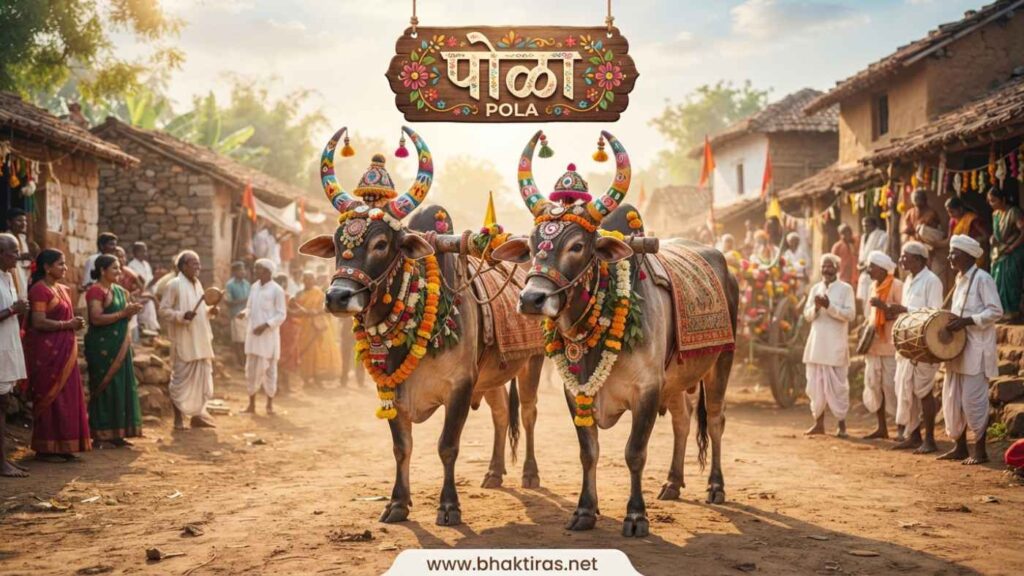
Pola is the day the working animal comes first. Across rural Maharashtra, Chhattisgarh and parts of Madhya Pradesh and Telangana, farmers set down their tools and turn all their attention to the bullocks and oxen that pull the plough and the cart the rest of the year. Held on the new moon of the Shravana month – 11 September in 2026 – the festival gives the cattle a full day off. They are bathed, their horns are painted, and they are dressed in ornaments, shawls and jingling bells before being led through the village and worshipped. It is a quiet, heartfelt thank-you from the farmer to the animal.
Pola 2026-2028: Dates & Calendar
Pola in 2026 is on Friday, 11 September. Because it follows the Amavasya (new moon) of the lunar month of Shravana, the date shifts each year against the Gregorian calendar, usually falling between mid-August and mid-September.
| Year | Date | Day | Notes |
|---|---|---|---|
| 2026 | 11 September | Friday | Next occurrence – Shravana Amavasya |
| 2027 | 31 August | Tuesday | Pithori Amavasya |
| 2028 | 20 August | Sunday | Shravana new moon |
The festival is a single-day observance. In Chhattisgarh the same new moon is marked as Polala Amavasya, and the children’s version, Tanha Pola, is often kept the following day.
Why Pola Is Celebrated
Pola is celebrated to honour bullocks and oxen for the work they do in farming. It marks the close of the sowing season, when the hardest ploughing is done and the animals have earned a rest.
Thanks to the working animal
Pola recognises that a small farmer’s livelihood depends directly on his cattle. By late Shravana the fields are sown and the bullocks have finished their most demanding labour, so the day is set aside to repay that effort with rest, good food and care.
The farmer-cattle bond
For agrarian communities the bullock is not merely livestock but a partner in survival. Grooming and decorating the animals, then bowing before them, expresses a relationship built on daily dependence rather than sentiment alone.
A seasonal pause
Coming on the Shravana new moon, Pola gives both farmer and animal a breather between the intense sowing weeks and the harvest work ahead. It functions as a natural rest day in the agricultural year.
Key Rituals, Step by Step
Preparations begin the evening before, and the main worship takes place through the day of the new moon.
- Rest and release. The bullocks are freed from all work for the day; no ploughing, carting or heavy load is put on them.
- Bathing. Early in the morning the animals are washed in a river, pond or at home, and their bodies rubbed clean.
- Painting and dressing. Horns are painted in bright colours, sometimes tipped with brass or wooden caps, and the animals are draped in fresh shawls, garlands, beads and bells.
- Worship. The decorated bullocks are offered turmeric, kumkum, flowers and a lamp; the farmer’s family performs aarti and touches the animals’ feet in respect.
- Feeding. Special food is prepared for the cattle – items such as puran poli, sweetened rice or jaggery-based treats – and they are fed by hand.
- Procession. The bullocks are led in a village procession, often behind a decorated arch or toran, with drums and music as families gather to watch.
- Tanha Pola for children. Children play with small wooden or clay model bulls, decorating and worshipping them in imitation of the adults, and sometimes going door to door with them.
Special Foods of Pola
Pola cooking is festive and shared, with sweets prepared both for the family and to feed the bullocks.
Puran Poli
A flatbread stuffed with a sweet filling of jaggery and cooked chana dal, flavoured with cardamom. It is the signature dish of Pola and is offered to the bullocks as well as eaten by the family.
Karanji
Crisp fried pastry parcels filled with sweetened coconut and dry fruit, made in advance and served to visitors through the day.
Kheer and sweet rice
Milk-and-rice kheer or jaggery-sweetened rice is cooked as a festival treat and a portion is fed to the cattle.
Local sweets
In Chhattisgarh households prepare regional sweets and fried snacks to mark Polala Amavasya, shared among neighbours and offered during the worship.
Regional Names & Variations
The festival is kept across the central and western Deccan, with the name and emphasis changing from state to state.
Maharashtra
Known as Bail Pola, it is one of the most widely observed rural festivals, with village bullock processions and the children’s Tanha Pola played with toy bulls.
Chhattisgarh
Celebrated as Pola on Polala Amavasya, with cattle worship and children playing with clay bull and other animal figurines.
Madhya Pradesh
Farming communities in parts of the state observe Pola in much the same way, resting and decorating their bullocks.
Telangana
Sections of the farming community keep the observance around the same new moon, honouring cattle central to agriculture.
Pola Do's and Don'ts
A few simple customs keep the spirit of the day, which is about care and gratitude toward the animals.
Do
- Give the bullocks a complete day of rest
- Bathe and gently groom the animals before decorating them
- Offer them special food such as puran poli by hand
- Include children through Tanha Pola with toy bulls
- Keep decorations comfortable and safe for the animals
Avoid
- Do not put the cattle to any work or heavy load on this day
- Avoid frightening the animals with loud, harmful firecrackers
- Do not use tight or painful ornaments on horns or body
- Avoid overfeeding rich sweets to the point of harming the cattle
- Do not neglect water and shade during the procession
Frequently Asked Questions
When is Pola in 2026?
Pola in 2026 falls on Friday, 11 September. It is observed on the Amavasya (new moon) of the Shravana month, also called Pithori Amavasya, when farmers rest and worship their bullocks.
When is Pola in 2027 and 2028?
Pola will be on Tuesday, 31 August 2027 and on Sunday, 20 August 2028. The date moves each year because it follows the Shravana new moon of the lunar calendar rather than a fixed Gregorian date.
Why is Pola celebrated?
Pola is celebrated to thank bullocks and oxen for their labour in farming. Coming at the end of the main sowing season, it gives the working animals a day of rest and honours the bond between the farmer and his cattle.
Where is Pola celebrated?
Pola is celebrated mainly in Maharashtra and Chhattisgarh, along with parts of Madhya Pradesh and Telangana. It is an agrarian festival kept in farming villages across these regions.
What is Tanha Pola?
Tanha Pola is the children’s version of the festival. Children decorate and worship small wooden or clay model bulls in imitation of the adults, and often carry them from house to house.
What is done to the bullocks on Pola?
On Pola the bullocks are given the day off, bathed, and have their horns painted. They are dressed in shawls, garlands, ornaments and bells, fed special food, then led in a village procession and worshipped.
Which festival is similar to Pola?
Pola is similar in spirit to other cattle-honouring and harvest festivals of India, such as the Mattu Pongal day of Tamil Nadu’s Pongal, when cattle are decorated and thanked for their role in farming.
Is Pola a religious or agricultural festival?
Pola is primarily an agricultural festival with religious observance woven in. Its focus is gratitude to farm animals, expressed through worship, decoration and rest for the bullocks rather than temple ritual.
May your bullocks be well and your fields be plenty – happy Pola.