
Govardhan Puja 2026 – The Annakut Feast for Krishna
गोवर्धन पूजा
When is Govardhan Puja in 2026?
Govardhan Puja falls on Tuesday, 10 November 2026. It is the fourth day of Diwali, observed on Kartik Shukla Pratipada, the day after Lakshmi Puja. Devotees build a small hill of cow dung or food to represent Govardhan and offer Annakut, a mountain of vegetarian dishes, to Krishna.
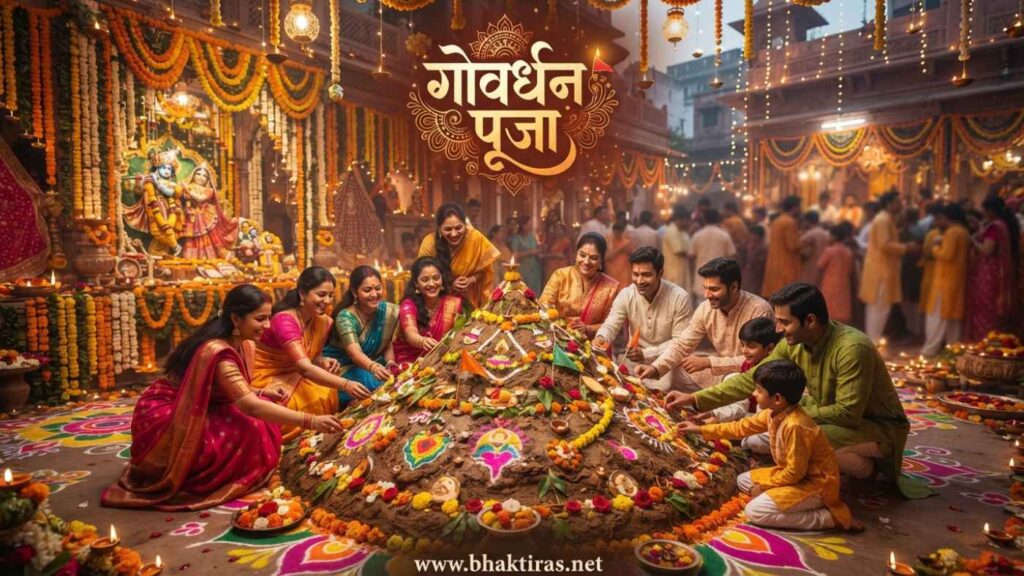
Govardhan Puja is the fourth day of Diwali, celebrated on Kartik Shukla Pratipada, the morning after Lakshmi Puja. It recalls the day the young Krishna raised the Govardhan hill on his little finger to shield the cowherds of Braj from a punishing storm sent by Indra. The heart of the observance is Annakut, literally a heap of food, when families cook dozens of vegetarian dishes and pile them before Krishna in gratitude. In 2026 it falls on 10 November.
Govardhan Puja 2026-2028: Dates & Calendar
The next Govardhan Puja is on Tuesday, 10 November 2026. The date shifts each year because it follows the Hindu lunar calendar, landing on Pratipada, the first day of the bright fortnight of Kartik.
| Year | Date | Day | Notes |
|---|---|---|---|
| 2026 | 10 November | Tuesday | Next occurrence – day after Lakshmi Puja |
| 2027 | 30 October | Saturday | Also Gujarati New Year (Bestu Varas) |
| 2028 | 18 October | Wednesday | Kartik Shukla Pratipada |
The tithi is short and can begin the previous afternoon, so local panchangs occasionally list the observance a day earlier or later. In some years, when the lunar day overlaps, Govardhan Puja is marked two days after Diwali rather than one, as happens in 2026.
Why Govardhan Puja Is Celebrated
Govardhan Puja marks Krishna lifting the Govardhan hill to protect the people of Braj, a story that teaches devotion to nature and honest labour over fear-driven ritual.
Krishna lifts the hill
The villagers of Braj used to offer their harvest to Indra, god of rain. Krishna urged them instead to honour the Govardhan hill and their cattle, the real sources of their livelihood. An angry Indra sent seven days of torrential rain, and Krishna lifted the entire hill on the little finger of his left hand, giving everyone shelter beneath it until the storm broke.
Nature over blind ritual
The tale is often read as a lesson in gratitude to the land, the forest and the animals that sustain daily life. By protecting the cowherds, Krishna showed that worship rooted in care for the immediate world matters more than appeasing a distant power out of fear.
A festival of abundance
Offering Annakut, a great heap of cooked food, is a way of thanking Krishna for a good harvest and asking for plenty in the year ahead. Cattle, especially cows, are washed, decorated and honoured on this day for their role in farming and rural life.
Deities & Figures Worshipped
Govardhan Puja centres on Krishna in his youthful Braj form, along with the sacred Govardhan hill itself and the cows he protected.
Krishna
Worshipped as the young cowherd of Vrindavan who lifted the hill. Images and idols of Krishna are bathed, dressed and offered the Annakut feast, with devotees recalling his childhood pastimes in Braj.
Govardhan Hill
The hill near Mathura is revered as a form of Krishna himself. Devotees build a miniature Govardhan from cow dung or food, decorate it with flowers and grass, and circumambulate it as they would the real hill.
Cows and cattle
Cows are central to the day. In villages they are bathed, marked with turmeric and vermilion, garlanded and fed special food, honouring their place at the heart of Braj life and Krishna’s own story.
Key Rituals, Step by Step
The observance runs from an early morning cleansing to the grand Annakut offering and circumambulation of the symbolic hill.
- Morning bath and cleaning. The household rises early, bathes, and cleans the home and courtyard before beginning any worship.
- Build the Govardhan. A small hill is shaped from cow dung, or sometimes from cooked food, and decorated with flowers, twigs, grass and figures of cows and cowherds.
- Honour the cattle. Where cows are kept, they are washed, marked with turmeric and vermilion, garlanded and fed, in memory of the animals Krishna sheltered.
- Cook the Annakut. Families prepare dozens of vegetarian dishes, from rice and dal to sabzi, kadhi, sweets and fresh breads, arranging them into a mountain of food.
- Offer to Krishna. The Annakut is placed before Krishna and the symbolic hill, with lamps, incense and prayers of thanks for protection and plenty.
- Parikrama. Devotees walk around the miniature Govardhan, and in Braj many complete the long parikrama around the actual hill.
- Aarti and prasad. The worship closes with aarti, after which the offered food is shared as prasad among family, neighbours and visitors.
Special Foods of Govardhan Puja
The Annakut is the whole point of the day: a vast spread of vegetarian dishes offered to Krishna and then shared as prasad.
Annakut spread
A large assortment of cooked dishes offered together, often numbering dozens of items, from rice and pulses to several vegetables, all vegetarian and freshly made.
Kadhi and rice
A gram-flour and yoghurt curry served with steamed rice is a common part of the offering in many northern homes and temples.
Mixed vegetable dishes
Seasonal vegetables cooked simply and in variety, reflecting the harvest and the idea of offering back the produce of the land.
Sweets and milk dishes
Milk-based sweets and preparations such as kheer are offered to Krishna, whose love of milk, butter and curd is central to his childhood stories.
Fresh breads
Puris and other breads are made in quantity to accompany the many dishes and to feed the gathering that shares the prasad.
Regional Names & Variations
The same fourth day of Diwali carries different names and moods across India.
Braj and Uttar Pradesh
In the Mathura-Vrindavan region the festival is at its most elaborate, with temple Annakuts and the famous parikrama around the Govardhan hill itself.
Gujarat
This day is Bestu Varas, the Gujarati New Year, when people greet one another with Saal Mubarak, open fresh account books and visit family, alongside Annakut offerings in temples.
Maharashtra
It is observed as Padwa, also called Bali Pratipada, remembering the return of King Bali. Wives apply tilak to their husbands and the day is treated as an auspicious start.
Temples across India
Krishna and Vaishnava temples, especially those in the Pushtimarg tradition, present grand Annakuts with hundreds of dishes arranged before the deity for public darshan.
Govardhan Puja Do's and Don'ts
A few simple points help keep the day respectful and in keeping with its spirit of gratitude.
Do
- Rise early, bathe and clean the home before worship
- Prepare fresh vegetarian food for the Annakut offering
- Honour cows and cattle where you keep or can visit them
- Share the prasad generously with family and neighbours
- Offer thanks for the harvest and for what sustains you
Avoid
- Do not offer non-vegetarian food or alcohol
- Do not waste the cooked food; share what is left
- Do not treat cows or cattle harshly on this day
- Do not skip the gratitude at the centre of the festival
- Do not invent or rely on unverified muhurat times
Frequently Asked Questions
When is Govardhan Puja in 2026?
Govardhan Puja is on Tuesday, 10 November 2026. It is the fourth day of Diwali, observed on Kartik Shukla Pratipada, the day after Lakshmi Puja.
When is Govardhan Puja in 2027 and 2028?
Govardhan Puja is on Saturday, 30 October 2027 and on Wednesday, 18 October 2028. The date moves each year because it follows the Hindu lunar calendar, always falling on Pratipada in the bright fortnight of Kartik.
Why is Govardhan Puja celebrated?
Govardhan Puja celebrates Krishna lifting the Govardhan hill on his little finger to shelter the people of Braj from a storm sent by Indra. The festival teaches devotion to nature and gratitude for the land and cattle that sustain daily life.
Which god is worshipped on Govardhan Puja?
Krishna is the main deity worshipped on Govardhan Puja, in his youthful Braj form as the cowherd who protected Vrindavan. The Govardhan hill and cows are also honoured, since both are central to the story.
What is Annakut?
Annakut means a mountain of food. On Govardhan Puja, families and temples cook dozens of vegetarian dishes and arrange them in a heap before Krishna as an offering of thanks, which is later shared as prasad.
How is Govardhan Puja linked to Gujarati New Year?
In Gujarat, Govardhan Puja day is also Bestu Varas, the Gujarati New Year. People exchange the greeting Saal Mubarak, open new account books and visit family, alongside the Annakut offering.
Is Govardhan Puja the same as Diwali?
Govardhan Puja is not Diwali itself but the fourth day of the five-day Diwali festival, observed the day after Lakshmi Puja. It focuses on Krishna and the Annakut offering rather than on Lakshmi and lamps.
How do you perform Govardhan Puja at home?
To perform Govardhan Puja at home, clean the house, build a small hill of cow dung or food to represent Govardhan, decorate it, and offer freshly cooked vegetarian dishes to Krishna with lamps and prayers. Walk around the symbolic hill and share the food as prasad.
May Krishna’s blessings from Govardhan bring plenty and protection to your home. Happy Govardhan Puja, and Saal Mubarak to all who mark the Gujarati New Year today.