
Nandotsav 2026 – Krishna's Joyous Birth Party in Braj
नन्दोत्सव
When is Nandotsav in 2026?
Nandotsav falls on Saturday, 5 September 2026, the day right after Krishna Janmashtami. It marks the celebration Nanda Baba held in Gokul to rejoice at the birth of his foster-son Krishna, and Braj temples mark it with kirtan, sweets and showers of curd and turmeric-water.
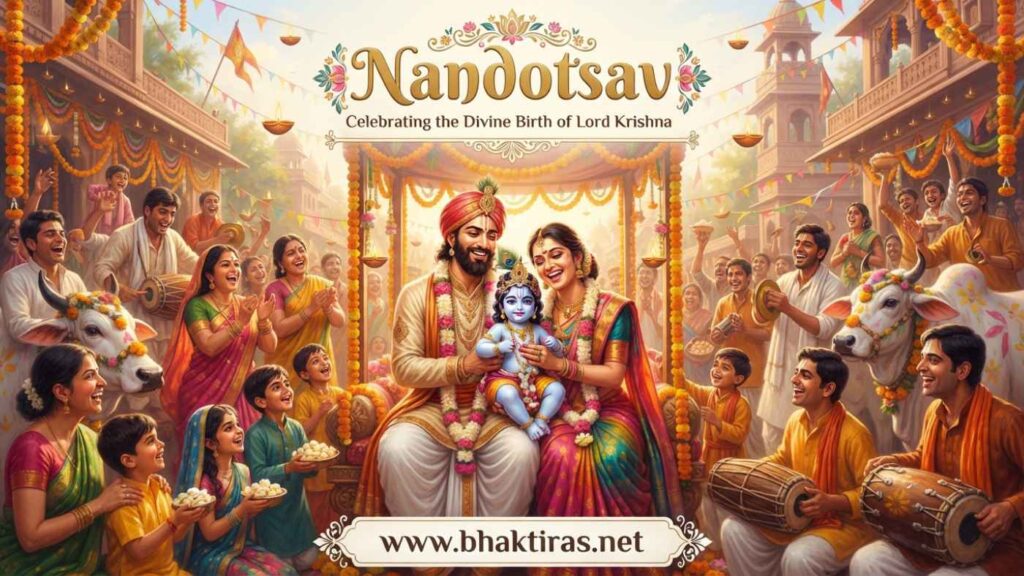
Nandotsav, also called Nanda Mahotsav, is the day-after sequel to Krishna Janmashtami, and in the Braj region it is the louder, happier half of the story. Where Janmashtami honours the sacred midnight birth, Nandotsav recreates the morning after, when Nanda Baba, Krishna’s foster-father, threw open his home in Gokul and gave away sweets, curd, cloth and turmeric-water to every neighbour who came to see the newborn. In 2026 it is observed on 5 September. The mood is pure, unguarded festivity – Krishna’s welcome party.
Nandotsav 2026-2028: Dates & Calendar
The next Nandotsav is on 5 September 2026. Because it is fixed to the day after Krishna Janmashtami, its date follows the lunar Hindu calendar and shifts each year across August and September.
| Year | Date | Day | Notes |
|---|---|---|---|
| 2026 | 5 September | Saturday | Next occurrence (day after Janmashtami, 4 Sept) |
| 2027 | 26 August | Thursday | Day after Janmashtami (25 Aug) |
| 2028 | 14 August | Monday | Day after Janmashtami (13 Aug) |
In Gokul and Nandgaon the celebration begins soon after sunrise, unlike Janmashtami’s midnight vigil. Some Vaishnava temples that observe Janmashtami a day later (following the ISKCON reckoning) also shift their Nandotsav by a day, so local temple notices are worth checking.
Why Nandotsav Is Celebrated
Nandotsav celebrates the joy of Nanda Baba and the people of Gokul on learning that a son had been born in their village. It turns the reverence of Janmashtami into open, shared happiness.
The morning after a divine birth
Krishna was born at midnight in Mathura’s prison and carried across the Yamuna to Gokul, where Nanda and Yashoda raised him. Nandotsav marks the daybreak celebration in Gokul, when the cowherd village woke to the news of a new child in Nanda’s house.
Nanda's generosity
The festival takes its name from Nanda Baba, who is said to have given away gifts, cows, gold, cloth and food in his happiness. That impulse to share good fortune widely, rather than hoard it, is the heart of the day.
A birth party, not a fast
Where Janmashtami involves fasting and a solemn midnight puja, Nandotsav is its release – feasting, singing, dancing and playful showers of curd and haldi. The two days together move from devotion to delight.
Deities & Figures Worshipped
Nandotsav centres on the infant Krishna and his foster-parents in Gokul, the ordinary cowherd family chosen to raise a divine child.
Krishna
The baby Krishna, Bala Gopala, is the reason for every celebration. Nandotsav honours him not as the philosopher of the Gita but as the beloved child of Braj, cradled, adored and doted upon.
Nanda Baba
Nanda, the chief of the Gokul cowherds, is the figure the festival is named for. His fatherly joy and open-handed generosity give the day its character and its rituals of giving.
Yashoda
Yashoda, Krishna’s foster-mother, is remembered alongside Nanda. Devotees sing of her nursing, bathing and cradling the child, and many temple lyrics of the day are addressed to her as the mother of Gopala.
Key Rituals, Step by Step
In Braj temples the day unfolds as a joyful re-enactment of the celebration in Nanda’s household, beginning after sunrise.
- Bathing the infant deity. The image of baby Krishna is given an abhishekam, often with milk, curd, honey and water, then dressed in fresh clothes and ornaments.
- Announcing the birth. Priests and singers proclaim that a son is born in Nanda’s house, and the congregation responds with cheers of नन्द के आनन्द भयो (“joy has come to Nanda”).
- Kirtan and folk songs. Musicians lead continuous kirtan and Braj folk songs about Krishna’s birth, Yashoda’s love and the wonder of the cowherds.
- Showering curd, milk and haldi. The congregation is sprinkled and splashed with curd, milk and turmeric-water, the same auspicious substances Nanda is said to have poured out in celebration.
- Distributing gifts and sweets. Temples and households give away panjiri, curd, sweets, coins, cloth and small gifts to devotees, echoing Nanda’s open-handed generosity.
- Cradle darshan. The infant deity is placed in a decorated cradle and gently rocked, and devotees line up to see and swing the cradle as a blessing.
- Feasting together. The day ends with a shared meal, breaking the restraint of the previous day’s Janmashtami fast.
Special Foods of Nandotsav
The foods of Nandotsav are Krishna’s own favourites – dairy above all – shared freely as prasad.
Panjiri
A dry sweet of roasted wheat flour with ghee, sugar, dried fruit and warming spices, panjiri is the signature Nandotsav prasad in Braj, distributed by the handful to everyone present.
Dahi (curd)
Curd is central to the day, offered, shared and playfully poured over the crowd. It ties directly to Krishna’s love of milk and butter and to Nanda’s celebratory showers.
Makhan-mishri
Fresh white butter with rock sugar, the classic offering to baby Krishna the butter-thief, placed before the cradle and given out as prasad.
Charnamrit
A sweet blend of milk, curd, honey, ghee and sugar used to bathe the deity and then sipped by devotees as a blessing.
Milk sweets
Pedas, kheer and other milk-based sweets round out the feast, reflecting the abundance of a cowherd village and the joy of a birth celebration.
Where It's Celebrated
Nandotsav is above all a Braj festival, though it travels wherever Krishna devotion runs deep.
Gokul
Gokul, where Nanda raised Krishna, holds the most heartfelt celebration. Its temples fill with kirtan and the streets with showers of curd and haldi, as the village re-enacts the original day of rejoicing.
Nandgaon
Nandgaon, associated with Nanda Baba’s later home, marks the day with special temple festivities, folk songs and the distribution of prasad.
Vrindavan & Mathura
Across the Braj heartland, Vrindavan and Mathura temples hold cradle darshan, feasting and singing, drawing pilgrims who stay on after Janmashtami for the celebration.
Vaishnava temples beyond Braj
ISKCON and other Vaishnava temples worldwide observe a Nandotsav the day after their Janmashtami, with kirtan, a feast and gifts, carrying the Braj tradition to a global congregation.
Nandotsav Do's and Don'ts
A few simple courtesies help you share in the day’s spirit of joy and generosity.
Do
- Join the kirtan and folk singing wholeheartedly – the day is meant to be joyful.
- Share sweets, curd and small gifts with others, in the spirit of Nanda’s generosity.
- Take part in the cradle darshan of the infant Krishna if a temple offers it.
- Wear clothes you don’t mind getting splashed, as curd and haldi are showered freely.
- Offer makhan, curd or milk sweets to baby Krishna if you keep the observance at home.
Avoid
- Don’t treat it as a solemn fast day; Nandotsav is a celebration that follows Janmashtami.
- Don’t waste food in the play; share the curd and sweets rather than throwing them away.
- Don’t confuse it with Janmashtami itself – Nandotsav is the day after.
- Don’t crowd or push at the cradle; let others, especially children and elders, have their turn.
- Don’t skip the giving; even a small gift or sweet to a neighbour keeps the spirit of the day.
Frequently Asked Questions
When is Nandotsav in 2026?
Nandotsav in 2026 is on Saturday, 5 September, the day after Krishna Janmashtami (4 September). It is the Braj celebration of Nanda Baba’s joy at Krishna’s birth in Gokul.
When is Nandotsav in 2027 and 2028?
Nandotsav falls on Thursday, 26 August 2027, and on Monday, 14 August 2028. In each year it is observed the day after Krishna Janmashtami, so its date shifts with the lunar Hindu calendar.
What is the difference between Janmashtami and Nandotsav?
Janmashtami marks the midnight birth of Krishna and involves fasting and a solemn night puja, while Nandotsav is the joyful celebration held the very next day. Nandotsav recreates Nanda Baba’s happiness at his son’s birth, with kirtan, sweets and showers of curd and turmeric-water.
Why is Nandotsav celebrated?
Nandotsav is celebrated to mark the joy of Nanda Baba and the people of Gokul at the birth of Krishna, their new son. Nanda is remembered for giving away gifts, cows and sweets in his happiness, and the festival re-enacts that open-handed celebration.
Which god is worshipped on Nandotsav?
Nandotsav honours the infant Krishna, worshipped as Bala Gopala, the beloved child of Braj. His foster-parents Nanda Baba and Yashoda are remembered alongside him as the family who raised him in Gokul.
Where is Nandotsav celebrated most?
Nandotsav is celebrated most fervently in the Braj region of Uttar Pradesh, especially Gokul, Nandgaon, Vrindavan and Mathura. Vaishnava temples elsewhere, including ISKCON centres worldwide, also observe it the day after their Janmashtami.
What is distributed on Nandotsav?
On Nandotsav, temples and households distribute panjiri, curd, makhan-mishri, milk sweets and small gifts as prasad. The congregation is also playfully showered with curd, milk and turmeric-water, echoing Nanda Baba’s celebration.
Is Nandotsav the same as Dahi Handi?
No, though both follow Janmashtami. Nandotsav is the Braj celebration of Nanda Baba’s joy, with kirtan, gifts and curd showers, while Dahi Handi is the human-pyramid game of breaking a hanging pot of curd, most popular in Maharashtra.
May the joy of Nanda’s household fill your home this Nandotsav – नन्द के आनन्द भयो, जय कन्हैया लाल की.