
Puri Rath Yatra 2026 – Jagannath's Grand Chariot Festival
जगन्नाथ रथ यात्रा
When is Puri Rath Yatra in 2026?
Puri Rath Yatra falls on Thursday, 16 July 2026. On this day Lord Jagannath, his elder brother Balabhadra and sister Subhadra leave the Jagannath Temple on three towering wooden chariots and are pulled by thousands of devotees along the Bada Danda (Grand Road) to the Gundicha Temple. The deities return on the Bahuda Yatra nine days later, on 24 July 2026.
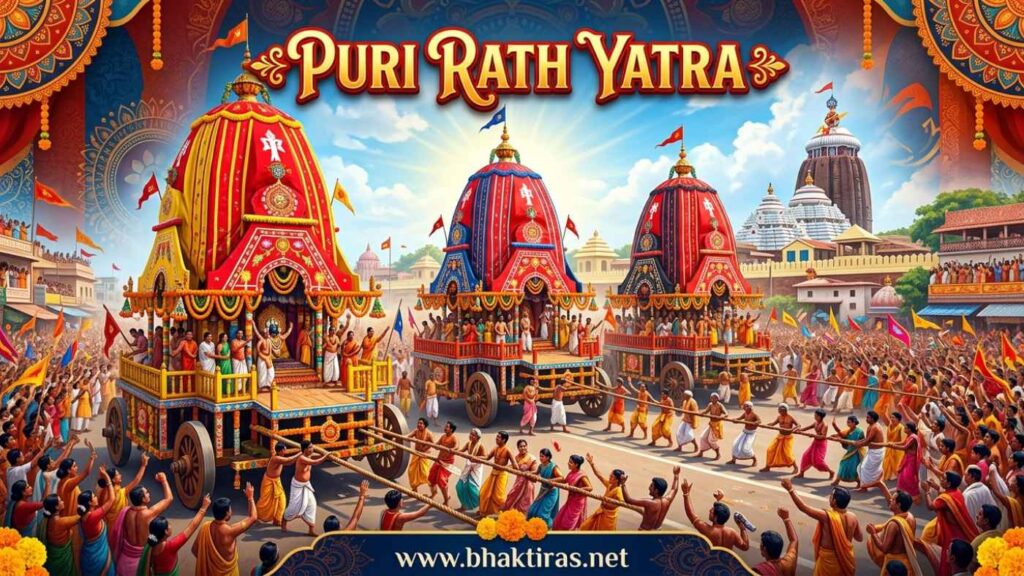
Rath Yatra is the annual chariot festival of Puri, when the presiding deities of the Jagannath Temple in Odisha step out of the sanctum and travel in public procession. Lord Jagannath (a form of Krishna), his elder brother Balabhadra and their sister Subhadra ride three separate wooden chariots that thousands of pilgrims haul by rope down the Bada Danda to the Gundicha Temple, about three kilometres away. Held on Ashadha Shukla Dwitiya, it is one of the few occasions when non-Hindus and every caste may see and touch the deities. In 2026 the procession sets out on 16 July.
Puri Rath Yatra 2026-2028: Dates & Calendar
The next Rath Yatra is on 16 July 2026. The date shifts each year because it follows the Hindu lunar month of Ashadha, always falling on the second bright day (Shukla Dwitiya).
| Year | Rath Yatra | Day | Bahuda (return) |
|---|---|---|---|
| 2026 | 16 July | Thursday | 24 July 2026 |
| 2027 | 5 July | Monday | 13 July 2027 |
| 2028 | 24 June | Saturday | 2 July 2028 |
The main outward procession from the Jagannath Temple to Gundicha Temple is the Rath Yatra itself. The deities rest at Gundicha for a week, and the Bahuda Yatra marks their return journey along the same Grand Road roughly nine days later.
Why Puri Rath Yatra Is Celebrated
Rath Yatra is held so the deities can leave the temple and visit their birthplace, the Gundicha Temple, giving darshan to every devotee regardless of caste or faith.
The deities' annual outing
For most of the year Jagannath, Balabhadra and Subhadra stay within the sanctum. Rath Yatra is the one time they come out among the people. Devotees who cannot enter the temple can see and even pull the chariots, which is believed to wash away lifetimes of sin.
Visit to Gundicha
The Gundicha Temple is described as the deities’ garden retreat or maternal home. The week-long stay there, called the Gundicha Yatra, is remembered as Jagannath’s holiday away from the main shrine before the Bahuda return.
A festival open to all
Unlike the inner Jagannath Temple, which restricts entry, the chariots on the Grand Road are open to everyone. This inclusiveness is central to the festival’s meaning and draws pilgrims from across India and abroad.
Deities & Figures Worshipped
Three deities ride out on three chariots: Lord Jagannath, his elder brother Balabhadra and their sister Subhadra, each with a chariot of a fixed colour, name and size.
Lord Jagannath
Jagannath, a form of Krishna and the presiding deity of Puri, rides the tallest chariot, Nandighosa. It has sixteen wheels and is draped in red and yellow cloth. His name means Lord of the Universe.
Balabhadra
Balabhadra, Jagannath’s elder brother, travels on Taladhwaja, a chariot with fourteen wheels covered in red and blue-green cloth. He is worshipped as the strong protector who leads the procession.
Subhadra
Subhadra, the sister of Jagannath and Balabhadra, rides Darpadalana, the smallest of the three with twelve wheels and red and black cloth. Her presence completes the divine trio pulled along the Bada Danda.
Key Rituals, Step by Step
The festival follows a fixed sequence, from building the chariots to the deities’ return. Here is how the day and the days around it unfold.
- Building the chariots. Three new wooden chariots are built from scratch every year using specific timber, then decorated with bright cloth. Nothing is reused from the previous year.
- Pahandi procession. On the morning of Rath Yatra the deities are carried out of the temple to their chariots in a swaying, ceremonial march called Pahandi.
- Chhera Pahara. The Gajapati King of Puri arrives and sweeps the chariot platforms with a gold-handled broom and sprinkles them with sandalwood water, a ritual that marks all devotees as equal before the deity.
- Pulling the chariots. Thousands of pilgrims grip thick ropes and haul the chariots down the Bada Danda toward the Gundicha Temple, believing that a single pull earns great merit.
- Gundicha stay. The deities rest at the Gundicha Temple for about a week, receiving worship in what is seen as their garden retreat.
- Hera Panchami. Midway through the stay, Goddess Lakshmi is said to visit Gundicha in search of Jagannath, a much-loved episode of the festival.
- Bahuda Yatra. The deities are pulled back to the main temple along the same Grand Road, on 24 July in 2026.
- Niladri Bijaya. The festival closes as the deities re-enter the sanctum, with the well-known ritual of Lakshmi barring Jagannath’s return until he offers her sweets.
Special Foods of Puri Rath Yatra
The Jagannath Temple is famous for its Mahaprasad, cooked in earthen pots and offered to the deities before being shared with pilgrims.
Mahaprasad
The temple kitchen at Puri prepares a vast array of rice, dal, vegetables and sweets in stacked clay pots over wood fires. Once offered, this Mahaprasad is treated as sacred and eaten by pilgrims of every background.
Poda Pitha
Poda Pitha is a slow-baked rice and lentil cake, browned on the outside and soft within. It is closely linked with Jagannath and is a favourite offering during the festival season.
Khaja
Khaja is a layered, deep-fried sweet soaked in sugar syrup, sold widely around the temple town and offered to the deities. It is one of the best-known sweets associated with Puri.
Kheer and dal
Simple rice kheer and dalma, a dal cooked with vegetables, are staples of the Mahaprasad served during Rath Yatra and shared among families and pilgrims alike.
Rath Yatra Beyond Puri
While Puri hosts the original and grandest Rath Yatra, chariot festivals for Jagannath are held in many cities in India and around the world.
Ahmedabad, Gujarat
Ahmedabad holds one of India’s largest Rath Yatras after Puri, with the Jagannath Temple in Jamalpur sending three chariots through the old city under heavy public participation.
Kolkata and ISKCON
ISKCON runs Rath Yatra processions in Kolkata, Mayapur and many other cities, having taken the festival worldwide with public chariot pulls in London, New York and beyond.
Odisha towns
Beyond Puri, towns across Odisha such as Baripada, which is called the Dwitiya Srikshetra or second Puri, hold their own chariot festivals on the same day.
Global diaspora
Indian communities abroad mark Rath Yatra with chariot processions and cultural programmes, keeping the tradition alive far from Odisha.
Puri Rath Yatra Do's and Don'ts
A few simple practices help pilgrims take part respectfully and safely in the huge crowds.
Do
- Arrive early on the Bada Danda to find a safe spot before the crowds swell
- Join the rope pulling calmly and follow the instructions of the sevayats and police
- Carry water and protect yourself from the July heat and rain
- Share and respect the Mahaprasad as sacred food
- Keep children and elderly companions close in the dense crowd
Avoid
- Do not push or rush toward the chariots when they start moving
- Do not litter the Grand Road or the temple surroundings
- Do not attempt to climb the chariots or block the deities’ path
- Do not ignore crowd-control barriers and marshals
- Do not treat the day only as a spectacle; keep the devotional spirit
Frequently Asked Questions
When is Puri Rath Yatra in 2026?
Puri Rath Yatra is on Thursday, 16 July 2026. It falls on Ashadha Shukla Dwitiya, the second bright lunar day of the month of Ashadha, when the three deities are pulled from the Jagannath Temple to the Gundicha Temple.
When is Puri Rath Yatra in 2027 and 2028?
Puri Rath Yatra is on 5 July 2027 and on 24 June 2028. The date changes each year because the festival follows the Hindu lunar calendar, always occurring on Ashadha Shukla Dwitiya.
Why is Rath Yatra celebrated?
Rath Yatra is celebrated so Lord Jagannath, Balabhadra and Subhadra can leave the temple and visit the Gundicha Temple, giving darshan to everyone regardless of caste or faith. It is one of the few times the deities appear in public and can be seen and touched by all devotees.
Which gods are worshipped during Rath Yatra?
Three deities are worshipped during Rath Yatra: Lord Jagannath, a form of Krishna, his elder brother Balabhadra, and their sister Subhadra. Each rides a separate chariot named Nandighosa, Taladhwaja and Darpadalana respectively.
What are the three chariots of Rath Yatra called?
The three chariots are Nandighosa for Jagannath, Taladhwaja for Balabhadra and Darpadalana for Subhadra. They differ in height, number of wheels and cloth colours, and are built new every year from fresh wood.
What is Chhera Pahara?
Chhera Pahara is the ritual in which the Gajapati King of Puri sweeps the chariot platforms with a gold-handled broom and sprinkles sandalwood water. It symbolises that before Lord Jagannath even a king is a humble servant, and that all devotees are equal.
What is the Bahuda Yatra?
Bahuda Yatra is the return journey when the deities are pulled back from the Gundicha Temple to the Jagannath Temple along the same Grand Road. In 2026 the Bahuda Yatra falls on 24 July, nine days after the outward procession.
Are the chariots reused each year?
No, the chariots are built new every year. Craftsmen construct all three from freshly cut timber to fixed traditional specifications, so a completely new set of chariots rolls down the Bada Danda each Rath Yatra.
May Lord Jagannath’s chariot bring blessings to your home this Rath Yatra. Jai Jagannath.