
ॐ
Thousand Pillar Temple
Shiva, Vishnu & Surya · Kakatiya · Telangana
॥ ॐ नमः शिवाय ॥
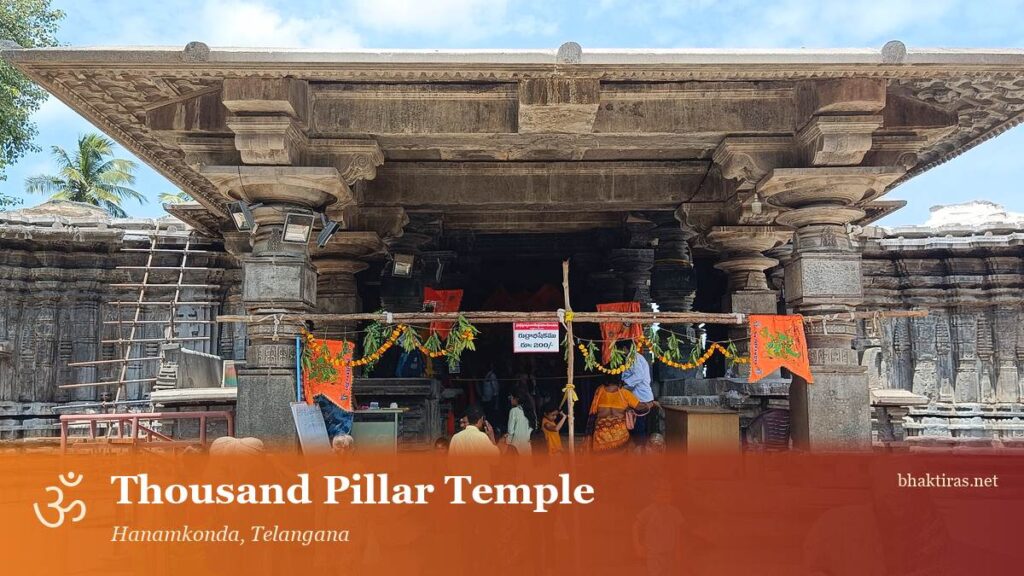
On the slope of Hanamkonda near Warangal, the Thousand Pillar Temple has gathered devotees since 1163 CE, when the Kakatiya king Rudradeva raised it. Built on a star-shaped plan, it is a trikutalaya — a three-shrine temple dedicated together to Shiva, Vishnu and Surya — its rows of intricately cut pillars and a polished monolithic Nandi marking the high craft of the Kakatiya age.
A shrine for three gods under one roof
Unlike temples built around a single sanctum, this monument follows the trikutalaya scheme: three garbhagrihas open onto a shared central hall, dedicated respectively to Shiva, Vishnu and Surya. The arrangement let worshippers of all three traditions gather at one site, a deliberate gesture of inclusion by its Kakatiya builders.
Rudradeva, also remembered as Prataparudra I, commissioned the temple in 1163 CE. An inscription on the premises records the dedication, fixing both the date and the royal hand behind the work.
Pillars, the great Nandi and rock-cut elephants
The temple takes its popular name from the dense forest of carved pillars in its mandapa, each shaft worked with bands of ornament so that no two faces feel quite the same. The polished surfaces catch light differently through the day, giving the hall its shifting character.
Facing the Shiva shrine sits a monolithic Nandi carved from black basalt and finished to a high sheen — among the finest of its kind in the region. Rock-cut elephants flank the approach, and the star-shaped platform repeats the geometry favoured across Kakatiya architecture.
History, decline and survival
The temple passed through turbulent centuries after the fall of the Kakatiyas, suffering damage and long neglect, yet its core shrines and pillared hall endured. Conservation work in the modern era stabilised the structure and reopened it to worship and visitors.
Because the Warangal and Hanumakonda accounts describe the same monument on the same hill, they refer to one temple — the Thousand Pillar Temple at Hanamkonda — rather than two separate shrines.
How to reach Thousand Pillar Temple
- By road: The temple sits within Hanamkonda, about 4–5 km from Warangal city centre; city buses, autos and taxis reach it easily from across the Warangal–Hanamkonda urban area.
- By train: Warangal railway station, roughly 5–6 km away, is on the main Delhi–Chennai line and well linked to Hyderabad, Vijayawada and Secunderabad.
- By air: The nearest airport is Hyderabad’s Rajiv Gandhi International Airport, about 145 km away, connected to Warangal by road and rail.
Frequently Asked Questions
Who built the Thousand Pillar Temple?
The Kakatiya king Rudradeva (Prataparudra I) built it in 1163 CE at Hanamkonda near Warangal.
Why is it called the Thousand Pillar Temple?
The name comes from the many ornately carved pillars filling its mandapa; ‘thousand’ reflects their abundance rather than an exact count.
Which deities are worshipped here?
It is a trikutalaya, a three-shrine temple dedicated jointly to Shiva, Vishnu and Surya.
Is the Thousand Pillar Temple in Warangal or Hanamkonda?
Both names point to the same temple. It stands in Hanamkonda (Hanumakonda), which adjoins Warangal, so the two references describe one monument.
What is special about the Nandi here?
The Nandi is a single monolithic block of black basalt, finished to a smooth polish — one of the finest examples from the Kakatiya period.
When is the best time to visit?
October to February offers pleasant weather, and Maha Shivaratri is the temple’s most active festival day.
॥ हर हर महादेव ॥ • Bhaktiras.net Temple Guide
| Deity | Shiva, Vishnu and Surya |
| Significance | Kakatiya trikutalaya (three-shrine) temple on a star-shaped plan |
| Built | 1163 CE by King Rudradeva |
| Architecture | Star-shaped plan with carved pillars and rock-cut elephants |
| Special | Monolithic black-basalt polished Nandi |
| Main Festival | Maha Shivaratri |
Related Temples
Explore more sacred temples connected by deity and region.
 ShivaAlampur Nava Brahma Temples & Jogulamba📍 Telangana
 ShivaRamappa Temple (Ramalingeswara), Palampet📍 Telangana
 Shiva108 Shiva Temple, Kalna (Nava Kailash)📍 West Bengal
 ShivaAiravatesvara Temple, Darasuram📍 Tamil Nadu
 ShivaAmbarnath Shiv Temple (Ambreshwar)📍 Maharashtra
 ShivaArunachaleswarar Temple, Thiruvannamalai📍 Tamil Nadu