
Tripura Sundari
त्रिपुर सुंदरी
Tripura Sundari is the third of the ten Mahavidyas and the supreme goddess of the Sri Vidya tradition. Also called Lalita and Shodashi, she embodies beauty, consciousness and bliss, and rules the three worlds from a throne resting on the five great gods. She is worshipped through the Sri Chakra and the Lalita Sahasranama.
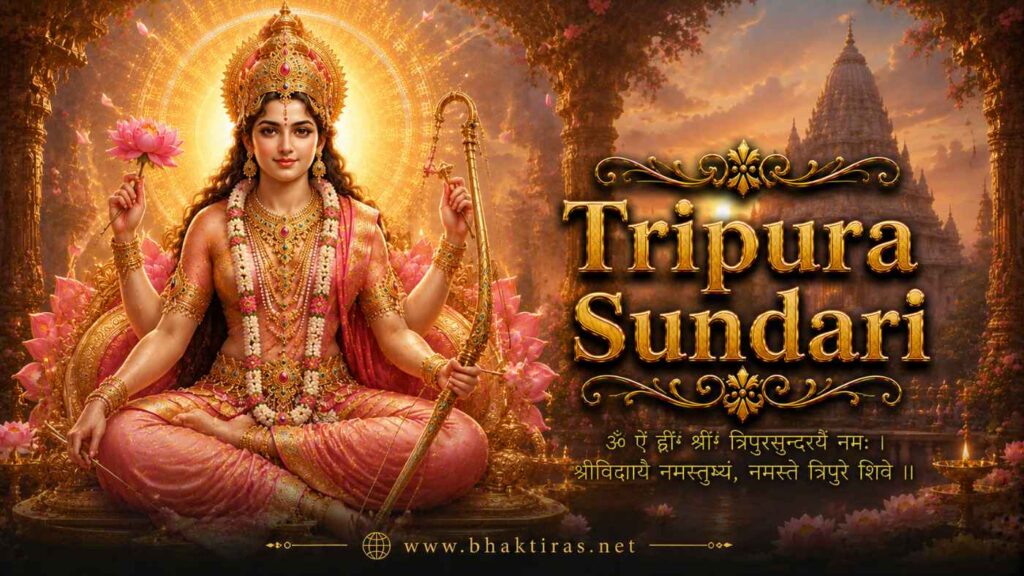
Who Is Tripura Sundari
Tripura Sundari is one of the most tender and radiant figures in the Hindu goddess tradition. Her name joins two ideas – Tripura, the three cities or three states of being, and Sundari, beauty – so she is understood as the loveliness that fills and surpasses all three worlds. Among the ten Mahavidyas, the great forms of the Divine Mother taught in Tantra, she is counted third, and she is by far the gentlest and most auspicious of them.
She is also called Lalita, the one who plays, and Shodashi, the sixteen-year-old, a name that points to the fresh, ever-young quality of pure awareness. In the Sri Vidya lineage she is not simply one goddess among many; she is the supreme reality itself, the consciousness in which every other deity, world and thought arises and dissolves.
Her red, glowing form holds a sugarcane bow and five flower arrows, close cousins to the weapons of Kama, the god of desire. The meaning is not carnal but cosmic: she is the sweet pull that draws the many back toward the one, the attraction at the heart of all longing. Where the fiercer Mahavidyas such as Kali or Chinnamasta shock the seeker awake, Tripura Sundari wins the heart through grace.
Devotees approach her through sound and symbol – the thousand names of the Lalita Sahasranama, the verses of the Saundarya Lahari, and above all the Sri Chakra, the great diagram of nine interlocking triangles that is treated as her very body.
The Beauty of the Three Worlds
The word Tripura carries several layers. On the surface it means the three worlds – earth, atmosphere and heaven – so she is the beauty spread across the whole of creation. But the tradition reads it far more inwardly. The three cities are the three ordinary states of every mind: waking, dreaming and deep sleep. In each of these we live, forget ourselves, and live again, moving from one city to the next without ever touching the ground beneath them.
Tripura Sundari is the one who dwells in all three yet belongs to none. She is the silent awareness that watches waking and dream alike and remains when both fall away in dreamless sleep. That fourth ground, called turiya, is her seat. To meditate on her is to look for the seer behind the seen, the beauty that does not come and go with experience.
This is why teachers say she is both utterly personal – a warm, red-hued mother crowned and smiling – and utterly abstract, the pure consciousness at the root of the self. The Sri Vidya path holds these two together without strain: the goddess you love and the awareness you are turn out to be the same.
Iconography & Symbols
Tripura Sundari is nearly always shown as a young woman of glowing red beauty, and every part of her image carries meaning.
Red radiant form
Her complexion is the rose of early dawn, the colour of rising energy and warmth. Red marks her as the active, life-giving power of the divine, full and overflowing.
Four arms
Her four hands hold her characteristic emblems, showing that though she appears as a gentle young woman, she wields the full authority of the supreme goddess.
Noose (pasha)
The looped cord stands for attachment and desire – the bonds that tie a soul to the world. In her hand it becomes a tool she alone can loosen.
Goad (ankusha)
The elephant goad represents restraint and knowledge, the gentle prod that steers a wandering mind back toward its centre.
Sugarcane bow
Her bow is made of sweet sugarcane, symbol of the mind and its sweetness. Unlike an iron weapon, it wins by attraction rather than force.
Five flower arrows
Her five arrows are made of blossoms, standing for the five senses. She does not destroy the senses but redirects their pull toward the divine.
Seated on the five gods
Her couch, the Panchabrahmasana, rests on the bodies of Brahma, Vishnu, Rudra, Ishvara and Sadashiva – showing that even the great gods serve as the ground beneath her feet.
The Sri Chakra
Behind and within her stands the Sri Chakra, nine interlocking triangles around a central point. It is her yantra, her subtle body, and the map of the whole cosmos.
The Sri Chakra & Sri Vidya Tradition
The heart of Tripura Sundari’s worship is the Sri Chakra, also called the Sri Yantra, regarded as the greatest of all yantras. It is formed of nine triangles that interlock to make forty-three smaller triangles, ringed by lotus petals and gateways, all gathered around a single point, the bindu. Five triangles point downward for the goddess and four point upward for Shiva; their union is the whole diagram. The tradition treats this figure not as a picture of the goddess but as the goddess herself, and as a map of how the one consciousness unfolds into the many worlds and folds back again.
The path built around her is called Sri Vidya, the auspicious knowledge. It is an inner discipline of mantra, meditation and yantra worship, passed carefully from teacher to student. Its central sound is the fifteen-syllabled panchadashi mantra, and its literature is rich: the Lalita Sahasranama, one thousand names of the goddess drawn from the Brahmanda Purana, is recited daily by countless devotees, each name a facet of her nature. The Saundarya Lahari, the Waves of Beauty, attributed to Adi Shankara, praises her form and the Sri Chakra in a hundred flowing verses that are both devotional poetry and coded instruction.
Through these three – name, verse and yantra – Sri Vidya offers a way to love the goddess and, at the same time, to recognise her as one’s own awareness.
The Slaying of Bhandasura
Lalita, Kamakshi and Shodashi – Her Forms
Tripura Sundari is known and loved under many names, each catching a different note of her single nature. As Lalita, the playful one, she is the goddess of the Lalita Sahasranama, sovereign and sweet, ruling the worlds as a mother rules a loving household. As Shodashi, the sixteen-year-old, she carries the freshness and fullness of the moon on its sixteenth digit, the ever-young quality of awareness that never ages or tires.
As Rajarajeshwari, the queen of kings, she is honoured as the supreme sovereign of all realms, the power behind every throne. And as Kamakshi, she is beloved in the South, especially at Kanchipuram, where she is seen as the one whose eyes hold and fulfil desire, granting boons to those who come to her.
These are not competing goddesses but faces of one reality. Whether a devotee sings to Lalita, meditates on Shodashi or bows before Kamakshi, the tradition holds that they reach the same supreme mother – the beauty of the three worlds, at once close and beyond.
How Tripura Sundari Is Worshipped
Devotion to Tripura Sundari ranges from simple daily prayer to the careful inner discipline of Sri Vidya. A few of the most cherished practices are:
- Worship of the Sri Chakra or Sri Yantra, offered flowers, kumkum and lamps as the very form of the goddess
- Daily recitation of the Lalita Sahasranama, chanting her thousand names as an act of love and meditation
- Chanting of the panchadashi and shodashi mantras under a qualified teacher within the Sri Vidya lineage
- Reading and reciting the Saundarya Lahari, whose verses are both praise and quiet instruction
- Observance of Fridays and of Navaratri, when the Devi in all her forms is honoured with special fervour
- Offering of red flowers, sugar and sweet foods, fitting for a goddess whose weapons are sugarcane and blossoms
Sri Vidya practice in its fuller form is traditionally taken up with initiation and guidance, since its mantras and yantra worship are meant to be learned rather than merely read. Yet the loving recitation of her names is open to all.
Temples & Sacred Sites
Tripura Sundari is honoured across India, with especially deep roots in the South, though her presence is felt in many regions.
- Kamakshi Amman Temple, Kanchipuram – the great southern shrine where the goddess is worshipped as Kamakshi, a central seat of Sri Vidya and associated with Adi Shankara
- Tripura Sundari Temple, Udaipur (Matabari), Tripura – one of the revered Shakti sites, giving the state its very name, where the goddess is worshipped as the presiding mother
- Sharadamba and Sri Vidya centres at Sringeri – where the Sri Chakra and the worship of the goddess as consciousness are carefully maintained
- Shrines and home altars throughout India where the Sri Chakra is installed and the Lalita Sahasranama is a daily offering
Prayers & Mantras
The simplest and most widely loved way to call on the goddess is her seed mantra, in which each syllable is a subtle sound of the divine feminine. Recited with attention and love, it steadies the mind and turns it toward her radiant presence.
ॐ ऐं ह्रीं श्रीं त्रिपुरसुंदर्यै नमः
Om Aim Hreem Shreem Tripurasundaryai Namah
The three seed sounds honour speech and wisdom, illusion and power, and abundance and grace, gathered into a single salutation to Tripura Sundari, the beautiful mother of the three worlds. Alongside this, the daily reading of the Lalita Sahasranama remains the heart of her devotion.
Frequently Asked Questions about Tripura Sundari
Who is Tripura Sundari?
Tripura Sundari is the third of the ten Mahavidyas and the supreme goddess of the Sri Vidya tradition. Her name means the beauty of the three worlds. She embodies beauty, consciousness and bliss, holds a sugarcane bow and flower arrows, and is worshipped through the Sri Chakra and the Lalita Sahasranama.
Is Tripura Sundari the same as Lalita?
Yes. Lalita, meaning the playful one, is one of her best-loved names, and she is the goddess of the Lalita Sahasranama. Shodashi, Rajarajeshwari and Kamakshi are further names for the same goddess, each catching a different aspect of her single supreme nature.
What is the Sri Chakra?
The Sri Chakra, or Sri Yantra, is the supreme yantra of the Sri Vidya tradition. It is formed of nine interlocking triangles gathered around a central point. It is treated as the very body of Tripura Sundari and as a map of how the one consciousness unfolds into the many worlds and returns.
Why is she called Tripura?
Tripura means the three cities. Outwardly these are the three worlds she fills with beauty. Inwardly they are the three states of every mind – waking, dream and deep sleep. She dwells in all three yet transcends them, resting in the fourth ground of pure awareness.
Which demon did Tripura Sundari slay?
She defeated Bhandasura, a demon born from the ashes of Kama who drained love and delight from the world. The Lalitopakhyana tells how the goddess emerged from the Sri Chakra, led her army against him and restored beauty and desire to creation in their rightful form.
What texts are central to her worship?
The Lalita Sahasranama, a thousand names of the goddess from the Brahmanda Purana, and the Saundarya Lahari, the Waves of Beauty attributed to Adi Shankara, are her two most cherished texts. Together with the Sri Chakra they form the core of Sri Vidya practice.
Where are her most famous temples?
She is worshipped as Kamakshi at the great Kamakshi Amman Temple in Kanchipuram in Tamil Nadu, and as the presiding goddess at the Tripura Sundari temple near Udaipur in Tripura, which gives the state its name. Sri Vidya centres such as Sringeri also honour her.
Can anyone worship Tripura Sundari?
The loving recitation of her names and her seed mantra is open to everyone. The fuller Sri Vidya discipline, with its panchadashi mantra and Sri Chakra worship, is traditionally taken up under the guidance of a qualified teacher, since it is meant to be learned rather than only read.
May the grace of Tripura Sundari, the beauty of the three worlds, fill your heart with light, love and quiet joy.