
Shashthi Devi
षष्ठी
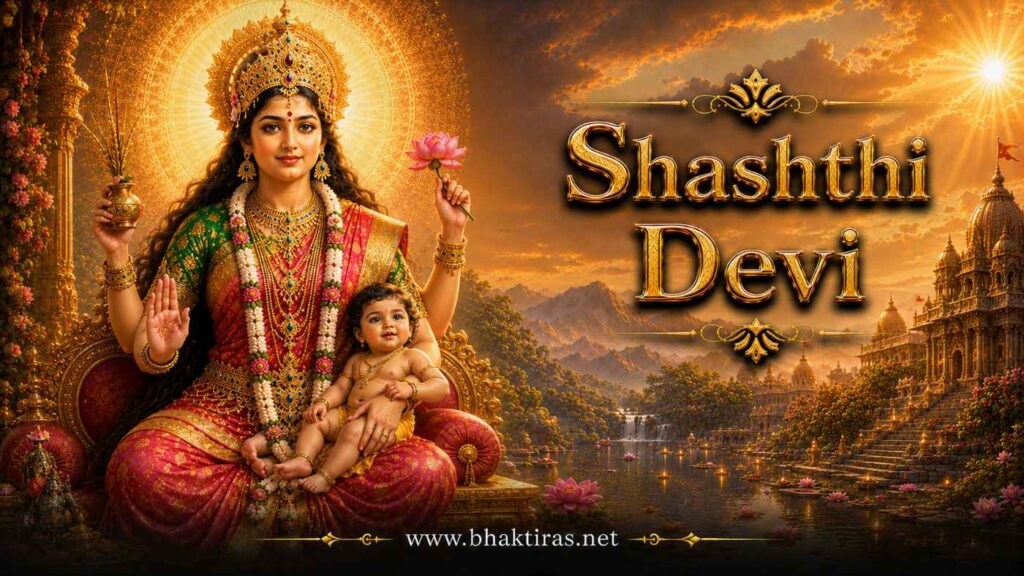
Shashthi Devi is the folk mother goddess who watches over children, infants and childbirth, and blesses couples with healthy offspring. Her name means the sixth, since she is honoured on the sixth day after a baby is born. She rides a cat and is loved most in Bengal and eastern India.
Who Is Shashthi Devi?
Shashthi Devi belongs to the warm, domestic side of Hindu worship, the part that lives in courtyards and birthing rooms rather than grand stone temples. She is the goddess a family turns to the moment a new baby arrives, and the one grandmothers invoke when a child runs a fever or takes its first shaky steps.The household mother
Where many deities are approached with awe, Shashthi is approached with something closer to trust. Women speak to her the way they might speak to an elder in the family, asking her to keep the little ones safe, to ease a difficult labour, to send a child to a couple who has waited a long time.
A name that is a promise
Her name simply means the sixth. That number carries the whole story: she is worshipped on the sixth day after a birth, and again on the sixth day of the lunar fortnight. Each Shashthi day is a small renewal of the same prayer, that the child born into a home may grow up whole and well.
Loved across the east
Though her worship is found in many parts of India, she is dearest in Bengal, Odisha, Assam and Bihar, where the cycle of Shashthi vratas gives shape to the year. In these regions a mother’s calendar and Shashthi’s calendar are almost the same thing.
The Guardian of Children and Mothers
Every culture has its fears around childbirth and early childhood, and older India was no different. Infant illness was common, and a mother’s own survival was never taken for granted. Shashthi grew from that tender anxiety, becoming the presence who stood watch over the most fragile weeks of any life.Mothers place their newborns under her care and ask her to guard them through fevers, teething, first illnesses and the long uncertain climb to childhood. In many homes a small shrine, a smoothed stone, a low banyan platform or a simple mark on a wall, becomes her seat, and offerings of fruit, milk and sweets are left there whenever a child needs her blessing. She is invoked not once but again and again, at each new stage, so that her protection follows the child like a steady hand at the back.Why the Sixth Day
The heart of Shashthi worship is a number, and understanding it explains almost everything about her.The sixth day after birth
In many communities the sixth day after a baby is born is set aside for Shashthi. The house is cleaned, the mother and child are honoured, and the goddess is asked to accept the newborn under her protection. This rite, sometimes called Chhathi, marks the moment the family formally welcomes the child and places its future in her hands.
The sixth tithi of the fortnight
Beyond that single day, the sixth lunar day of each fortnight belongs to her as well. Women who keep her vrata fast, offer fruit and unpounded rice, and tell or listen to her stories on these days, weaving her worship into the ordinary rhythm of the month.
A recurring blessing
Because the sixth returns twice a lunar month and again at every birth, Shashthi is never a once-a-year goddess. Her worship is repeated, patient and cumulative, matching the slow, watchful work of raising a child.
The Cat and Her Symbols
Shashthi’s imagery is gentle and easy to read, made for households rather than scholars.Her cat
Her vahana is the cat, an animal at home in the very rooms where she is worshipped. The choice feels natural: the cat is a familiar house companion, watchful and soft-footed, and in some folk tellings it is a fierce mother of its own litter. A few local traditions even ask children to treat cats kindly for her sake.
The children around her
She is most often shown as a full, motherly woman with an infant on her lap or several small children gathered close. Sometimes she is golden-hued and richly dressed, sometimes plainly drawn on a wall, but the children are always there. They are her emblem and her purpose.
Simple offerings
Fruit, milk, curd, unhusked rice, fans of palm leaf and cotton thread tied on wrists all belong to her rites. There is little that is costly here. Her worship was built by ordinary women with what a home already held.
The Shashthi Vratas Through the Year
Shashthi is honoured not through one great festival but through a whole ring of vratas spread across the seasons. Each one carries its own flavour, yet all share the same wish for the wellbeing of children and family. A few of the best loved are these:- Jamai Shashthi – kept in the month of Jyeshtha, when a mother honours her son-in-law (jamai) and, through him, her daughter, praying for the couple’s happiness and children. A festive meal and gifts mark the day.
- Aranya Shashthi – the forest Shashthi, observed in early summer, when women worship the goddess amid trees and greenery for the health of their offspring.
- Mula Shashthi – kept in autumn, associated with the root and origin, when mothers renew their prayers for the strength of their children.
- Ashoka Shashthi – a springtime vrata linked with the ashoka tree, its very name suggesting freedom from sorrow, especially the sorrow of losing a child.
- Durga Shashthi – the sixth day of Sharad Navaratri, when Durga’s arrival is welcomed and Shashthi’s protective role blends into the larger worship of the Mother.
- Chhathi / sixth-day rite – the birth ceremony itself, kept in every home the moment a new child completes its first six days.
Shashthi and Devasena
Folk goddesses often gather threads from the wider tradition, and Shashthi is sometimes drawn into the family of the great gods through her link with Devasena.In several Puranic and folk accounts, Shashthi is identified with Devasena, the divine consort of Skanda, also called Kartikeya, the youthful god of war and the son of Shiva and Parvati. This connection lifts the household goddess into the celestial family: as the wife of Skanda she becomes a figure of the heavens, yet she keeps her earthly work of guarding children. The pairing feels fitting. Skanda himself is a god of youth and vigour, born to defeat a demon, and a goddess who cradles the newborn makes a natural companion to him. Through this bond Shashthi is also loosely associated with Skandamata, the mother-of-Skanda form of Durga worshipped during Navaratri. Whether approached as a village mother or as the bride of Kartikeya, her heart remains the same, turned always toward the safety of the young.How Shashthi Devi Is Worshipped
Worship of Shashthi is homely and hands-on, carried out mostly by the women of a household rather than by priests. A few common practices run through her rites:- Keeping the vrata on Shashthi days by fasting until the worship is done, often eating fruit and food that has not been pounded or milled.
- Setting up a simple seat for the goddess, a smoothed stone, a small clay image, a banyan or wood-apple tree, or a marked spot on the courtyard wall.
- Offering fruit, milk, curd, sweets and unhusked rice, along with flowers and a lamp.
- Tying protective threads on the wrists of children and sometimes fanning them gently as a blessing of health.
- Listening to or reciting the Shashthi vrata katha, the traditional story that explains the fruits of her worship.
- Gathering the family, especially mothers, daughters and sons-in-law, so that the blessing is asked for the whole household together.
A Story from Tradition
The neglectful daughter-in-law
A well-loved vrata tale tells of a young wife in a large household who cared nothing for Shashthi. Each time she gave birth, her child would sicken and die soon after, and in her grief and shame she began to blame the house cat, the goddess’s own creature, for stealing her babies. She would strike the cat and drive it away. One day the cat, wounded by her cruelty, carried the truth to Shashthi Devi. The goddess, who had watched the woman ignore every sixth-day rite, appeared to her in a dream and gently showed her the harm she had done, both to the animal and to her own worship. Chastened, the woman begged forgiveness. She learned to honour the cat, to keep the Shashthi vrata with a full heart, and to trust the goddess with her children. In time she was blessed with sons and daughters who grew up strong, and she became a devoted keeper of Shashthi’s worship, teaching the vrata to every young mother who came after her.
Prayers & Mantras
Shashthi is called upon with short, heartfelt mantras rather than long liturgies, the kind a mother can whisper over a sleeping child. The simplest and most widely used salutation is this:Frequently Asked Questions about Shashthi Devi
Who is Shashthi Devi?
Shashthi Devi is a folk mother goddess in Hinduism who protects children, infants and mothers, watches over childbirth, and blesses couples with progeny. Her name means the sixth, because she is honoured on the sixth day after a child's birth. She is loved most in Bengal and eastern India.
What is Jamai Shashthi?
Jamai Shashthi is a Shashthi vrata kept in the month of Jyeshtha, mainly in Bengal, when parents honour their son-in-law, the jamai, with a festive meal and gifts. Through him they bless their daughter and pray to Shashthi Devi for the couple's happiness and healthy children.
Why is she called the sixth?
Her name Shashthi means the sixth. She is worshipped on the sixth day after a baby is born, when the family formally places the newborn under her care, and again on the sixth lunar day of each fortnight, making her worship a recurring blessing rather than a once-a-year festival.
What is Shashthi Devi's vahana?
Her vahana, or mount, is the cat. As a familiar house companion and, in folk belief, a watchful mother of its own young, the cat suits a goddess whose whole concern is the safety of children within the home. Some traditions ask that cats be treated kindly for her sake.
Is Shashthi the same as Devasena?
In several Puranic and folk accounts, Shashthi is identified with Devasena, the divine consort of Skanda or Kartikeya. This links the household goddess to the celestial family of Shiva and Parvati, while she keeps her earthly task of guarding infants and mothers.
Who worships Shashthi Devi and why?
She is worshipped chiefly by mothers, grandmothers, expecting women and couples hoping for children. They keep her vratas and offer fruit, milk and rice to ask for safe childbirth, the health of their children, and the gift of progeny for those still waiting for a child.
What are the main Shashthi vratas?
The best known include Jamai Shashthi, Aranya Shashthi, Mula Shashthi, Ashoka Shashthi and Durga Shashthi, along with the sixth-day birth rite itself. Spread through the year, these vratas keep a mother in steady, seasonal conversation with the goddess for the wellbeing of her family.
May Shashthi Devi keep a gentle hand on every child and every mother, and fill the waiting homes with the small, priceless miracle of new life.