
Lord Kartikeya
कार्तिकेय
Kartikeya, worshipped in the south as Murugan, is the son of Shiva and Parvati and the commander of the gods' army. Born to defeat the demon Tarakasura, he carries the divine spear Vel and rides a peacock. He has six faces, so devotees also call him Shanmukha, Skanda, and Subrahmanya.
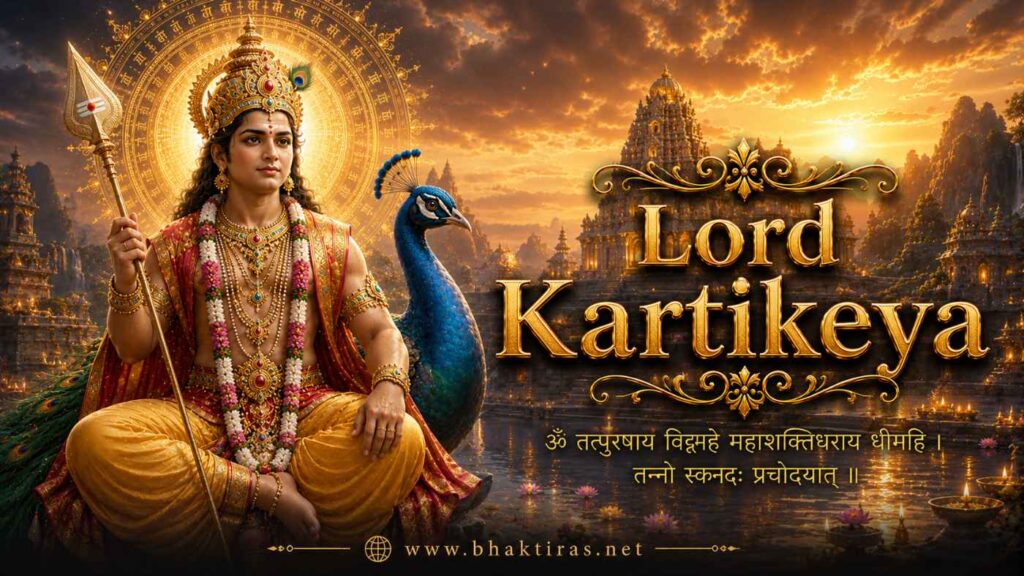
Who Is Lord Kartikeya
Lord Kartikeya is the second son of Shiva and Parvati, born for a single purpose – to lead the army of the gods and destroy the demon Tarakasura, whom no ordinary warrior could touch. He is the god of war and victory, and unlike deities linked to slow patience, his blessing is swift and decisive. Devotees turn to him when they face a battle of any kind, whether an exam, an illness, or a fear that has held them for years.
His worship follows two great streams. In North India he is known chiefly as Skanda or Kartikeya, the youthful general, though his temples there are fewer. In the South he is Murugan, one of the most loved gods of the Tamil people, the presiding deity of the hills and the guardian of Tamil devotion. The two traditions describe the same god, yet the southern worship gave him his wife Valli, his six sacred hills, and the passionate festivals of kavadi that draw millions each year.
He is called Kumara, the eternal youth, because he never ages past the freshness of a young warrior. He is Guha, the one who dwells in the cave of the heart, and Subrahmanya, dear to the seekers of higher knowledge. To his devotees he is both a fierce commander and a tender child, a god who fights their wars and then sits close, listening.
Birth & the Six Faces
The demon Tarakasura had won a boon that only a son of Shiva could kill him, and since Shiva was deep in meditation after the loss of Sati, the demon believed himself safe forever. The gods, desperate, roused Shiva. When he opened his eyes, a fiery seed of divine energy leapt out, too powerful for any womb to hold. It passed through Agni, the fire god, and then to the river Ganga, who could not bear it either, until at last it rested in a reed forest called Saravana.
There the energy split into six sparks of flame. Six of the Krittika stars, the Pleiades, took the form of nursing mothers and each cradled one spark. When Parvati came to gather her child, she embraced all six at once out of a mother’s love, and the six infants fused into a single body with six faces and twelve arms. Because six mothers nursed him, he became Kartikeya; because he has six faces, he is Shanmukha; and because he was born in the reed grove, his oldest mantra sings his name as Saravana Bhava, the one who arose in Saravana.
The six faces are not only a wonder to look at. Devotees read them as the god watching every direction at once, guarding the four quarters, the sky above, and the earth below, so that nothing escapes his sight and no enemy of the righteous can approach unseen.
Iconography & Symbols
Kartikeya is shown as a radiant young warrior, often with six faces and many arms, riding his peacock with the Vel raised. Each element of his image carries meaning.
Six Faces (Shanmukha)
The six heads look in every direction, symbols of all-seeing awareness. Some traditions link them to the six chakras, teaching that the god who guards the outer world also governs the inner path.
Twelve Arms
His many arms hold weapons and gestures of blessing at once. They show a general who can wage war on every front while still keeping a hand open in grace to his devotees.
The Vel
His shining spear is his defining emblem, gifted by Parvati as her own power in the form of a weapon. The Vel is sharp, wide, and deep – piercing ignorance, breaking obstacles, and running deep into the heart of the enemy.
The Peacock
His mount, the peacock Paravani, is often shown gripping a serpent in its claws. It stands for beauty mastered and the ego subdued, the wild pride of a bird turned into a willing servant of the divine.
The Serpent
The snake beneath the peacock’s feet is the restless mind and the pull of desire, held firmly in check. Kartikeya keeps command over what would drag an ordinary person down.
The Rooster Banner
His flag bears the image of a rooster, the bird whose crow announces the dawn. It signals the coming of light after darkness and the fearless call that summons warriors to the field.
The Vel & the Slaying of Tarakasura
The spear that ended the demon
When Kartikeya came of age, though he was still a youth of six days by some accounts, the gods crowned him commander of their army. Parvati gave him the Vel, her own energy shaped into a spear, and told him it would never fail while his heart stayed pure. He rode out on his peacock at the head of the divine host to meet Tarakasura, whose boon had made him untouchable to every being except a son of Shiva. The battle shook the three worlds, and the demon’s illusions and armies fell one by one. At last Kartikeya hurled the Vel, and it struck Tarakasura through, ending the terror that had bound the gods. His victory is why his very name means triumph, and why soldiers, seekers, and anyone facing a hard fight call on him first.
The Arupadai Veedu – Six Sacred Abodes
In Tamil Nadu, six ancient temples are counted as the personal homes of Murugan, together called the Arupadai Veedu, the six battle camps. Each marks a moment in his life and each draws pilgrims through the year. Many devotees make it a life goal to worship at all six.
- Palani – the hilltop shrine where Murugan sits as a renunciate after the quarrel over the golden mango
- Tiruchendur – the seashore temple marking where he prepared to strike down the demon Surapadman
- Swamimalai – the hill where the child Murugan taught the meaning of Om to his own father, Shiva
- Thiruparankundram – the site of his marriage to Devasena, near Madurai
- Pazhamudirchola – the forest shrine linked to his love for the huntress Valli
- Thiruthani – the peaceful hill where the god rested after his battles and settled his mind
How Lord Kartikeya Is Worshipped
Devotion to Murugan is famous for its intensity. Worshippers do not only pray with words – they carry their devotion on their bodies and walk it up the hills. Common practices include:
- Kavadi – carrying a decorated arch or a pot of milk on the shoulders as a vow, sometimes after piercing the skin, offered in thanks or in prayer for a wish
- Skanda Sashti vrat – a six-day fast leading to the sixth lunar day, recalling the six days of his war against the demons
- Abhishekam with panchamrit – bathing the deity in milk, honey, curd, ghee, and sugar, then offering fruit and sandal paste
- Tuesday worship – Tuesday, and the night of the Kritika star each month, are held especially dear to him
- Climbing the hills – many of his shrines sit on hilltops, and the climb itself, often barefoot, is treated as part of the prayer
Festivals of Lord Kartikeya
The festivals of Murugan fill temple towns with drums, painted faces, and endless streams of pilgrims.
Thaipusam
Celebrated in the Tamil month of Thai, this is the great kavadi festival. Devotees fast, shave their heads, and carry ornate kavadis, some with hooks and small spears through the skin, borne without pain as an act of faith. The processions at Palani and at Batu Caves in Malaysia are among the largest gatherings of Murugan worshippers on earth.
Skanda Sashti
Held in the month of Aippasi, this six-day observance retells and re-enacts the war against Surapadman. On the final day, the Soorasamharam drama shows the demon defeated and the Vel raised in victory. Fasting and temple worship mark each of the six days.
Vaikasi Visakam
Falling under the Visakha star in the month of Vaikasi, this festival celebrates the birth of Kartikeya. Temples perform special abhishekams and adorn the deity, and devotees give thanks for the god who was born to protect them.
A Story Every Devotee Knows
The race around the world
Sage Narada once brought a single golden mango to Kailasa, a fruit of wisdom that could not be cut or shared. Shiva and Parvati decided to give it to whichever son first circled the whole world. Kartikeya, sure of his speed, leapt onto his peacock and flew off around the earth. Ganesha, heavier and slower, simply walked around his parents and folded his hands, saying that for him they were the whole world. Delighted, Shiva and Parvati gave the mango to Ganesha. When Kartikeya returned and found the fruit gone, he felt wronged and, in a proud sorrow, left for the south to live on the hill of Palani as a bare renunciate. This is why so many of his greatest shrines rose in the Tamil land – the god who went south and made it his home.
Valli and the elephant
In the hills lived Valli, the daughter of a hunter chief, whom Murugan loved. To win her he came first as an old man asking for help, then, when a wild elephant charged, Valli ran to the old man for protection and he revealed himself as the young god. Her fright and her love became the same feeling. Their courtship is remembered fondly in the South, where Murugan is the god who came down from his hills and won a village girl’s heart as an ordinary suitor, not only as a lord of war.
Prayers & Mantras
The oldest and most beloved chant to Kartikeya is his six-syllabled seed mantra, sung across every one of his temples. Devotees repeat it as a shield and as a call, trusting that the god who arose in the reed grove will hear his own name.
Frequently Asked Questions about Lord Kartikeya
Who is Lord Kartikeya?
Kartikeya is the son of Shiva and Parvati and the commander of the army of the gods. He was born to destroy the demon Tarakasura, whom no one else could kill. He is the god of war and victory, carries the divine spear called the Vel, and rides a peacock. In the South he is worshipped as Murugan.
Why is Kartikeya also called Murugan?
Murugan is his Tamil name, and it is by far the most common way he is worshipped in South India, Sri Lanka, and Malaysia. Kartikeya and Murugan are the same god, but the southern tradition gave him his hill temples, his wife Valli, and the great festivals of kavadi and Thaipusam that draw millions.
Why does Kartikeya have six faces?
When Shiva's fiery energy split into six sparks, six Krittika stars each nursed one spark as an infant. When Parvati embraced all six children at once out of love, they fused into a single body with six faces. This is why he is called Shanmukha, the six-faced one, said to watch over every direction at once.
What is the Vel and why is it important?
The Vel is the divine spear that Parvati gave to Kartikeya, her own power taking the form of a weapon. He used it to slay the demon Tarakasura. Devotees see the Vel as the force that pierces ignorance and destroys obstacles, and it is the single most recognized symbol of the god.
What are the Arupadai Veedu?
The Arupadai Veedu are the six sacred abodes of Murugan in Tamil Nadu: Palani, Tiruchendur, Swamimalai, Thiruparankundram, Pazhamudircholai, and Thiruthani. Each temple marks an event in his life, and many devotees make it a life goal to worship at all six of them.
What is Skanda Sashti?
Skanda Sashti is a six-day festival remembering Kartikeya's war against the demons, ending on the sixth lunar day of the month of Aippasi. Devotees keep a fast through the six days, and on the last day temples re-enact the Soorasamharam, the moment the demon Surapadman is defeated and the Vel is raised in victory.
What is Thaipusam and kavadi?
Thaipusam is the great festival of Murugan in the month of Thai. Kavadi is the vow devotees fulfil during it, carrying a decorated arch or a pot of milk on their shoulders, sometimes with small spears or hooks piercing the skin, borne as an act of faith and thanks. The Palani and Batu Caves processions are the most famous.
Who are the consorts of Kartikeya?
In the Tamil tradition Murugan has two consorts, Devasena and Valli. Devasena, the daughter of Indra, represents his divine, dutiful marriage after his victory. Valli, a hunter chief's daughter whom he courted in the hills, represents his tender, human side. Together they stand beside him in most southern temples.
When and how should I worship Lord Kartikeya?
Tuesday and the night of the Kritika star each month are especially dear to him, along with Skanda Sashti and Thaipusam. Devotees offer abhishekam with panchamrit, fruit, honey, and sandal paste, chant the mantra Om Saravana Bhava, and often keep vows such as the six-day Sashti fast or carrying kavadi.
Whether you know him as Kartikeya of the north or Murugan of the southern hills, may his Vel clear the path ahead of you and his six faces watch over every side of your life.