
Rishi Markandeya
मार्कण्डेय
Rishi Markandeya is an immortal sage (Chiranjivi) of the Puranas and a devoted worshipper of Lord Shiva. Fated to die at sixteen, he clung to a Shivalinga in unbroken prayer. Shiva burst forth to stop Yama, the god of death, and blessed the boy to stay sixteen forever, deathless.
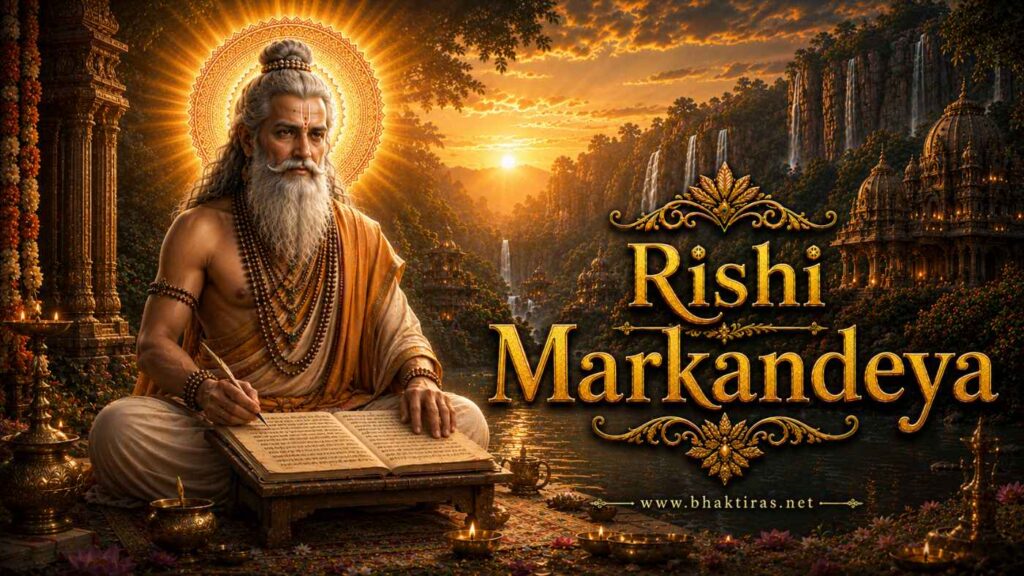
Who Is Rishi Markandeya
Rishi Markandeya belongs to a small circle of beings the Hindu tradition calls Chiranjivi – the deathless ones who move through age after age while empires rise and fall around them. He is remembered not for the length of his life alone, but for how he won it: through a devotion to Lord Shiva so complete that death itself was turned away at his door.
In the Puranas he appears again and again as a witness to the deepest secrets of existence. He is the seer to whom the Markandeya Purana is ascribed, and within that text sits the Devi Mahatmya, the great hymn to the Goddess recited by millions during Navaratri. To sit with Markandeya’s story is to sit with someone who has looked directly at both the face of death and the sleeping form of the universe.
His name carries the memory of his father, the sage Mrikandu, whose longing for a child set the whole story in motion. Markandeya’s life is really the story of a family’s faith, a boy’s courage, and a God’s love answering a devotee who refused to let go.
For those who fear death, illness, or the passing of years, Markandeya is a steady figure of hope. His life whispers that sincere devotion is stronger than the cord of fate, and that the divine hears the one who calls with a whole heart.
The Boy Destined to Die at Sixteen
A childless couple and a hard choice
The sage Mrikandu and his wife Marudmati lived a quiet, disciplined life, yet one sorrow shadowed them: they had no child. For years they gave themselves to penance and prayer to Lord Shiva, asking for a son. Their devotion was so earnest that Shiva at last appeared before them, pleased and ready to grant a boon.
Brilliant and brief, or long and ordinary
Shiva set before the couple a strange and searching choice. He could give them a son who would be dull, unremarkable, and coarse in nature, yet who would live a full, long life. Or he could grant them a son of shining virtue, wisdom, and beauty – a child who would delight the whole world – but who would live only sixteen years. The parents did not hesitate. They asked for the gifted child, choosing the depth of those few years over the length of many empty ones.
The child of light
So Markandeya was born, and he grew into everything Shiva had promised. He was gentle, quick to learn, and radiant with devotion, mastering the scriptures while still very young. His parents loved him beyond measure, and yet a quiet grief travelled beside their joy, for they knew the appointed day drew nearer with every birthday. As the sixteenth year approached, Mrikandu could no longer hide his sorrow, and the boy, wise beyond his age, gently asked his father to tell him the truth.
Turning fear into worship
When Markandeya learned that death was written for his sixteenth year, he did not weep or flee. He turned instead to the one he trusted most. Shiva had given him life, and to Shiva he would give his final hours. The boy devoted himself wholly to worship of the Shivalinga, letting the mantra of the great God fill his days, his fear dissolving into steady, unbroken love.
How Shiva Conquered Death for Markandeya
The appointed hour
On the day his sixteenth year ended, Markandeya sat before the Shivalinga in a temple, absorbed in prayer. He held nothing back. His whole being was poured into the worship of Shiva, and the mantra rose from his lips without pause. Around him the ordinary world went on, but within that small circle of devotion a great meeting was about to take place.
Yama arrives with his noose
At the fated moment Yama, the god of death, came riding his buffalo, his dark noose in hand, ready to draw the boy’s life away as the law of time demanded. But Markandeya, seeing death approach, did not release his hold. He wrapped his arms around the Shivalinga and clung to it, refusing to be parted from his Lord even by death itself. When Yama cast his noose, it fell around both the boy and the sacred stone.
Shiva bursts from the linga
At that, the linga split open and Shiva emerged in a blaze of power as Kalantaka, the ender of Death. His fury was terrible. He struck down the very approach of Yama, stopping the god of death in his tracks for daring to cast a noose over a devotee sheltering at the Shivalinga. In that instant Shiva revealed himself as Mrityunjaya, the conqueror of death, master even of the one who masters all mortals.
Sixteen forever
Then Shiva, whose anger had risen only in love for his devotee, turned to Markandeya with grace. He blessed the boy to remain sixteen years old for all time, untouched by aging and beyond the reach of death – a Chiranjivi, an immortal. Yama’s order was set right in due course, but the message endured: where true devotion clings to the divine, even death must wait upon the Lord’s word.
The Seer of the Markandeya Purana
Having received the gift of endless life, Markandeya used it not for himself but as a vessel of knowledge. The Markandeya Purana carries his name because it is framed as teachings connected to him, passed on through the ages. Among the eighteen great Puranas it holds a special place, prized for the range of its wisdom and the beauty of its hymns.
Its most celebrated portion is the Devi Mahatmya, also known as the Durga Saptashati or Chandi Path – seven hundred verses that tell how the Great Goddess slays the demons Madhu and Kaitabha, Mahishasura, and Shumbha and Nishumbha. Recited across India during Navaratri, this hymn made Markandeya’s Purana the seedbed of the whole living tradition of Goddess worship.
That an immortal devotee of Shiva should be the seer through whom the glory of the Goddess reaches the world is fitting. It quietly binds together the Shaiva and Shakta streams of faith, reminding worshippers that the one divine reality wears many forms. Through Markandeya, the tradition receives both the mercy of Shiva and the power of the Mother.
The Vision of Bala Mukunda
The world dissolves
Because Markandeya lived beyond death, he witnessed what almost no other being could: the pralaya, the great dissolution at the end of a cosmic age, when the worlds fold back and the seas swallow all that was. The mountains sank, the skies emptied, and the whole creation returned to a single boundless expanse of water. Alone in that shoreless flood, Markandeya wandered, weary and amazed, with no earth beneath him and no horizon before him.
A child on a leaf
As he drifted through the endless waters, he saw a wonder floating in the vastness: a single banyan leaf, and resting upon it a small, luminous infant. The child lay serene amid the ruin of the universe, glowing softly, breathing gently, utterly at peace where all else had ended. This was Bala Mukunda, the infant form of Vishnu, sometimes seen as the child Krishna, holding within himself the seed of all that would be born again.
The universe within the child
Drawn to the infant, Markandeya was suddenly swept inside him with a single breath. There, within the body of the child, he beheld the whole cosmos he thought had perished – the mountains, rivers, oceans, and all the worlds, alive and whole. When he was breathed out again into the waters, he understood at last: creation is never truly lost, only gathered back into the divine, waiting to unfold once more. In that vision Markandeya received the deepest teaching of all, that the same One who ends the worlds also cradles them tenderly, ready to give them life again.
Markandeya and the Mahamrityunjaya Mantra
Because his story is the story of death overcome through Shiva, Markandeya is closely tied to the Mahamrityunjaya Mantra – the great victory-over-death prayer drawn from the Rigveda and Yajurveda. Devotees who chant it call upon Shiva as Tryambaka, the three-eyed one, asking for healing, protection, and release from the fear of death, just as the boy-sage was released at his darkest hour.
The mantra does not ask crudely for a longer life. It asks to be freed from bondage to death as gently as a ripe cucumber slips from its vine, without pain and without clinging, moving toward immortality. This is the very grace Markandeya received: not a frightened grasping at years, but a devotion so pure that death lost its hold on him.
In many homes the mantra is chanted for the sick, the aging, and those in danger, and Markandeya’s example is held up as its living proof. His life teaches that the prayer works not as a spell but as surrender – the heart turning fully to the divine, trusting that the same Lord who conquered death for a devoted boy still hears every sincere call.
Iconography & Symbols
A youthful sage
Markandeya is almost always shown as a young man, forever sixteen, his face calm and bright. This eternal youth is the visible sign of Shiva’s blessing and sets him apart from the aged, bearded seers of other stories. His freshness is a reminder that his life stopped at the moment of grace.
Embracing the Shivalinga
The most beloved image shows the boy clasping the Shivalinga with both arms while Yama’s noose falls around him and Shiva bursts forth in fury. This scene, carved in temples across South India, captures the exact instant devotion defeated death and is the heart of his iconography.
Rudraksha and simple garb
He wears the marks of a Shaiva devotee – rudraksha beads, sacred ash, and the plain cloth of one who has renounced worldly desire. These signs place him firmly within the tradition of Shiva worship and mark his inner discipline as clearly as his outer form.
Water and the banyan leaf
In images of the cosmic vision, Markandeya is shown amid vast waters gazing at the infant Bala Mukunda upon a banyan leaf. This scene sets his story against the largest possible backdrop – the dissolution and rebirth of all creation – and shows him as the witness of eternity.
How Rishi Markandeya Is Remembered
Markandeya is honoured wherever Shiva is worshipped and death is feared, and his memory is kept alive in countless small ways across daily Hindu life:
- As the patron figure of the Mahamrityunjaya Mantra, invoked for healing and long life during illness and old age.
- Through temples such as Markanadeya shrines and the great Kalahasti and Thirukkadaiyur temples, where his story of rescue from Yama is retold and re-enacted.
- In the Devi Mahatmya recited during Navaratri, where he is remembered as the seer through whom the Goddess’s glory reaches the faithful.
- As a name of blessing, given to children in the hope that they may share his long life, wisdom, and protection.
- In the observance of Markandeya rituals for longevity, especially for young people and those recovering from serious illness.
- As a moral example told to children – the boy who turned his fear into prayer and clung to the divine when everything seemed lost.
Prayers & Mantras
The most powerful prayer linked to Markandeya is the Mahamrityunjaya Mantra, the same current of devotion that saved him from death. It is chanted for health, protection, and peace of mind, and it may be offered before a Shivalinga with a lamp and a few flowers.
Mahamrityunjaya Mantra:
ॐ त्र्यम्बकं यजामहे सुगन्धिं पुष्टिवर्धनम् । उर्वारुकमिव बन्धनान्मृत्योर्मुक्षीय मामृतात् ॥
Om Tryambakam Yajamahe Sugandhim Pushtivardhanam, Urvarukamiva Bandhanan Mrityor Mukshiya Maamritat.
Meaning: We worship the three-eyed Lord Shiva, who is fragrant and who nourishes all beings. As the ripe cucumber is freed effortlessly from its binding vine, may he free us from the bondage of death, for the sake of immortality – and not from the deathless state itself.
A simple prayer to the sage himself may also be offered: Om Markandeyaya Namah. Chanted with faith, it is a way of asking for the courage, devotion, and freedom from fear that the immortal boy-sage came to embody.
Frequently Asked Questions about Rishi Markandeya
Who is Rishi Markandeya?
Rishi Markandeya is an immortal sage of the Puranas and a supreme devotee of Lord Shiva. Fated to die at sixteen, he was saved when Shiva burst from the Shivalinga to stop Yama, the god of death, and blessed him to stay sixteen forever. He is the seer of the Markandeya Purana.
How did Markandeya conquer death?
When Yama came at the end of his sixteenth year, Markandeya clung to the Shivalinga in unbroken prayer. Shiva emerged as Kalantaka, the ender of Death, and Mrityunjaya, the conqueror of death, stopping Yama and blessing the boy to remain forever young and deathless.
What is the Markandeya Purana?
The Markandeya Purana is one of the eighteen great Puranas, framed around teachings connected to the sage. Its most famous portion is the Devi Mahatmya, or Durga Saptashati, the seven hundred verses in praise of the Goddess that are recited across India during Navaratri.
Why is Markandeya called a Chiranjivi?
A Chiranjivi is a being blessed to live on through the ages without dying. Shiva granted Markandeya eternal youth and freedom from death, so he is counted among these immortals. Because of this he could witness rare events such as the cosmic dissolution and the infant Vishnu on the banyan leaf.
What is the vision of Bala Mukunda that Markandeya saw?
During the pralaya, the great dissolution when the worlds are swallowed by water, Markandeya wandered the endless flood and saw an infant resting on a banyan leaf. This was Bala Mukunda, the child form of Vishnu. Drawn inside the child, he beheld the whole universe held safe within, waiting to be reborn.
Which mantra is associated with Rishi Markandeya?
Markandeya is deeply tied to the Mahamrityunjaya Mantra, the great victory-over-death prayer beginning Om Tryambakam Yajamahe. Because Shiva saved him from death, devotees chant this mantra for healing, protection, and freedom from the fear of dying, remembering his rescue as its living proof.
How is Rishi Markandeya worshipped today?
He is remembered through the Mahamrityunjaya Mantra, in temples that retell his rescue from Yama, and through the Devi Mahatmya recited at Navaratri. Devotees invoke him for long life, health, and courage, and his story is told to inspire faith and fearlessness in the face of death.
May the courage of the immortal boy-sage steady your heart, and may his devotion to Lord Shiva turn every fear you carry into faith.