
Narada Muni
नारद
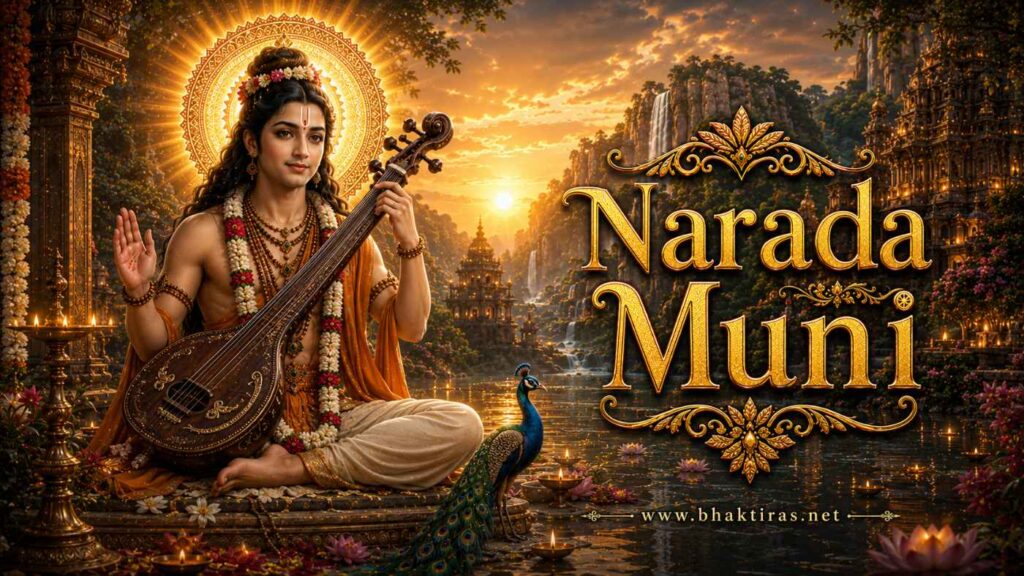
Narada Muni is the celebrated Devarishi, a divine sage born from the mind of Brahma. He wanders freely across the three worlds with his veena, singing the name of Vishnu. Honoured as the foremost devotee and the great teacher of bhakti, he is traditionally the author of the Narada Bhakti Sutras, the aphorisms on divine love.
Who Is Narada Muni?
Narada Muni is one of the most beloved figures in Hindu tradition – a sage who belongs to the gods themselves, which is why he carries the title Devarishi, the rishi among the celestials. He was not born of a human mother or father in the ordinary way. He came directly from the mind of Brahma the creator, which makes him a Manasaputra, a mind-born son. That divine origin gives him a freedom few beings possess: he moves through the heavens, the earth, and the lower realms as easily as we walk from one room to another.
A Sage Among the Gods
Where most sages sit in one forest or on one mountain, Narada is always on the move. He carries no home and needs none. His whole life is a pilgrimage, and everywhere he goes he brings news, songs, and the reminder that the divine name is the sweetest sound in creation.
The Voice of Devotion
If you had to name one thing Narada stands for, it would be bhakti – loving devotion to God. He does not preach dry doctrine. He simply sings, chants, and loves, and in doing so he shows countless souls that the path to the divine is open to anyone with a sincere heart.
Across the Puranas, the Mahabharata, and countless smaller stories, Narada appears again and again – sometimes to warn, sometimes to guide, sometimes to gently stir up a situation that needs stirring. He is never far from the action, and he is never far from the name of Narayana on his lips.
The Wandering Sage with the Veena
Picture the sky, the mountains, and the great oceans of the three worlds, and somewhere across them a lone figure walking with a stringed instrument cradled in his arms. That is how the tradition remembers Narada. His veena, called the mahati, is as much a part of him as his own voice, and beside it he carries a tanpura to hold the drone beneath his song.
Narayana, Narayana
As he travels, Narada sings two words above all others: ‘Narayana, Narayana.’ It is the name of Vishnu, and for Narada it is breath, food, and joy all at once. Wherever the sound reaches, hearts grow lighter and minds turn, even for a moment, toward the divine.
Free Across the Three Worlds
No door is closed to Narada. He walks into the courts of kings, the assemblies of the gods, the palaces of the demons, and the humble huts of forest hermits. This freedom is not for his own comfort – it lets him carry the right word to the right place at the right time.
His wandering is not restlessness. It is service. By moving constantly, Narada keeps the story of devotion flowing between heaven and earth, connecting beings who would otherwise never meet, and reminding each one that the divine is always within reach of a song.
Foremost Devotee and Teacher of Bhakti
Among all the great devotees of Vishnu, Narada holds a special place. He is often called the foremost bhakta, the one whose love for the Lord is so pure that it has become the model for everyone else. And he does not keep that love to himself. He spends his endless days passing it on, teaching souls how to walk the path of the heart.
The Narada Bhakti Sutras
Tradition credits Narada with the Narada Bhakti Sutras, a short and luminous set of aphorisms on divine love. In them he describes bhakti as the highest goal, a love so complete that the devotee forgets all else and finds full peace in the divine. These verses have guided seekers for centuries.
Devotion Above All
For Narada, ritual and learning have their place, but nothing surpasses simple, wholehearted love. He teaches that when the heart truly melts for God, the divine name sung with feeling carries a person further than any amount of dry study or harsh penance.
This is why Narada is so dear to devotees. He removes the idea that God is far away or reserved for the learned few. Through his life and his sutras, he insists that love is enough, and that the door of devotion stands open to every sincere seeker.
The Divine Catalyst – Mischief for a Higher Purpose
Read enough Puranic stories and you will notice a pattern: whenever events need a push, Narada appears. He drops a word here, carries a piece of news there, and suddenly the whole situation shifts. Because of this, he earned the affectionate nickname Kalahapriya, the one who is fond of quarrels. But there is far more to it than mere mischief.
The Stirring That Serves
What looks like Narada causing trouble almost always turns out to serve a greater good. A boast he provokes exposes hidden pride; a rumour he carries brings two destined figures together; a challenge he raises sets in motion the very events that protect the devout and humble the arrogant.
Kalahapriya, With a Purpose
His quarrels are never petty or cruel. They are the gentle nudges of a sage who can see the larger design that ordinary beings cannot. Time and again the same lesson emerges – what seemed like discord was really the divine plan taking shape for the good of devotees.
So the affectionate teasing about Narada being a stirrer of pots hides a deeper truth. He is a trusted instrument of Vishnu, and his apparent mischief is a form of grace, arranging the world so that righteousness rises and sincere hearts are rewarded.
The Devotees He Inspired
One of the surest signs of Narada’s greatness is the company of souls he set on the path. When Narada meets a searching heart, that meeting often changes a life forever. A few of the most famous are remembered wherever his story is told.
- Valmiki: The sage who would compose the Ramayana first heard the glory of Rama from Narada, whose words inspired the very telling of that great epic.
- Prahlada: While still in his mother’s womb, the boy-devotee Prahlada absorbed teachings on devotion to Vishnu that Narada shared, and grew into one of the greatest bhaktas of all.
- Dhruva: When the young prince Dhruva set out with a fierce longing to reach God, it was Narada who guided him, gave him the sacred mantra, and steadied his resolve until he attained his eternal place.
- Countless others: Kings, hermits, and ordinary seekers across the Puranas found their turning point in a chance meeting with the wandering sage.
In each case Narada asks for nothing in return. He simply plants the seed of devotion and moves on, trusting the divine to bring it to fruit. That quiet, generous teaching is his lasting gift to the world.
Iconography & Symbols
Narada is easy to recognise in art and imagination. Every element of his form points back to his life of wandering devotion.
The Veena (Mahati)
His constant companion, the veena rests in his arms as a symbol of music offered to God. Through it, devotion becomes sound, and sound becomes a bridge between the human heart and the divine.
The Tanpura
Beneath his song hums the steady drone of the tanpura, an image of the unchanging divine presence that underlies all the changing notes of life. It reminds us that God is the constant beneath every melody.
Matted Hair & Ascetic Robes
His simple robes and matted locks mark him as one who owns nothing and needs nothing. He is a renunciate whose only wealth is the name of Narayana and his boundless love for the Lord.
The Name of Narayana
Above every visible symbol stands the sound on his lips. The ceaseless chant of ‘Narayana, Narayana’ is Narada’s truest emblem, showing that the divine name is the heart of all devotion.
Seen together, these symbols paint a clear picture: a joyful, free, and utterly devoted sage whose whole being is turned into an offering of song and love.
How Narada Muni Is Remembered
Narada is woven into the devotional life of Hindus in many quiet, everyday ways. His memory lives less in grand temples and more in stories, songs, and the culture of devotion itself.
- As the patron of wandering singers and devotional musicians, who see in him the first and greatest minstrel of God.
- In the Bhakti Sutras attributed to him, still studied by seekers who want to understand the path of pure love.
- In the countless Puranic and epic tales where his arrival signals that the divine plan is about to unfold.
- In the affectionate name Naradaji, used with warmth for a sage who feels less like a distant deity and more like a familiar, mischievous friend of devotees.
- In the simple practice of chanting the divine name, which he championed as the easiest and sweetest way to reach God.
To remember Narada is to remember that devotion can be light, joyful, and full of song – and that the divine is always as near as the next heartfelt utterance of the holy name.
Prayers & Mantras
Devotees invoke Narada Muni to awaken sincere devotion in their own hearts and to receive his blessing on the path of bhakti. The simplest and most powerful practice, fittingly, is to chant the name he himself loved most – Narayana – along with a short mantra honouring the sage.
The Narada Mantra
ॐ नारदाय नमः
Om Naradaya Namah
Meaning: I bow to Narada, the divine sage. Repeating this mantra with feeling invites his blessing of pure, joyful devotion and steadiness on the path of the heart.
The Chant of Narayana
ॐ नमो नारायणाय
Om Namo Narayanaya
Meaning: I bow to Narayana, the supreme Lord. This is the very name Narada sings without pause, and to chant it is to walk beside him on his endless pilgrimage of love.
Chanted with sincerity, these mantras turn ordinary moments into small acts of devotion, exactly as Narada would wish – the name of God carried lightly, lovingly, and often.
Frequently Asked Questions about Narada Muni
Who is Narada Muni?
Narada Muni is the Devarishi, a divine sage born from the mind of Brahma. He wanders the three worlds with his veena, singing the name of Vishnu, and is honoured as the foremost devotee of the Lord and the great teacher of bhakti, or loving devotion, to God.
Why does Narada sing Narayana Narayana?
Narayana is a name of Vishnu, the Lord to whom Narada is utterly devoted. By singing it without pause, Narada keeps his mind fixed on the divine and spreads its blessing wherever he goes. For him, the name is the sweetest and most direct way to stay close to God.
Is Narada a troublemaker?
He is affectionately called Kalahapriya, fond of quarrels, because he often stirs up events. Yet his apparent mischief always serves a higher purpose. What looks like discord turns out to advance the divine plan, protect devotees, and humble the proud, so his stirring is really a form of grace.
What are the Narada Bhakti Sutras?
The Narada Bhakti Sutras are a short set of aphorisms on divine love traditionally attributed to Narada. They describe bhakti as the supreme goal of life – a love for God so complete that the devotee finds full peace and forgets all lesser desires. Seekers have studied them for centuries.
Whose son is Narada?
Narada is a mind-born son, or Manasaputra, of Brahma the creator. He was not born in the ordinary way but sprang directly from Brahma's mind. This divine origin gives him the freedom to travel across the heavens, the earth, and the lower worlds as a sage among the gods.
Which devotees did Narada inspire?
Narada set many great souls on the path of devotion. He inspired Valmiki to compose the Ramayana, guided the boy-prince Dhruva with a sacred mantra, and shared teachings that shaped Prahlada into a supreme devotee. Countless other seekers found their turning point in meeting him.
What does Narada Muni teach us?
Narada teaches that loving devotion is the highest path and that it is open to everyone. He shows that a heart melted by love and a tongue chanting the divine name reach God faster than dry learning or harsh penance. His life is a lesson in joyful, wholehearted surrender to the Lord.
May the wandering sage fill your heart with his song, and may the name of Narayana be ever sweet upon your lips.