
Nandi
नंदी
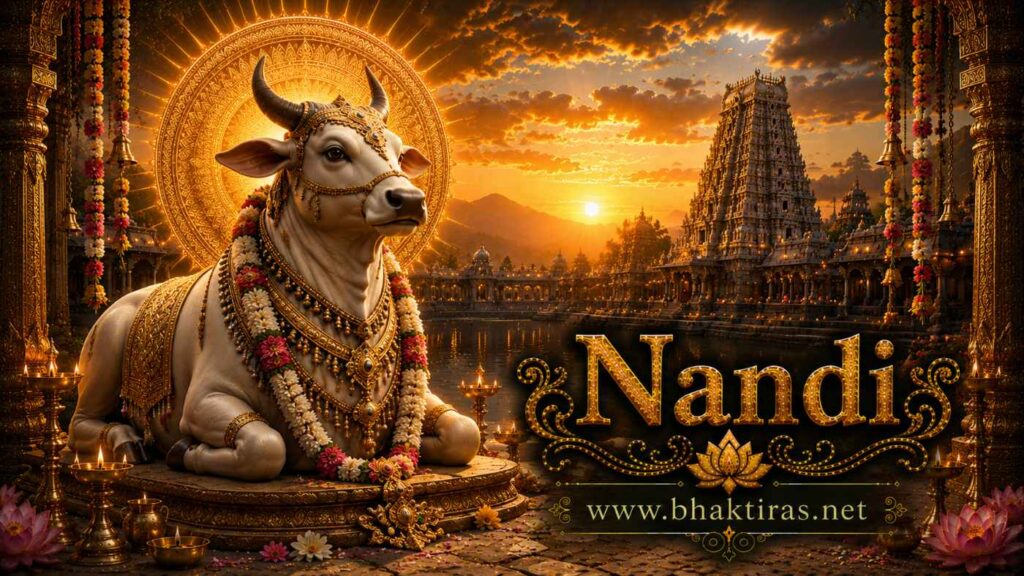
Nandi is the sacred bull of Lord Shiva – his mount, his gatekeeper, and the foremost of all his devotees. In every Shiva temple, a large image of Nandi sits directly before the sanctum, gazing steadily at his Lord. Devotees whisper their prayers into his ear, trusting him to carry each one to Shiva.
Who Is Nandi?
Nandi is the sacred bull who serves Lord Shiva in more ways than one. He is Shiva’s vahana – the mount who bears him across the worlds. He is the dwarapalaka – the gatekeeper who guards the threshold of his Lord. And above all, he is the foremost of Shiva’s devotees, the one whose love and loyalty are held up as the measure by which every other devotion is judged.
His name carries the meaning of joy and delight – Nandi, the joyful one. It is a fitting name for a being whose whole existence is bound up in the happiness of nearness to Shiva. Wherever the Lord goes, Nandi goes; wherever Shiva rests, Nandi keeps watch. He is also called Nandikeshwara and Vrishabha, the bull, and in some traditions he is honoured as the chief of the ganas – the strange and countless hosts of attendants who follow Shiva.
To picture Nandi is to picture the great seated bull found in front of every Shiva temple across India. He does not stand; he sits, folded and settled, in an attitude of endless waiting. His eyes never leave the sanctum where his Lord resides. In that single unmoving gaze, generations of worshippers have seen the ideal of what it means to love God without distraction, without impatience, and without end.
The Bull Who Guards the Sanctum
Walk into any Shiva temple – a small village shrine or a great stone complex in the south – and you will meet Nandi before you meet Shiva. His image is placed directly in the axis of the sanctum, facing inward, so that his line of sight runs straight to the Shiva Linga within. He sits as a guardian, marking the boundary between the ordinary world outside and the sacred inner chamber where the Lord dwells.
There is a quiet lesson in this arrangement. Nandi is the first to receive the visitor and the last barrier before the divine presence. He watches over the shrine day and night, in festival crowds and in the empty silence after the lamps are put out. Worshippers often pause to touch his hooves or rest a hand on his back before stepping toward the sanctum, greeting the devotee before approaching the Lord he serves.
Many temples build a small pavilion, the Nandi Mandapam, to house him, and the largest of these bulls are carved from a single block of stone and reach many feet in height. Yet whether he is small enough to hold in the palm or tall as a doorway, his posture is always the same – seated, alert, turned forever toward Shiva.
Whispering Prayers in Nandi's Ear
One of the most tender customs in all of Hindu worship belongs to Nandi. When a devotee has a wish, a worry, or a prayer too private to say aloud in the crowd, they lean close to the great bull and whisper it softly into his ear. The belief is simple and beautiful: Nandi, ever near to Shiva and ever trusted by him, will carry that whispered word straight to the Lord.
You can see people doing this even now. They cup a hand around the bull’s stone ear, murmur their hopes, and step back with a look of relief, as though a letter has been safely posted. Some traditions add that you should cover the bull’s other ear as you whisper, so the prayer travels only to Shiva and nowhere else. Others say you should keep the wish to yourself entirely, sharing it only with Nandi and the Lord.
The custom rests on a gentle truth about the divine household. Shiva is the great ascetic, often lost in deep meditation, seated on distant Mount Kailash. Who better to reach him than the faithful bull who never leaves his side? In whispering to Nandi, the worshipper is not going around Shiva but through the one servant Shiva loves and trusts the most.
The Perfect Devotee
Among all the beings who love Shiva, Nandi is remembered as the perfect devotee. What makes his devotion the ideal is not a single dramatic act but the qualities he holds without ever tiring: patience, attentiveness, loyalty, and a stillness of heart that never wanders from its object.
Think of him seated before the shrine. He is powerful – a great bull, capable of tremendous strength – yet all that power is folded and held in service. He does not use his might for himself. He waits. He watches. He listens. This is the meaning devotees draw from him: that true bhakti is not restless striving but a steady, calm turning of the whole self toward God.
Nandi also teaches the value of a fixed gaze. His eyes never leave Shiva, and in that unblinking attention lies a picture of the mind that has stopped chasing a hundred things and rests in one. The worshipper who prays before Nandi is quietly asking for the same gift – to love without distraction, to serve without needing reward, and to remain faithful whether the Lord is present or lost in meditation on a far mountain.
The Birth of Nandi
The Longing of Sage Shilada
The Shiva Purana tells that Nandi came into the world through the deep longing of a sage named Shilada. Shilada practised severe austerities, for he wished for a son – not an ordinary child born of the body and doomed to die, but a son who would be immortal and untouched by the sorrows of birth and death. His devotion was intense and unbroken, and it was to Lord Shiva that he turned.
Shiva, moved by the sage’s love, appeared before him and granted the boon in a form Shilada had not expected. The child would be his own son, yet born through Shiva’s grace and marked by the Lord’s own nature.
A Son Given by Shiva's Grace
In time the child appeared, and the sage named him Nandi. When Shilada learned that his beloved son would not live an ordinary lifespan and grieved at the thought, it was Shiva himself who reassured him. The Lord took Nandi to his heart, blessed him with immortality, and raised him to a place of the highest honour – making him the chief of his ganas, his gatekeeper, and his ever-present companion.
Nandi, given to Shiva as a father’s gift and then received back as the Lord’s own attendant, became the very shape of devotion returned. Born of grace, he spent his whole existence in grateful service, and so the bull who was granted to a longing father became the model of the perfect servant of God.
Nandi as a Symbol of Dharma and Strength
Nandi is more than a servant of Shiva; he is a symbol woven into the deeper ideas of Hindu thought. In many traditions the bull represents dharma – righteousness itself – standing firm on all four legs. In the great turning of the ages, dharma is said to lose one leg in each age, until in our own troubled time it balances on a single leg. The four-legged bull is the picture of dharma whole and unbroken, and so Nandi carries the memory of a world in right order.
He also embodies restrained strength. A bull is among the most powerful of animals, yet Nandi’s power is never wild. It is disciplined, held, offered up in service. This is the strength the tradition admires most – not force that dominates, but might that has learned to kneel. In the same spirit, the bull has long stood for fertility and the abundant, life-giving forces of the earth, and for steadfastness, the quality of remaining rooted through every storm.
So when a devotee bows before Nandi, they are bowing before a cluster of virtues: righteousness that does not waver, power that serves rather than rules, patience that outlasts every trial, and a devotion that asks for nothing in return.
Iconography & Symbols
The Seated Bull
Nandi is almost always shown seated rather than standing – folded, settled, at rest. This posture speaks of endless patience and of a servant who has taken his place and will not leave it. His stillness is the stillness of one who is content to wait as long as his Lord requires.
The Unblinking Gaze
His face and eyes are turned toward the sanctum, fixed on Shiva. This steady gaze is the heart of his meaning: the mind that has found its single object and rests there. Devotees are drawn to align their own line of sight with his, looking through Nandi toward the Lord.
The Ornaments
Nandi is often shown richly adorned – garlanded, draped with bells, and dressed in fine cloth and jewels. These ornaments mark him as a beloved and honoured being, not a mere animal but a divine attendant cherished by Shiva and worshippers alike.
The Hump and Strength
The raised hump and strong shoulders of the bull carry the sense of power held in reserve. Usually depicted as pure white, Nandi’s colour signals purity and sattva – the calm, luminous quality of a heart untroubled by lower urges.
How Nandi Is Honoured
Nandi is worshipped in his own right, not only as a gateway to Shiva. Across India, devotees show him honour through a range of simple, heartfelt acts.
- Greeting him first – many worshippers pause to bow to Nandi and touch his image before turning toward the Shiva sanctum, honouring the devotee before the Lord.
- Whispering wishes in his ear – the beloved custom of confiding a private prayer to Nandi, trusting him to carry it to Shiva.
- Offerings and garlands – flowers, bilva leaves, garlands, and sometimes a smear of sandal or vermilion are offered to the bull as tokens of love.
- Lighting lamps – devotees light lamps before Nandi’s image, especially on Mondays and on Maha Shivaratri, the great night of Shiva.
- Circumambulation – in many temples worshippers reverently walk around or bow to Nandi as part of their path through the shrine.
- Reciting his mantra – chanting ‘Om Nandikeshwaraya Namah’ to invoke his blessing of steadfast devotion and to seek his help in reaching Shiva.
Prayers & Mantras
The simplest and most loved way to honour Nandi is to call on him by name, remembering him as Nandikeshwara, the lord of the ganas and the perfect servant of Shiva. The following mantra is chanted before his image, often as the first step in worshipping Shiva.
ॐ नन्दिकेश्वराय नमः
Om Nandikeshwaraya Namah
Meaning: ‘Salutations to Nandikeshwara, the divine bull who is lord of Shiva’s ganas.’ To chant it is to bow before the ideal of devotion – to ask for Nandi’s patience, his loyalty, and his steady gaze, and to trust him to carry our prayers to the Lord he serves.
Frequently Asked Questions about Nandi
Who is Nandi?
Nandi is the sacred bull of Lord Shiva. He serves as Shiva's mount (vahana), his gatekeeper (dwarapalaka), and the foremost of all his devotees. In every Shiva temple, an image of Nandi sits before the sanctum, facing the Lord in an attitude of endless devotion.
Why do we whisper wishes in Nandi's ear?
Because Nandi is Shiva's most trusted and ever-present servant, devotees believe he will carry their whispered prayers straight to the Lord. Shiva is often deep in meditation on distant Kailash, and Nandi, who never leaves his side, is the faithful messenger who reaches him.
Why does Nandi face the Shiva sanctum?
Nandi is placed to gaze directly at the Shiva Linga so that his line of sight runs straight to his Lord. His unblinking gaze is a picture of perfect devotion – a mind fixed on God without distraction – and worshippers often align their own view with his to look toward Shiva.
How was Nandi born?
According to the Shiva Purana, Nandi was born to the sage Shilada, who performed severe austerities for an immortal son. Lord Shiva granted this boon, and Nandi came into the world through Shiva's grace. Shiva later blessed him with immortality and made him chief of his ganas.
What does Nandi symbolise?
Nandi symbolises dharma, or righteousness, often pictured as a bull standing firm on all four legs. He also represents restrained strength, patience, steadfastness, fertility, and above all devotion – power that serves rather than dominates, and love that asks for nothing in return.
What are Nandi's other names?
Nandi is also called Nandikeshwara, meaning the lord Nandi, and Vrishabha, which simply means the bull. In some traditions he is honoured as Nandikeshvara the teacher of music and dance, associated with the classical treatise on dramatic expression, the Abhinaya Darpana.
Is Nandi worshipped on his own?
Yes. Although he points the way to Shiva, Nandi is honoured in his own right. Devotees greet him first, offer him flowers and lamps, whisper prayers in his ear, and chant his mantra – seeking his blessing of steadfast devotion and his help in reaching the Lord.
May Nandi, the joyful bull who never turns his gaze from his Lord, carry your prayers to Shiva and grant you his own gift of patient, unwavering devotion.