
Muneeswaran (Muniyandi)
முனீஸ்வரன்
Muneeswaran is a Shaivite guardian deity worshipped across Tamil Nadu, Kerala and the Tamil diaspora as a form and attendant of Lord Shiva. Known as the divine sage lord, he protects families and villages and appears in both calm, blessing forms and fierce, protective ones.
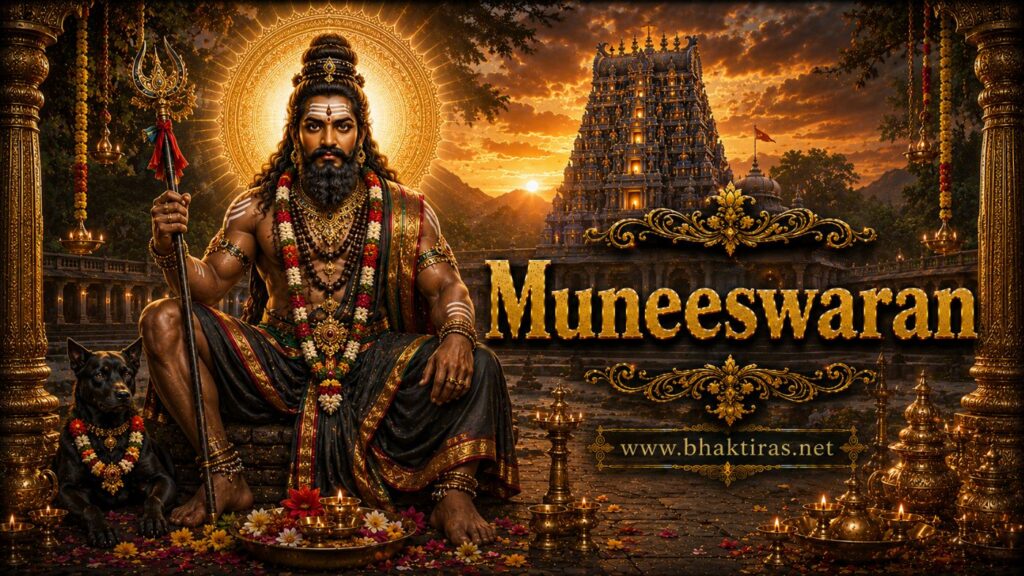
Who Is Muneeswaran?
Muneeswaran is a guardian deity of the Shaivite tradition, whose name joins muni, meaning sage or ascetic, with ishvara, a title of Lord Shiva. Together the name reads as the sage lord, and it points to his standing as a divine figure who carries the ascetic power of the great god into the daily life of ordinary people.
He is worshipped as a form of Shiva and, in many tellings, as one of his close attendants. This double identity is important – it lets devotees approach the cosmic god through a deity who feels near, personal and responsive to village concerns. Many Tamil households keep him as their family god, passing his worship down through generations.
His reach has spread far beyond southern India. Wherever Tamil communities settled, in Kerala and across the seas to Malaysia and Singapore, temples to Muneeswaran took root, making him one of the most travelled of the folk guardian gods.
Form and Symbols
Muneeswaran’s image blends the calm of a sage with the alertness of a guardian.
The Trident
He holds the trishula, the three-pronged trident that is Lord Shiva’s own weapon. It marks his descent from Shiva and stands for his power to cut through ignorance, danger and evil that threatens his devotees.
The Aruval
Alongside the trident he often carries the aruval, the curved Tamil sickle. This folk weapon ties him to the soil of the village and shows that he is ready to defend his people directly and without delay.
Two Natures
Muneeswaran is shown in both a benevolent form, seated and serene like a meditating sage, and a fierce form with wide eyes and a commanding stance. The two moods reflect a god who blesses those who honour him and guards fiercely against those who do harm.
Guardian of the Village
Muneeswaran serves as a kaval deivam, a protector deity who watches over both the wider village and the individual family that adopts him. As a form of Lord Shiva brought close to the community, he stands guard against illness, quarrels, misfortune and unseen harm, and devotees call on him for safety, fair dealings and the settling of disputes. His place sits within the village-deity tradition of the Tamil lands, where guardian gods keep order at the edges of settled life, and he is counted among the wider family of gramadevata who protect rural communities. What sets him apart is how personal his role has become – for countless households across Tamil Nadu and the diaspora he is a kuladevata, the family deity honoured at weddings, births and every important turn of life.
How Muneeswaran Is Worshipped
Muneeswaran is worshipped in both roadside village temples and small home shrines, which suits his role as a deity who is at once public guardian and private family god. His temples range from modest platforms holding his image and trident to larger built shrines with regular festivals. Devotees offer flowers, fruit, camphor, cooked rice and other traditional foods, and in his calmer temples the worship stays fully vegetarian. Annual festivals bring drumming, bhajans and processions, and many worshippers take vows to him in return for protection or a wish fulfilled. Among the Tamil diaspora in Malaysia and Singapore, Muneeswaran temples serve as community anchors, keeping ancestral practice alive far from the homeland and drawing crowds on festival days.
Legends and Living Practice
The sage who became a guardian
One tradition holds that Muneeswaran was an ascetic sage of great penance whose devotion to Lord Shiva was so complete that he was raised to divine rank and given the task of guarding the faithful. In this telling his name is well earned – a muni, a sage, who carries the authority of ishvara, the lord. Devotees see in him proof that steady devotion can lift a soul to a protecting power.
The family god across the seas
As Tamil labourers and traders crossed the ocean, they carried Muneeswaran with them in memory and in small images. A common living practice tells of families raising a shrine to him on new soil so that the god who watched their ancestors would watch them too. Today his temples abroad stand as a link between generations and between the diaspora and its roots.
Frequently Asked Questions
Who is Muneeswaran?
Muneeswaran, also called Muniyandi, is a Shaivite guardian deity worshipped as a form and attendant of Lord Shiva. He is a popular village and family god across Tamil Nadu, Kerala and the Tamil diaspora.
Is Muneeswaran a form of Shiva?
Yes. His name means the sage lord, joining muni (sage) with ishvara (a title of Shiva). He is regarded as a form of Lord Shiva and, in many traditions, as one of his close attendants, which lets devotees approach the great god through a nearer, personal deity.
What does Muneeswaran carry?
He is usually shown with the trishula or trident, the weapon of Lord Shiva, and often the aruval, the curved Tamil sickle. Together they mark both his divine origin and his readiness to protect his devotees.
Where is Muneeswaran worshipped?
He is worshipped across Tamil Nadu and Kerala and widely among the Tamil diaspora, especially in Malaysia and Singapore, where his temples serve as community centres for families far from their homeland.
What are the different forms of Muneeswaran?
He appears in a benevolent form, calm and sage-like, and in a fierce form with a commanding stance. The two natures show a god who blesses those who honour him and guards fiercely against those who mean harm.
May the sage lord guard your family across every generation.