
Lord Venkateswara
वेंकटेश्वर
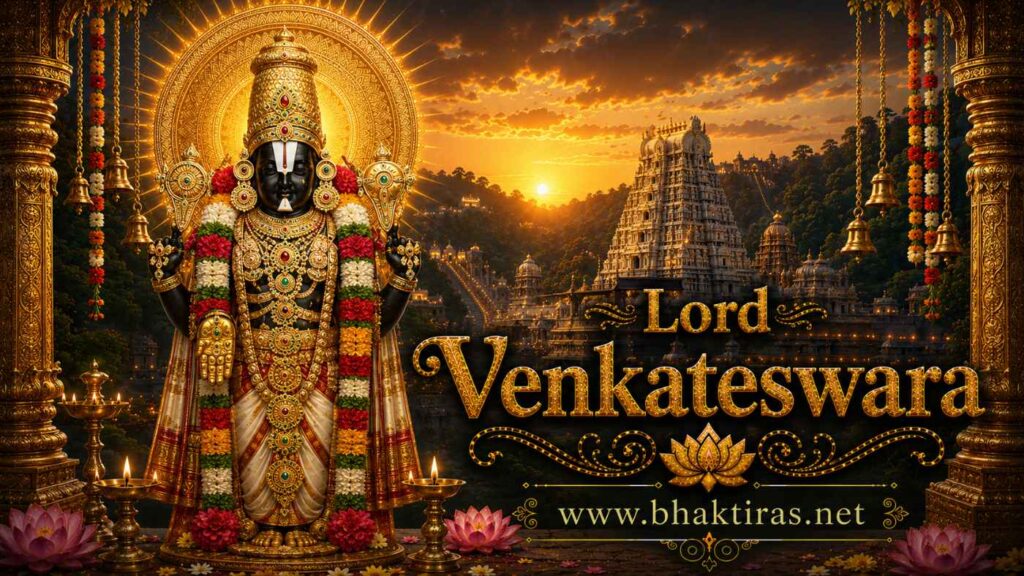
Lord Venkateswara is the supreme form of Vishnu enshrined atop the seven hills of Tirumala in Andhra Pradesh. Worshipped as Balaji, Srinivasa and Govinda, he is the presiding deity of the Tirumala Venkateswara Temple, the most visited and richest shrine on earth, and the compassionate granter of wishes in the Kali Yuga.
Who Is Lord Venkateswara?
Lord Venkateswara is worshipped across South India, and increasingly across the whole subcontinent, as the supreme and most approachable form of Lord Vishnu. He is the deity of Tirumala, the hill shrine in the Chittoor district of Andhra Pradesh where an ancient, dark-hued murti stands in the sanctum, decked in gold and diamonds, gazing out at an unending river of pilgrims. To millions he is simply Balaji, the child-like, generous Lord; to others he is Srinivasa, the one in whom Lakshmi (Sri) has taken her dwelling; and to the crowds who climb the hills chanting his name he is Govinda, the cowherd Lord who answers every call.
What sets Venkateswara apart in the Hindu imagination is his role in the present age. The scriptures describe four great yugas, and ours – the Kali Yuga – is held to be the darkest and most difficult, an age when older forms of penance and sacrifice are hard to sustain. In this age, tradition teaches, Vishnu chose to remain visible and reachable on the Venkata hill, so that even the simplest devotee, offering only a coin and a prayer, could touch grace directly. He is called the Kaliyuga Vaikuntha Nathan, the Lord of Vaikuntha made present in the age of Kali.
He is also known by the title Venkatachalapati, the Lord of the Venkata mountain, and the name Venkata itself is read as the hill that consumes sins, the place where the burden of past wrongs is burned away. This is why a journey to Tirumala is understood not as tourism but as a shedding, a leaving-behind of debts both worldly and spiritual, and a return home lighter than one came.
Venkateswara is not a regional footnote to Vishnu but, for his devotees, the living heart of Vaishnava worship in the south, drawing more visitors and more offerings than any shrine anywhere on earth.
The Lord of the Seven Hills
Tirumala rises as a cluster of seven peaks, and the number is not incidental. Devotees name them – Seshadri, Neeladri, Garudadri, Anjanadri, Vrishabhadri, Narayanadri and Venkatadri – and understand them together as the coiled body of Adishesha, the great serpent on whom Vishnu reclines in the cosmic ocean. In one telling, Adishesha himself became these hills so that his Lord might rest upon him in the world of men. To climb the hills, then, is to walk upon the serpent-couch of God.
The shrine at the summit is revered as Bhuloka Vaikuntha, Vaikuntha brought down to the earthly plane. Vaikuntha is the highest heaven of Vaishnava belief, the deathless abode of Vishnu, and the claim made for Tirumala is astonishing in its plainness: that this specific hilltop is that heaven, standing open and visible, where the Lord receives visitors in person. Pilgrims speak of the darshan, the sight of the deity, as the moment of arrival at that heaven, however brief the glimpse through the crowded sanctum.
For centuries the ascent was made on foot, up thousands of stone steps threaded through forest and along ridgelines, and many still choose to walk, some prostrating the whole way, some carrying children or the aged. The hills are treated as the Lord’s own body and estate; even the soil, the trees and the tirthas (sacred springs) scattered across Tirumala are held holy. Nothing about the place is ordinary to the devotee. The wind, the granite, the pushkarini tank before the temple, all belong to Bhuloka Vaikuntha, and the traveller who reaches the top has, in the language of faith, already come home.
Srinivasa and Padmavati – the Divine Wedding
The descent of Srinivasa
The Sthala Purana tells that when the age of Kali began to darken the world, Vishnu resolved to descend to the Venkata hill and dwell there among mortals. He came as Srinivasa and made his home in the forests of Tirumala, living for a time apart from his eternal consort Lakshmi, who in a moment of estrangement had left Vaikuntha. On the hills Srinivasa lived quietly, and it was there, out hunting one day, that his story turned toward marriage.
The meeting with Padmavati
In the nearby kingdom of the earthly king Akasa Raja, a daughter had been born from the earth in a golden lotus, and she was named Padmavati – the lotus-born, an incarnation of Lakshmi herself. When Srinivasa, following a stray elephant through the woods, came upon Padmavati and her companions in a garden, the two recognised in each other a love older than either lifetime. Srinivasa returned to seek her hand, and King Akasa Raja, learning that this forest-dweller was Vishnu in person, gladly gave his blessing to the match.
A wedding fit for the Lord of the worlds
The marriage of Srinivasa and Padmavati is celebrated as the grandest of divine weddings, a union of Vishnu and Lakshmi enacted upon the earth for the eyes of men. But a wedding on such a scale demanded a fortune, and Srinivasa, living simply on the hills, did not have it. To honour Padmavati and her father as befitted the Lord of the worlds, he turned to Kubera, the treasurer of the gods – and in that borrowing lies one of the most beloved and instructive of all Tirumala’s traditions.
The wedding of Srinivasa and Padmavati is not remembered as myth alone. It is re-enacted, sung and cherished as the reason the Lord and his bride remain on the hills to this day – and as the origin of a debt that binds him, in a sense, to his devotees forever.
The Loan from Kubera and Why Devotees Give
To pay for his wedding to Padmavati, Srinivasa borrowed an immense sum from Kubera, the keeper of the wealth of the gods. The loan was so vast that its repayment, tradition holds, was reckoned not in years but in ages – a debt to be settled slowly across the whole span of the Kali Yuga, with interest mounting all the while. This single story shapes the entire economy of devotion at Tirumala.
Because the Lord is understood to still carry this debt, his devotees give so that he may one day be free of it. This is the meaning of the hundi, the great collection vessel that stands in the temple. Into it pilgrims drop coins, notes, gold, jewellery, and the fruits of vows made in gratitude for prayers answered – a child born, an illness lifted, a marriage settled, a hardship survived. Each offering is understood as a repayment made on the Lord’s behalf, a share in helping Srinivasa clear his account with Kubera.
This is why Tirumala is the richest shrine in the world, and why its wealth carries no whiff of greed. The gold and the treasure are not the Lord hoarding, but the Lord being helped out of debt by those who love him. The immense offerings are read as tenderness, not accumulation. When a devotee gives here, the feeling is not that they are enriching a temple but that they are standing by a friend who once spent everything on his own wedding day.
Much of what is gathered flows outward again – into free meals for pilgrims, into hospitals, schools and welfare, so that the giving completes a circle. The debt of the Lord becomes, in practice, the generosity of the Lord toward the poor and the traveller. Devotees leave with the sense that they have participated in something larger than a donation: a centuries-long act of loyalty to a God who once needed their help.
The Sacred Traditions of Tirumala
Few shrines have customs as distinctive or as deeply loved as those of Tirumala. Each carries meaning drawn from the Lord’s own story, and together they give the pilgrimage its unmistakable character.
- The tonsure (mundan). Countless pilgrims shave their heads at Tirumala as an offering of the hair they were born with. The custom is tied to the legend of the Lord’s need and to Neela Devi, who once gave a lock of her own hair to repair a wound on the deity – and was blessed that the hair of devotees would forever be received here. To surrender one’s hair is to surrender vanity and ego at the Lord’s feet.
- The Tirupati laddu. The temple’s laddu prasadam, prepared in the sacred kitchen and blessed in the sanctum, is one of the most cherished offerings in all of India. Pilgrims carry these golden sweets home to share the Lord’s grace with family and neighbours; the laddu is so treasured that it holds a protected status of its own.
- The darshan queues. The wait for a glimpse of the Lord can stretch across many hours, sometimes through the night, in the winding corridors of the queue complex. Devotees accept the wait as part of the offering itself – a patience, a longing, that sweetens the moment when at last the sanctum opens and the diamond-crowned face of Venkateswara comes into view.
- Govinda Govinda. The single most heard sound at Tirumala is the roll of voices calling Govinda, one of the Lord’s dearest names. Pilgrims chant it climbing the hills, standing in queue, and at the instant of darshan, the whole crowd lifting the name together so that the corridors ring with it.
- Sevas and vows. From the pre-dawn Suprabhatam that wakes the Lord to the night-time ekanta seva that puts him to rest, the day at Tirumala is a round of services, and devotees take vows to attend particular sevas in thanks for prayers fulfilled.
These customs are not empty ritual to those who keep them. Each is a way of drawing near – of giving something of oneself, whether hair, patience, or breath spent calling his name – so that the Lord of the seven hills feels less like a distant idol and more like a familiar, waiting friend.
Brahmotsavam and the Festivals
The great festival of Tirumala is the Brahmotsavam, held over nine days each year in the month of Ashwin (around September or October). Its name means the festival begun by Brahma himself, for tradition says the creator-god was the first to celebrate it in the Lord’s honour. During these days the hills become a tide of colour and music, and the processional images of Venkateswara are taken through the temple streets on a succession of magnificent vahanas, the divine mounts.
Each night of the Brahmotsavam brings a different vahana. The Lord rides forth on Hanuman, on the great swan Hamsa, on the golden Garuda, on the elephant, the horse and the sun and moon chariots, and on the towering serpent Sesha. The Garuda Seva, when Venkateswara is carried on his eagle-mount, draws some of the largest gatherings of the year, the streets packed shoulder to shoulder with devotees hoping for a single sight of the Lord in motion. The Rathotsavam, the temple car festival, sees an enormous wooden chariot drawn by hand through the town.
Beyond the Brahmotsavam, the calendar is thick with observance. Vaikuntha Ekadashi, when the gates of the heaven-world are said to open, brings vast crowds to pass through the Vaikuntha Dwaram. Ratha Saptami honours the sun and sees the Lord processed on seven vahanas in a single day. The daily Suprabhatam, the dawn hymn that gently wakes Srinivasa, is itself among the most beloved recitations in Vaishnava devotion, sung softly before the world is fully light. Together these festivals turn the whole year at Tirumala into a continuous act of service to the Lord who chose to remain.
Iconography & Symbols
The white namam
The most recognisable mark of Venkateswara is the striking white Vaishnava namam painted across his face, framing a red streak at the centre. So broad is the namam that it covers the Lord’s eyes almost entirely, and devotees speak of this tenderly – that his gaze upon the world is too full of compassion, or that he veils his eyes so his radiance does not overwhelm. The namam declares him unmistakably as Vishnu, marked with the sacred sign of his own devotees.
The chakra (discus)
In one of his upper hands the Lord holds the Sudarshana Chakra, the spinning discus of Vishnu. It is the weapon that destroys evil and cuts through ignorance, the guardian of dharma. Its presence declares that the gentle Lord of the hills is also the sovereign protector of the cosmos, ever ready to defend those who take refuge in him.
The shankha (conch)
The other upper hand bears the Panchajanya, the conch of Vishnu, whose sound is the primordial vibration of creation, the sacred syllable Om made audible. Blown at the start of every worship, the conch calls the faithful and drives away all that is inauspicious. Together the chakra and shankha are the eternal insignia of Vishnu, borne by Venkateswara in the sanctum of Tirumala.
The standing form
Unlike Vishnu reclining on his serpent, Venkateswara stands – upright, four-armed and majestic, a self-manifested swayambhu murti not carved by human hands. His right lower hand rests in the varada gesture of boon-giving, while his left lower hand points down toward his own feet, an invitation to surrender, promising refuge to any who bow there. Crowned with a diamond kirita and draped in gold, he is at once a king in splendour and a saviour with his hand held open.
How Lord Venkateswara Is Worshipped
Worship of Venkateswara ranges from the vast temple sevas of Tirumala to the quiet daily practice of homes across the world. These are among the most common ways devotees turn to Balaji.
- Chanting his names. Repeating Govinda, or the Om Namo Venkateshaya mantra, and reciting the Venkatesa Suprabhatam at dawn, are gentle and much-loved daily practices.
- Making vows (mokku). Devotees vow an offering – a tonsure, a hundi donation, a particular seva – in return for a prayer answered, and fulfil it on reaching Tirumala.
- Offering in the hundi. Giving toward the Lord’s debt, whether a coin or one’s savings, is understood as an act of love, not a transaction.
- Receiving prasadam. Sharing the sacred laddu and the tirtha (blessed water) with family carries the Lord’s grace beyond the temple walls.
- Keeping his image at home. A picture or small murti of Balaji, garlanded and lit with a lamp on Saturdays, brings the shrine into the household.
- Observing Saturday. Shanivar, Saturday, is held especially dear to Venkateswara; many keep a fast and visit a Balaji temple on that day.
- Undertaking the pilgrimage. The journey to Tirumala, however difficult, remains the fullest form of devotion – to stand at last before the Lord of the seven hills.
Prayers & Mantras
The prayers of Venkateswara are among the sweetest in the Vaishnava tradition, from a single repeated name to the tender dawn hymn that wakes the Lord. Here are a few that devotees hold close.
The core mantra is the simplest and most powerful call upon the Lord:
Devanagari: ॐ नमो वेंकटेशाय
Transliteration: Om Namo Venkateshaya
Meaning: I bow to Lord Venkateshwara. To utter this is to place oneself entirely in his refuge, offering salutation to the Lord of the Venkata hill who grants every sincere wish.
The dwadasakshari mantra of Vishnu, dear also to Venkateswara devotees:
Devanagari: ॐ नमो भगवते वासुदेवाय
Transliteration: Om Namo Bhagavate Vasudevaya
Meaning: I bow to the divine Lord Vasudeva, the all-pervading Vishnu who dwells within all beings.
The Govinda namavali: above every formal mantra stands the single name that fills the hills. Pilgrims call it again and again – Govinda! Govinda! Govinda! – and the temple resounds with the invocation Srinivasa Govinda, Sri Venkatesa Govinda, the loving litany of names by which the Lord is drawn near. To simply keep calling Govinda, with faith and longing, is itself counted among the highest of prayers at Tirumala.
Frequently Asked Questions about Lord Venkateswara
Who is Lord Venkateswara?
Lord Venkateswara is the supreme form of Vishnu enshrined on the seven hills of Tirumala in Andhra Pradesh. Known as Balaji, Srinivasa and Govinda, he is the presiding deity of the world's most visited and richest temple, worshipped as the compassionate granter of wishes in the Kali Yuga.
Why do devotees offer their hair at Tirupati?
The tonsure is an offering of ego and vanity at the Lord's feet. Tradition links it to Neela Devi, who gave a lock of her own hair to the deity and was blessed that the hair of devotees would forever be received here. Surrendering one's hair fulfils a vow and symbolises leaving one's pride behind.
Why is Venkateswara said to be in debt?
According to the Sthala Purana, Srinivasa borrowed a vast sum from Kubera, the treasurer of the gods, to fund his wedding to Padmavati. The debt was so great it must be repaid across the whole Kali Yuga. Devotees give in the hundi to help the Lord clear this loan, which is why the shrine is so wealthy.
What is the difference between Venkateswara, Balaji and Srinivasa?
They are all names of the same Lord. Venkateswara means Lord of the Venkata hill; Balaji is the affectionate, child-like name popular in the north and west; Srinivasa means the one in whom Sri (Lakshmi) dwells. Govinda and Venkatachalapati are further loving names for the same deity of Tirumala.
Where is the Venkateswara temple located?
The Tirumala Venkateswara Temple stands atop the seven hills of Tirumala, near the town of Tirupati in the Chittoor district of Andhra Pradesh, South India. The hilltop shrine is revered as Bhuloka Vaikuntha, the heaven of Vishnu present upon the earth, and draws more pilgrims than any shrine in the world.
What does the laddu prasadam mean?
The Tirupati laddu is a sweet prepared in the temple's sacred kitchen and blessed in the sanctum before the Lord. Pilgrims carry it home to share the grace of Venkateswara with family and neighbours. So treasured is this prasadam that it holds a protected status of its own among Indian offerings.
Why do devotees chant Govinda at Tirumala?
Govinda is one of the dearest names of the Lord, referring to Vishnu as the cowherd and protector. Chanting it climbing the hills, waiting in queue and at the moment of darshan unites the whole crowd in devotion. The corridors of Tirumala ring constantly with the call of Govinda Govinda.
What is Brahmotsavam?
Brahmotsavam is the grand nine-day annual festival of Tirumala, said to have first been celebrated by Brahma himself. Each night the processional image of Venkateswara rides a different divine mount, from Garuda to the serpent Sesha, through the temple streets, drawing enormous crowds hoping for a glimpse of the Lord in procession.
May the Lord of the seven hills veil away your sorrows as he veils his own eyes, and keep his open hand of refuge always turned toward you. Govinda Govinda.